Accurate Coding Slashes Orthopedic Claim Rejections by 74%
Service
Medical BillingIndustry
General OrthopedicsLocations
5 sitesProviders
18 cliniciansTimeline
3–6 monthsRegion
TexasAbout This Project
The client is an established orthopedic practice in Texas operating across five sites, with eighteen clinicians spanning orthopedic surgery, sports medicine, and joint reconstruction. The group did not grow this large overnight. Like many successful specialty practices, it expanded through a combination of organic growth and the acquisition of smaller practices, each of which arrived with its own internal processes, its own coding habits, and its own assumptions about how orthopedic medical billing should work.
That history matters, because it explains how the problem formed. Each acquired practice had billed claims its own way for years before centralization. Nobody had ever forced those workflows into a single standard, and for a while nobody needed to. Volume kept climbing, revenue kept arriving, and the friction stayed hidden inside individual billing queues where no one was measuring it at the group level.
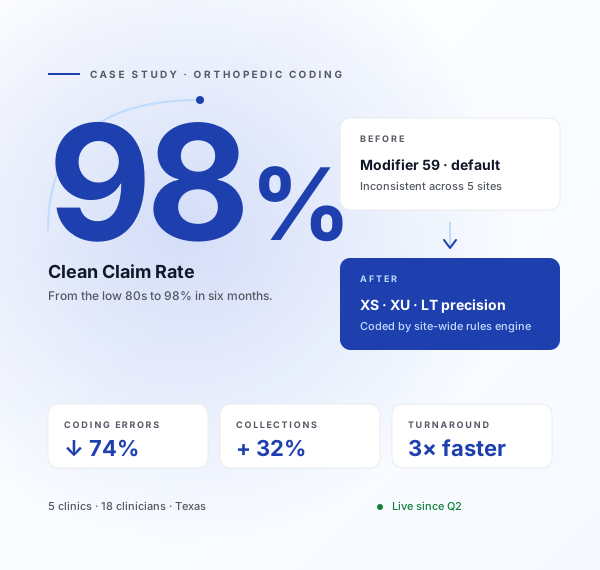
When revenue cycle leadership finally commissioned a formal audit, the picture changed quickly. What had once been a manageable patchwork had become a structural weakness. Billing practices differed from location to location, avoidable denials were arriving in steady volume, and the group's first-pass claim acceptance rate had drifted down to around the 80s mark, a level at which reworking rejected claims consumed more staff time than producing new ones. The clean claim rate had never even been measured at the aggregate level before the audit, which is itself a common finding in multi-site groups built through acquisition.
The practice engaged CureMed to diagnose the root causes and rebuild the coding and claim submission process from the ground up. The engagement combined specialty-specific orthopedic billing services with process redesign, technology integration, and provider education, rather than treating the denials as a series of isolated errors to be corrected one claim at a time.
This case study walks through what the audit found, why orthopedic coding is unusually vulnerable to exactly these failure modes, what CureMed built, and the measurable results the group achieved within two quarters of full implementation.
The Challenge: Modifier Confusion and Documentation Gaps
The audit surfaced two distinct but reinforcing problems: inconsistent coding practices across the five locations, and operative documentation that did not give coders what they needed. Either one alone would have suppressed the clean claim rate. Together, they compounded.
Modifier Chaos Across Locations
With five locations effectively functioning as independent billing operations, no group-wide coding guideline had ever been established. The most damaging symptom was inconsistent modifier use.
Different coders held different understandings of when modifier 59 was appropriate versus the more specific X-modifiers: XE (separate encounter), XS (separate structure), XP (separate practitioner), and XU (unusual non-overlapping service). Since CMS introduced the X-modifiers as more precise subsets of modifier 59, payers have increasingly expected them where they apply, and many commercial payers scrutinize claims that default to 59 when a more specific descriptor exists. At this practice, whether a claim carried 59 or the correct X-modifier depended largely on which coder happened to be working that day.
Laterality was equally inconsistent. The LT and RT modifiers, which identify the left or right side of the body, were applied differently depending on who handled the coding on a given date. In orthopedics, where bilateral joints, paired extremities, and staged procedures are routine, laterality errors are not cosmetic. They create direct contradictions between the claim and the operative report.
The downstream effects were far-reaching:
- Insurance carriers flagged bundling scenarios that failed National Correct Coding Initiative (NCCI) edits, triggering automatic denials.
- Improper modifier stacking led payers to automatically downcode claims, quietly reducing reimbursement even when claims were not outright denied.
- Laterality discrepancies produced mismatches between claims and operative reports, inviting both denials and payer audit attention.
The group's clean claim rate, once finally measured across all five sites, sat well below the industry benchmark, at around the 80s mark on first-pass acceptance.
Surgeon Documentation Gaps
The second fault line ran through the operative report itself. The group's surgeons were skilled clinicians, not billing specialists, and their reports reflected that. The notes were medically thorough but consistently lacked three things coders needed:
- Implant specificity. Device and implant details sufficient to support accurate coding and device reimbursement.
- Multi-procedure justification. Clear narrative support for reporting multiple procedure codes performed in the same session.
- Medical necessity language. Documentation that justified additional CPT codes beyond the primary procedure.
This left coders with two bad options. They could default to the most conservative code the documentation could support, which meant systematically leaving earned revenue on the table. Or they could chase the operating surgeon for an addendum, which consumed hours per claim and delayed submission. Both paths were expensive; the practice was paying for the documentation gap either in under-coding or in labor.
Why Orthopedic Coding Is Uniquely Demanding
It is worth pausing on why this specialty produces these failure modes so reliably, because the pattern at this Texas group is one CureMed sees across orthopedic clients.
Orthopedic coding sits at the intersection of several high-risk billing conditions. Surgical cases frequently involve multiple procedures in a single session, which means NCCI bundling edits, multiple procedure reductions, and modifier logic all come into play on the same claim. Laterality applies to a large share of the code set because the specialty deals in paired structures: shoulders, hips, knees, hands, feet. Implants and hardware introduce device reimbursement rules that vary by payer. And global surgical periods complicate the billing of follow-up care and staged procedures.
On top of that, payer behavior in orthopedics is unusually aggressive. Because orthopedic procedures carry high allowed amounts, payers apply dense edit logic and audit attention to the specialty. A generic claim scrubber tuned for primary care will pass claims that an orthopedics-aware review would catch, because the scrubber lacks context about how component codes relate to a primary arthroplasty or fusion procedure.
The practical consequence is that general-purpose medical billing workflows, even competent ones, tend to underperform in orthopedics. The specialty rewards billing operations that encode its specific rules: which code pairs bundle, when an X-modifier is defensible, how implant documentation must read, and which commercial payers deviate from CMS logic. That is precisely the gap the five-location group had fallen into. Each acquired practice had partial, informal versions of this knowledge, held in individual coders' heads and applied inconsistently, with no system enforcing any of it.
The Solution: Three Coordinated Workstreams
Rather than deploying point fixes for individual denial categories, CureMed approached the engagement as a redesign of the entire claim production system. Denials are outputs; the inputs are coding rules, charge capture, and documentation. Three interrelated workstreams launched simultaneously, each targeting a different layer of the problem.
A Specialty Coding Rules Engine
The foundation was a specialty-specific rules engine that applies orthopedic edit logic for surgical bundling, modifier ordering, and device reimbursement before a claim ever leaves the practice.
CureMed built the engine on three data sources: the CMS National Correct Coding Initiative edit tables, commercial payer-specific rules, and the practice's own two-year claims history. That last source matters most. The historical claims data revealed exactly which edits this group's payer mix actually enforced and which denial patterns recurred, so the engine was tuned to the practice's real-world exposure rather than a generic rule set.
Unlike generic clearinghouse scrubbers, which evaluate codes without case context, the rules engine understands procedure relationships. When a claim carries the CPT code for a primary shoulder arthroplasty, the engine recognizes the bundling implications for associated component codes and knows that the applicable X-descriptor, not a bare modifier 59, is the defensible choice. Errors that previously surfaced as payer denials were now caught and corrected before submission.
EHR-Integrated Charge Capture
The second workstream attacked claim lag. CureMed integrated the charge capture process directly with the group's EHR so that operative note information flowed automatically into the billing workflow.
The core of the integration is a translation layer that maps the terminology surgeons actually use in their notes to the relevant CPT codes. Coders no longer had to look up CPT tables or manually transcribe details from operative reports; the system presented candidate codes drawn from the note itself, and coders reviewed and finalized them. Manual coding delays disappeared from the workflow, and claim lag dropped from days to same-day submission.
This step also improved accuracy in a less obvious way. Manual transcription is where many laterality and code-selection errors are born. By pulling structured information directly from the operative note, the translation layer removed an entire class of transcription mistakes before the rules engine even ran.
Quarterly Provider Education
The third workstream addressed the documentation gap at its source: the surgeons. CureMed designed a quarterly education program with a deliberately narrow format, because surgeon time is the scarcest resource in any orthopedic group.
Each quarterly workshop:
- Opens with the practice's own top five denial categories from the previous quarter, presented in clinical language so surgeons can recognize their own note-writing patterns in the data.
- Runs exactly forty-five minutes, a length chosen so attendance never competes with clinical schedules.
- Is offered both in person and as a video recording, so every surgeon can participate regardless of surgical calendar.
The critical design decision was to build the curriculum from the practice's own denial data rather than from generic coding guidelines. Abstract documentation rules rarely change physician behavior. Showing a surgeon that a specific phrasing habit in their own operative reports caused a specific, recurring denial does. The goal was to make documentation standards part of how care is recorded in the moment, not a billing afterthought handled through addenda.
Together, the three workstreams follow the logic of end-to-end revenue cycle management: fix the inputs (documentation), automate the throughput (charge capture), and enforce quality at the exit (the rules engine), so that clean claims become the default output of the system rather than the product of heroic rework.
Results
The results below reflect performance two quarters into full implementation, measured against the group's pre-engagement audit baseline.
| Metric | Result | What changed |
|---|---|---|
| Clean claim rate | 98% first-pass acceptance, up from around the 80s mark | The rules engine caught modifier, bundling, and laterality errors before submission instead of after denial |
| Net collections | Up 32% two quarters into full implementation | Fewer denials and faster payer processing converted previously lost or delayed revenue into collected revenue |
| Claim-level coding errors | Down 74%, from a double-digit percentage per month to single digits | Standardized coding rules replaced five locations' inconsistent habits; the translation layer eliminated transcription mistakes |
| Claim turnaround | Threefold decrease, from days to hours after service | EHR-integrated charge capture enabled same-day claim submission |
| Rework hours | Billing staff time recovered from reprocessing, appeals, and corrections | Staff shifted from fixing rejected claims to producing new ones and working genuine exceptions |
Two aspects of these results deserve emphasis. First, the 32% collections improvement did not come from seeing more patients or renegotiating contracts. It came entirely from capturing revenue the practice was already earning but losing to denials, downcoding, and conservative code selection. Second, the 74% reduction in claim-level coding errors is the metric that makes the others durable. A clean claim rate propped up by manual scrubbing degrades the moment staffing changes; a clean claim rate produced by systematic error prevention holds.
The pattern is consistent with what CureMed has delivered in other specialties. A comparable engagement focused on first-pass acceptance for a dermatology group followed the same logic: fix the inputs, automate the pipeline, and clean claims follow.
We were spending far too much time fixing errors rather than creating new claims. In less than six months, we had converted a recurring liability into an income generator. We’re collecting more money, we have almost no re-work anymore, and we know the value of the surgeons’ documents.
Managing Partner & Lead Surgeon, Multi-Location Orthopedic Group, Texas
Why It Worked
Three decisions separated this engagement from a conventional cleanup project.
It treated denials as a system output, not a coder problem. The audit could have ended with retraining coders on modifier 59 versus the X-modifiers. That would have helped briefly and faded. Instead, the engagement addressed all three layers at once: the documentation that feeds coding, the charge capture pipeline that moves it, and the rules engine that validates it. Each workstream reinforced the others, which is why the improvement compounded rather than plateaued.
It was built on the practice's own data. The rules engine drew on two years of the group's actual claims history, and the surgeon workshops were built from the group's actual top denials. Specialty billing improvement is most effective when it is tuned to a practice's real payer mix and real failure patterns rather than to generic benchmarks.
It respected how surgeons work. Forty-five-minute sessions, clinical language, flexible delivery. Documentation improvement fails when it demands that physicians think like billers. It succeeds when billing intelligence is translated into the vocabulary of the operating room.
For multi-location orthopedic groups, especially those assembled through acquisition, the underlying lesson is that coding consistency does not happen by default. It has to be engineered. CureMed's orthopedic coding and physician billing teams specialize in exactly this work: standardizing coding across sites, integrating charge capture with the EHR, and turning surgeon documentation into fully reimbursable claims. For this Texas group, that combination turned a recurring liability into a reliable revenue engine in under six months.
& Tools
Curious what your revenue cycle is actually leaving on the table?
Spend 30 minutes with our revenue cycle team and we'll walk through your current setup, surface where money is leaking from denials, slow payer follow up, undercoded encounters, and quantify what cleaning it up is worth in your first 90 days. No prep, no slide deck, just a working conversation with people who do this every day.