Accelerating Provider Enrollment from 120 Days to 45 Days for a Rapidly Expanding Urgent Care Network
Service
Credentialing & EnrollmentIndustry
Urgent CareLocations
12 sitesProviders
40 cliniciansTimeline
OngoingRegion
USAbout This Project
An urgent care chain was growing at a pace most practices only plan for: an average of two to three new centers opening every quarter. Each new location came with the same requirement: every physician, nurse practitioner, and physician assistant had to be credentialed and enrolled with around 15 different health plans before the center could bill for the care it delivered.
That is where growth stalled. The average payer enrollment turnaround was four months. For 120 days per provider, per plan, new centers were seeing patients they could not bill for, or were holding claims they might never collect. In urgent care, where walk-in volume ramps quickly and payer mix is broad, a four-month enrollment lag is not an administrative inconvenience. It is a direct revenue leak that compounds with every new site.
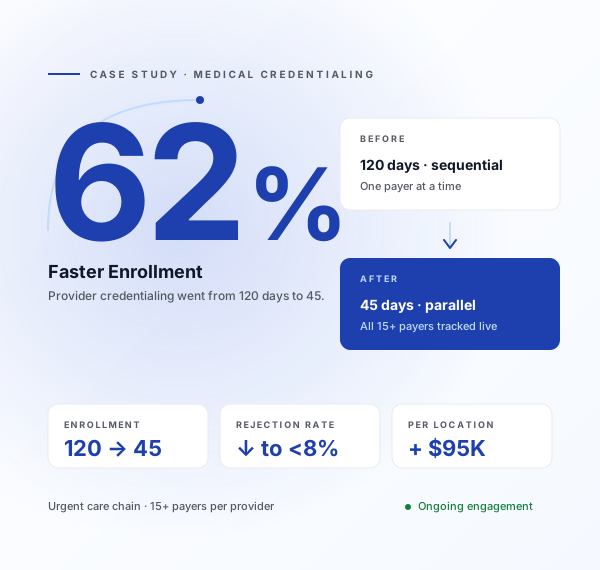
The network engaged CureMed to rebuild its provider enrollment operation from the ground up. The results, covered in detail below: enrollment turnaround cut from 120 days to 45 days, application denial rates reduced from 35% to under 8%, and approximately $95,000 in losses salvaged per site through retroactive billing contracts.
The Challenge: Enrollment Delays That Stalled Every New Center
The network's credentialing problems were not caused by a single failure. They were the product of four structural weaknesses that reinforced one another.
Fifteen payers, fifteen rulebooks
Every new provider needed applications submitted to Medicare, Medicaid, and 13+ commercial insurance companies. Each payer maintained its own forms, its own documentation requirements, its own submission portals, and its own processing timelines. Medicare enrollment runs through PECOS with its own revalidation logic. State Medicaid programs layer on separate site and provider requirements. Commercial payers each apply their own credentialing committee schedules. Without a standardized process, staff effectively restarted the learning curve with every application.
Credentialing as a side task
The applications were being handled by administrative personnel who were also responsible for front-desk operations, scheduling, and general office management. Credentialing was nobody's full-time job. Applications sat in queues, requests for additional information went unanswered for days, and small errors (an expired document, a missing attestation, an outdated CAQH profile) slipped through unnoticed. The downstream effect showed up as delayed enrollments and denied claims.
No centralized visibility
There was no monitoring system tracking where each provider stood in the enrollment pipeline. Management could not answer basic questions: Which providers are fully enrolled? Which applications are pending, and with which payers? Which centers can bill which plans today? Every status check required someone to dig through emails, spreadsheets, and payer portals. Forecasting revenue for a new center was effectively guesswork.
Silent denials
The most expensive failure mode was the quiet one. Providers would see patients for several weeks before anyone discovered that a payer had denied the enrollment application, usually because of incomplete information. By the time the denial surfaced, the network had accumulated weeks of unbillable encounters and had to restart the application from the beginning. With a 35% application denial rate, this was not an edge case. Roughly one in three applications was failing, and each failure reset the 120-day clock.
Why Payer Enrollment Breaks Down in Multi-Site Urgent Care
The pattern this network experienced is common across expanding urgent care groups, and it is worth understanding why the operating model of urgent care makes payer enrollment uniquely punishing.
First, urgent care depends on breadth of payer participation. A primary care practice can open its doors with a handful of contracts and grow its panel over time. An urgent care center cannot turn away walk-in patients based on insurance, so it needs to be in-network with essentially every major plan in its market from day one. That multiplies the enrollment workload: every new provider times every relevant payer.
Second, urgent care staffing is fluid. Centers rely on rotating physicians, advanced practice providers, and per-diem clinicians. Each new hire triggers a fresh round of credentialing, and turnover means the enrollment pipeline never empties. A group adding two to three centers per quarter is effectively running a permanent, high-volume enrollment operation, whether it has staffed one or not.
Third, the cost of delay is front-loaded. New urgent care centers typically see meaningful patient volume within weeks of opening, driven by location and walk-in demand rather than a slowly built referral base. When enrollment lags behind opening day, the revenue lost during that window is often the difference between a site that reaches breakeven on schedule and one that drags on the balance sheet for its first year. Effective urgent care billing depends on enrollment being complete before the first patient walks in, not months after.
Finally, enrollment errors are self-concealing. Payers rarely proactively alert a practice that an application has stalled. Unless someone is actively following up, a rejected or incomplete application simply sits, while the provider keeps generating encounters that will never be paid. This is why enrollment and revenue cycle management cannot be treated as separate functions: an enrollment gap is a revenue cycle failure, it just happens before the first claim is ever submitted.
The Solution: A Structured Provider Enrollment System
CureMed replaced the network's ad hoc approach with a dedicated enrollment operation built around four components, each mapped to one of the failure points identified during the initial assessment.
1. A standardized enrollment process across all payers
CureMed's credentialing staff created a single, standardized enrollment workflow covering all payers: Medicare, Medicaid, and every commercial plan in the network's mix. Instead of treating each of the 15 health plans as a separate project, the team built payer-specific checklists inside one master process: required documents, submission channels, known processing timelines, and the exact information each payer's credentialing committee expects to see.
Standardization matters because most enrollment denials are not judgment calls by the payer. They are mechanical rejections triggered by missing or inconsistent information. A repeatable process with payer-specific quality checks removes those errors before submission, which is how the network's application denial rate fell from 35% to under 8%.
2. A centralized provider database with pre-filled CAQH profiles
The team built a complete database of all providers in the network: licenses, DEA registrations, board certifications, malpractice coverage, work history, and every other data element that payer applications draw from. Critically, CAQH profiles were pre-filled and maintained continuously, so the profile every commercial payer pulls from was accurate before it was ever needed.
The operational payoff was speed at the moment of hire. Because the underlying data was already assembled and verified, applications for new providers were submitted within one week of hiring. Under the old model, the clock did not even start until administrative staff found time to gather documents; under the new model, a provider's start date and their enrollment submission date were days apart, not weeks.
3. A real-time credentialing tracking dashboard
CureMed implemented a real-time credentialing tracking system that gave management a live dashboard covering every provider and every payer. At any moment, leadership could see which applications were submitted, pending, approved, or flagged, and which centers were cleared to bill which plans.
For a network opening centers every quarter, this visibility changed how expansion was planned. Operations could align center opening dates with realistic enrollment timelines, staffing decisions could account for which clinicians were already enrolled with the local payer mix, and finance could forecast when each new site would begin generating clean, billable revenue. The dashboard also served the billing team directly: claims were held or released based on actual enrollment status rather than assumptions, preventing the avoidable denials that occur when claims go out under a provider who is not yet in-network. This is the same discipline that makes patient eligibility verification valuable on the front end of the revenue cycle: confirming coverage facts before the claim exists, instead of discovering problems after the denial arrives.
4. Weekly payer follow-ups and back-billing of onboarding revenue
The team instituted weekly follow-ups with all payers on every open application. This single habit eliminated the silent-denial problem. If a payer needed additional documentation, the team knew within days, not weeks. If an application was progressing slowly, the team escalated it rather than waiting for the payer's internal timeline to play out.
Just as important, CureMed pursued back-billing of the revenue generated while providers were still onboarding. By negotiating retroactive billing contracts, the network was able to bill for services delivered during the enrollment window once approval came through. Many payers permit retroactive effective dates when the request is made correctly and promptly, but the option is easy to lose when nobody is managing the process. For this network, recovered back-billed revenue amounted to approximately $95,000 in salvaged losses per site. That is money the network had previously been writing off as an unavoidable cost of expansion.
Results: Faster Enrollment, Fewer Denials, Recovered Revenue
Within the first enrollment cycles under the new system, the network's numbers moved decisively.
| Metric | Result | What changed |
|---|---|---|
| Average enrollment turnaround | 120 days reduced to 45 days (62% reduction) | Standardized payer workflows, pre-filled CAQH profiles, and weekly payer follow-ups removed idle time from every stage |
| Application denial rate | 35% reduced to under 8% | Payer-specific quality checks caught incomplete or inconsistent information before submission |
| Revenue recovered per site | Approximately $95,000 in losses salvaged | Retroactive billing contracts allowed back-billing of services delivered during the enrollment window |
| Application submission speed | Applications filed within one week of hiring | Centralized provider database meant documentation was ready before the hire date |
| Management visibility | Live dashboard across all providers and payers | Real-time credentialing tracking replaced spreadsheets and portal-by-portal status checks |
The 62% reduction in turnaround deserves context. Payer processing time is partly outside any billing company's control; credentialing committees meet on their own schedules. What CureMed compressed was everything else: document gathering, application preparation, submission, error correction, and follow-up. When the controllable portion of the timeline shrinks to near zero and denials stop forcing restarts, the total turnaround falls to something close to the payer's raw processing floor.
The denial rate improvement compounded the timeline gain. Under the old process, one in three applications failed and restarted the clock. Under the new process, fewer than one in twelve required rework, which means the 45-day average held steady even as the network kept adding two to three centers per quarter.
Lessons for Growing Urgent Care Networks
This engagement surfaced principles that apply to any multi-site group scaling faster than its administrative infrastructure.
- Treat enrollment as a revenue function, not a paperwork function. Every day a provider is unenrolled is a day of unbillable or at-risk encounters. Groups that measure enrollment turnaround the way they measure days in accounts receivable make faster, better decisions.
- Start the enrollment clock before the provider starts. The single biggest controllable delay is the gap between hiring and application submission. Maintaining a current provider database and pre-filled CAQH profiles turns that gap from weeks into days.
- Make application quality a gate, not an afterthought. A 35% denial rate is not a payer problem; it is a submission problem. Payer-specific checklists and pre-submission review are the cheapest interventions in the entire revenue cycle.
- Follow up on a schedule, not on suspicion. Weekly contact with every payer on every open application is the only reliable defense against silent denials and stalled files.
- Pursue retroactive billing systematically. Back-billing rights exist with many payers, but they are use-it-or-lose-it. A group opening new sites regularly should treat retroactive effective dates as a standard negotiating point, and its medical billing operation should be structured to release held claims the moment approvals land.
For networks employing a mix of physicians and advanced practice providers, these lessons extend naturally into how professional claims are managed once enrollment completes: accurate provider data feeds directly into cleaner physician billing downstream, since the same demographic and enrollment details that payers verify during credentialing also drive claim acceptance.
Why It Worked
The network's original problem was never a lack of effort. It was that payer enrollment, a specialized, deadline-driven, detail-heavy discipline, had been assigned as a part-time duty to staff with other full-time responsibilities. No amount of diligence overcomes a structural mismatch like that at the volume this network required.
CureMed's provider enrollment services succeeded because they replaced improvisation with system: one standardized process across roughly 15 health plans, one authoritative provider database feeding pre-filled applications, one dashboard showing the truth of every application in real time, and one non-negotiable rhythm of weekly payer follow-up. Each component addressed a specific failure point, and together they cut enrollment turnaround by 62%, dropped application denials from 35% to under 8%, and recovered approximately $95,000 per site that would otherwise have been written off.
For growing healthcare organizations, provider enrollment is where expansion plans meet payer reality. CureMed's provider credentialing services are built for exactly this situation: facilities where every enrolled provider represents income, and every enrollment delay represents loss. With experienced credentialing staff, structured processes, and disciplined payer communication, CureMed enabled this urgent care network to keep opening two to three centers per quarter while billing seamlessly at each new site from the earliest possible date.
Curious what your revenue cycle is actually leaving on the table?
Spend 30 minutes with our revenue cycle team and we'll walk through your current setup, surface where money is leaking from denials, slow payer follow up, undercoded encounters, and quantify what cleaning it up is worth in your first 90 days. No prep, no slide deck, just a working conversation with people who do this every day.