Find Revenue You Did Not Know You Were Losing
CureMed's billing audits dig into your claims data to uncover underpayments, coding errors, missed charges, and compliance gaps. You get a clear breakdown of where revenue is leaking and a concrete plan to recover it.
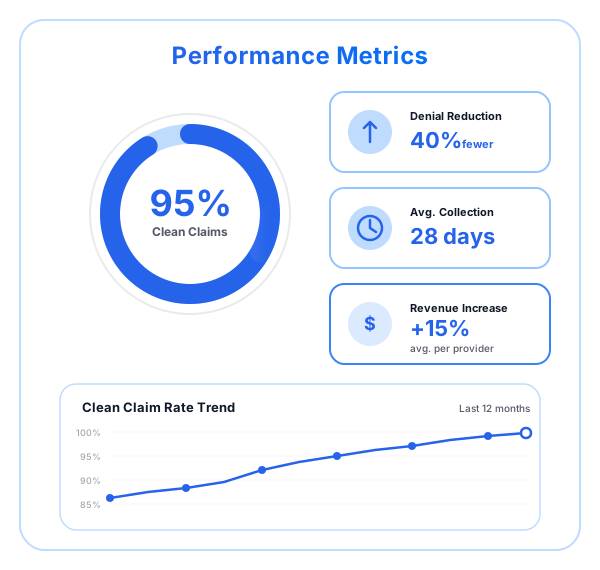
Most Practices Are Losing Revenue Without Knowing It
Billing errors, undercoding, missed charges, and payer underpayments accumulate quietly over time. Without regular audits, the losses compound.
- 5 to 10%
of practice revenue is lost annually due to coding errors, missed charges, and billing inefficiencies that go undetected without a formal audit.
- 30%
of claims contain errors that reduce reimbursement, including undercoding, incorrect modifiers, and missed billable services.
- $125K+
is the average annual cost of employing one in-house billing specialist. An audit often recovers more than that cost in the first review alone.
A billing audit is not about finding blame. It is about finding money your practice has already earned but never collected.
How Our Billing Audit Works
A structured, five-step review from data collection to actionable recovery plan.
- 01
Data Collection & Scoping
We gather claims data, remittance records, payer contracts, and coding reports. You define the scope: full practice, specific payers, or targeted date ranges.
- 02
Claims & Coding Analysis
Our audit team reviews claim submissions for coding accuracy, modifier usage, charge capture completeness, and documentation alignment.
- 03
Payer Reimbursement Review
We compare actual payments against contracted rates to identify underpayments, incorrect adjustments, and missed contractual obligations.
- 04
Compliance & Risk Assessment
We evaluate coding patterns for compliance risk, upcoding exposure, and documentation gaps that could trigger payer audits.
- 05
Findings Report & Action Plan
You receive a detailed report quantifying lost revenue, identifying root causes, and providing a prioritized action plan for recovery and prevention.
Most audits are completed within 2 to 3 weeks. Preliminary findings are available within 72 hours.
What's Included in a CureMed Billing Audit
A comprehensive review covering every stage of your revenue cycle where money can be lost.
Coding Accuracy Review
Line-by-line analysis of CPT, ICD-10, and HCPCS code assignments to identify undercoding, overcoding, and missed billable services.
Charge Capture Analysis
Cross-referencing scheduled appointments, clinical documentation, and submitted claims to find services that were delivered but never billed.
Modifier Compliance Check
Review of modifier usage across all claims to identify patterns causing denials, downcoding, or bundling rejections.
Underpayment Detection
Comparison of actual reimbursements against payer contract rates to identify systematic underpayments and incorrect adjustments.
Denial Pattern Analysis
Root cause breakdown of denial trends by payer, procedure, and denial reason code to identify preventable patterns.
Compliance Risk Assessment
Evaluation of coding patterns for regulatory risk, including potential upcoding flags, documentation gaps, and audit exposure.
Payer Contract Review
Analysis of fee schedules and reimbursement terms to ensure your contracts reflect current market rates and are being honored by payers.
Actionable Recovery Report
A prioritized report with specific dollar amounts recoverable, root causes identified, and step-by-step recommendations for prevention.
Why Choose CureMed for Billing Audits
We do not just hand you a report. We quantify lost revenue, identify root causes, and give you a clear plan to recover it.
Dollar-Specific Findings
Every finding includes the specific dollar amount at risk or recoverable. No vague percentages or general recommendations. You know exactly what is on the table.
Specialty-Aware Auditors
Our audit team includes coders with specialty-specific expertise across 200+ specialties. They know what correct billing looks like for your practice type.
Payer Contract Benchmarking
We compare your reimbursements against contracted rates and market benchmarks to identify underpayments you may have accepted as normal.
Prevention, Not Just Detection
Every audit report includes workflow recommendations and process fixes to prevent the same errors from recurring after recovery.
Most practices leak between 8 and 12 percent of collectible revenue
You never see it, because it looks like ordinary denial noise. This is where we usually find it.
Undercoding
Providers documented a level higher than what was billed. Common on 99213 against 99214 splits.
Missed modifiers
Modifier 25, 59 and 79 dropped from claims that would have been paid separately.
Aged AR
Claims past 90 days quietly written off instead of appealed. Money left on the table.
Eligibility gaps
Denials that started at the front desk. Wrong plan, expired coverage, missing prior auth.
Four steps, one week, no cost
You send the data, we do the work, you get a written report. Whether you switch to us afterwards is entirely up to you.
- 1Day 1
You share the data
Three months of claims and denials, exported from your PM system. We send a secure upload link.
- 2Day 2 to 5
We review everything
Certified coders go through each claim: coding, modifiers, denials by payer, and aging patterns.
- 3Day 6
We write it up
A plain English report with leakage estimates, specific claim examples, and recommended fixes.
- 4Day 7
Walk-through call
Thirty minutes on the phone. We answer questions and hand over the report. No follow-up pressure.
Six things every audit report includes
Real numbers from your practice, benchmarked against your specialty. Not a generic deck.
Revenue leakage estimate
A dollar figure showing what you are likely losing every month right now.
Denial breakdown
Sorted by payer and reason code, so you can see which battles to pick first.
Coding accuracy score
A sample review of E/M codes, procedure codes, and modifier use, benchmarked to your specialty.
Aging AR analysis
Buckets at 30, 60, 90, and 120 plus days, highlighting the claims still worth chasing.
Clean claim rate
Your first-pass acceptance rate against industry and specialty medians.
Specific recommendations
Not vague advice. Concrete fixes with example claim numbers you can act on today.
- Estimated monthly leakage
- $18,400
- Denial rate
- 7.8%
- Clean claim rate
- 81%
- Days in AR
- 52 days
- Top denial reason
- CO-16 missing info
- Projected recovery
- +$220K a year
Yours to keep either way
Whether you work with us or not, the report is yours. Take it to your current biller and use it as ammunition. Share it with your partners. Sit on it. We are not going to keep chasing you because you did not sign a contract.
“CureMed's audit found $340K in recoverable revenue we had no idea we were leaving on the table. The report was detailed, specific, and gave us a clear roadmap to fix everything.”
Billed across every specialty we cover
Coders who work your specialty daily, not generalists reading a manual. Same rate whichever one you are.
Frequently Asked Questions
Yes, external audits provide objective insights and detect issues internal teams might overlook, enhancing revenue cycle integrity.
CureMed identifies billing errors, compliance risks, and process gaps, recommending corrective actions to maximize reimbursements and reduce liabilities.
Without audits, providers risk overpayments, claim denials, compliance violations, and delayed or lost revenue.
Audits review coding accuracy, claim submissions, insurance verification, payment posting, denials, and appeals management.
Audits are recommended at least annually, with larger practices performing them quarterly for optimal compliance and revenue health.
Ready to see what cleaner billing looks like for your practice?
CureMed's billing audits dig into your claims data to uncover underpayments, coding errors, missed charges, and compliance gaps. You get a clear breakdown of where revenue is leaking and a concrete plan to recover it.