Automating Eligibility & Claims with RPA: 1,200+ Staff Hours Saved Annually
Service
RPA & AutomationIndustry
Multi-SpecialtyLocations
3 sitesProviders
22 physiciansTimeline
3–6 monthsRegion
USAbout This Project
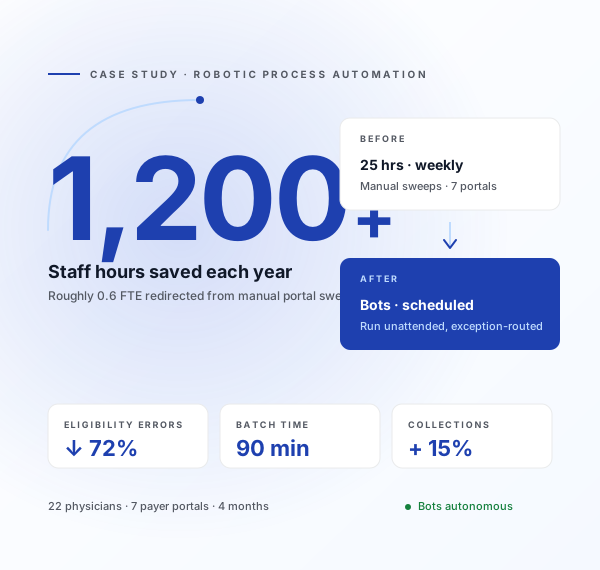
A multi-specialty group practice with 22 physicians was losing roughly 25 hours every week to two non-clinical tasks: patient eligibility checks and claim-status follow-ups across seven different payer portals. Every one of those hours was spent the same way. A billing specialist logged into a portal, searched for a patient or a claim, copied the answer into the practice management system, logged out, and started over on the next portal. A single manual verification took four to eight minutes, and the volume generated by a 22-physician schedule meant the practice was effectively dedicating more than half a full-time employee to work that required no clinical knowledge and very little billing judgment.
The practice did not have a staffing problem. It had a workflow problem, and it is one of the most common workflow problems in the revenue cycle. Eligibility checks and claim-status inquiries are high-volume, rule-based, and repetitive, which makes them a textbook use case for robotic process automation in healthcare. RPA software performs the same portal navigation a person would perform, following the same steps in the same order, but it does so at machine speed, around the clock, and without transcription mistakes. CureMed designed and deployed custom bots through its robotic process automation service to handle both workflows end to end across all seven payer portals.
The outcome, covered in detail below: more than 1,200 staff hours saved annually, a 72% reduction in eligibility errors, claim-status batches compressed from a full day to 90 minutes, and a 15% increase in collections within three months. Notably, that collections gain did not come from the bots themselves. It came from what the billing team did with the time the bots gave back.
The Challenges
Before automation, the billing department's week was structured around portal work. Four problems compounded one another, and each made the others harder to fix.
25 Hours a Week Across Seven Payer Portals
The billing staff logged into seven payer portals several times each day to verify patient eligibility. Verifying a single patient typically took four to eight minutes: authenticate, navigate to the eligibility screen, enter the member information, interpret the response, and transcribe the result into the practice management system. Multiplied across the appointment volume of 22 physicians, eligibility work alone consumed more than half an FTE, with claim-status look-ups layered on top of that.
None of this is unusual. Most payer portals do not integrate with practice management systems, so a human being becomes the integration layer. The work is essential. Eligibility verification in medical billing is the first checkpoint that prevents a denied claim, and skipping it simply moves the cost downstream. But nothing about signing into a portal and copying a status field requires a trained biller.
Frequent Data Entry Errors
Because every verification was manual, every verification was also an opportunity to mistype. Incorrect data entry led to wrong eligibility determinations. Claims were filed for patients whose coverage had lapsed or changed, and the error stayed invisible until the payer denied the claim weeks later. By that point the practice had already delivered the care, and the true cost of the mistake included the rework, the payment delay, and sometimes the write-off. Accurate patient eligibility verification performed before the visit is far cheaper than working the same problem as a denial after the fact.
No Consistent Workflow
Each billing specialist checked eligibility and claim status in their own way and on their own schedule. There was no standardized sequence, no guaranteed completion time, and no way to see where the bottlenecks were. When a check was skipped or delayed, nobody knew until a claim came back denied. For a revenue cycle director, that lack of visibility is as damaging as the errors themselves, because a process you cannot see is a process you cannot manage or improve.
Reactive Claim-Status Follow-Up
Without a system to track claim status proactively, pending claims sat outstanding longer than necessary. Follow-up happened when an account aged into a worklist, not when a payer first flagged a problem. The practice was managing aged accounts receivable reactively instead of catching stalled claims early, which meant slower cash flow and avoidable aging in AR. In a multi-payer environment, that reactive posture tends to get worse over time, not better, because the volume of claims to monitor grows faster than the staff available to monitor them.
The Solution: Medical Billing Automation Built for This Practice
CureMed's approach began with process mapping, not software. Before building a single bot, the team documented exactly how each of the seven portals behaved: login flows, session timeouts, where eligibility data lived, how claim status was displayed, and what the recurring edge cases looked like. Medical billing automation only pays off when the process underneath it is fully understood. Automating a poorly defined process just produces mistakes faster.
Custom RPA Bots for All Seven Payer Portals
CureMed built bots customized to each of the seven payer portals. The bots log in, gather eligibility and claim-status information, and write updates back to the practice management system without any manual intervention. Because each bot is purpose-built for a specific portal, it navigates that portal the way an experienced biller would, handling the quirks of each payer's interface rather than relying on a one-size-fits-all script that breaks the first time a screen looks different.
Eligibility Checks 48 Hours Before Every Appointment
The bots run verifications for every appointment 48 hours in advance. When a coverage problem surfaces, such as a lapsed policy, a plan change, or a mismatched member ID, the issue is routed to the front desk before the patient arrives, not discovered when the claim gets denied. The 48-hour window is deliberate. It is close enough to the visit that the answer reflects the patient's current coverage, and far enough out that staff have time to contact the patient, correct the record, or discuss payment options before anyone is standing at the check-in desk.
Automated Claim Status Updates and Exception Routing
Bots check all outstanding claims on a predefined schedule and update the status inside the practice management software. Just as important, the system knows what it cannot handle. When a bot encounters an edge case, such as a portal change, an ambiguous response, or a claim that genuinely needs a phone call, the exception is routed to the appropriate person with full context attached: the patient, the payer, the claim, and exactly what the bot found. Staff never start an exception from zero. Practices without in-house capacity to work that human layer often pair automation with virtual medical assistance so exceptions are handled the same day instead of joining a backlog.
How the Automation Works
The workflow the bots follow is simple by design. Every step either happens automatically or lands in front of a specific person with the information they need to act.
- Appointment scheduled. Patient appointments enter the practice management system exactly as they always have. Nothing changes for the front desk or the schedulers; the automation watches the schedule rather than adding a step to it.
- Bot triggers at 48 hours. The RPA bot automatically initiates an eligibility check on the relevant payer portal for every upcoming appointment. No one queues the work, and no appointment can be missed because a staff member was out sick or the day got busy.
- Result recorded. The eligibility status is written back to the practice management system instantly, in a consistent format, in the same field every time. Anyone who looks up the patient sees the verified answer without hunting through notes.
- Issues flagged. Coverage gaps or mismatches are routed to the front desk for resolution before the visit. Staff contact the patient, update the insurance record, or arrange collection at time of service, whichever the situation calls for.
- Claim filed clean. Verified eligibility feeds directly into charge capture with no manual re-entry, so the claim goes out the door with insurance information that was confirmed against the payer's own system two days earlier.
The claim-status side of the automation follows the same pattern: scheduled batch runs across all seven portals, automatic write-back into the practice management system, and exception routing for anything that requires human judgment.
Key Deliverables
The engagement produced a complete, self-running system rather than a collection of scripts:
- Custom-built RPA bots for all seven payer portals, covering both eligibility verification and claim-status checks end to end.
- A daily 48-hour eligibility batch process that executes with no human intervention required.
- Scheduled claim-status checks with results automatically updated in the practice management system on predefined timelines.
- An exception-handling workflow that routes bot failures and edge cases to the right person with complete context, so no exception disappears into a shared inbox.
- A standardized, repeatable process. Because the bots execute the same steps every time, eligibility and claim-status work no longer varies by staff member, shift, or workload.
- More than 1,200 staff hours returned to the billing team annually, capacity that was redirected to revenue-producing work rather than eliminated.
One point worth underlining for administrators evaluating this kind of project: payer portals change. Login flows get redesigned, fields move, and security requirements tighten. RPA in healthcare should therefore be treated as a managed capability rather than a one-time build, with someone accountable for keeping the bots current as portals evolve. That ongoing ownership is what separates automation that quietly stops working from automation that keeps paying for itself.
Results
Within three months of go-live, the practice saw movement across five metrics.
| Metric | Result | What changed |
|---|---|---|
| Staff hours saved | 1,200+ per year | The equivalent of 0.6 FTE moved from manual portal look-ups to higher-value work. |
| Eligibility errors | Down 72% | Manual data entry was no longer an error point in the verification process. |
| Claim status turnaround | Full day → 90 minutes | The batch check that once consumed an entire day now completes in 90 minutes. |
| Collections | Up 15% within three months | Billing staff shifted their time into denial management, and collections followed. |
| Staff satisfaction | Measurably improved | The repetitive portal work staff disliked most was removed from their week. |
The collections figure deserves the most attention, because it is the one the bots did not produce directly. Automation saved the hours; the billing team converted those hours into revenue by concentrating on denial management and AR recovery work that had previously been squeezed into whatever time was left after portal duty. That distinction matters for any practice building a business case for automation. The return does not come from the software alone. It comes from redeploying skilled people onto the tasks that actually require skill.
The 72% reduction in eligibility errors followed the same logic in reverse. Removing manual data entry removed the main source of wrong eligibility determinations, which meant fewer claims filed against lapsed or changed coverage and fewer denials entering the queue in the first place. And the claim-status turnaround, from a full day to 90 minutes, meant stalled claims were identified while there was still time to act on them.
The billing team spent one-fourth of their week signing into portals. It was essential for the job, but it did not require skill. The bots from CureMed relieved them of that responsibility. After three months, our collections increased by 15%, not by hiring new people, but by giving our current staff time to do what makes a difference.
Revenue Cycle Director, Multi-Specialty Group Practice
Why It Worked
Eligibility verification and claim-status checking are two of the strongest candidates for RPA in healthcare because they combine three traits: high volume, rule-based logic, and time sensitivity. Bots handle all three well. The only reason these tasks were still being performed manually at this practice was the absence of infrastructure built for the purpose, and CureMed supplied that infrastructure.
The bots did not replace the billing team. They removed the portion of the job that kept the team from doing its real work. The 15% growth in collections was not a consequence of robotic process automation by itself; it was a consequence of what the billing department did once the automation returned 25 hours a week to their calendars.
Multi-specialty groups are particularly exposed to eligibility and claim-status inefficiency. More clinicians, more payers, and more appointments mean more manual inquiries, more opportunities for error, and more delay. Robotic process automation in healthcare turns that volume from a liability into a non-issue. The bots scale with the appointment schedule; the errors do not.
Automation is also not the only way to reclaim staff time, and it is not always the right one. Workflows that depend on conversation and judgment respond better to skilled people than to scripts, as one family practice found when it cut no-shows with a virtual medical assistant. The common thread is matching the tool to the task. For high-volume, rule-based portal work like eligibility and claim status, purpose-built RPA is the tool, and CureMed builds, deploys, and maintains it as part of its revenue cycle services for US practices.
Curious what your revenue cycle is actually leaving on the table?
Spend 30 minutes with our revenue cycle team and we'll walk through your current setup, surface where money is leaking from denials, slow payer follow up, undercoded encounters, and quantify what cleaning it up is worth in your first 90 days. No prep, no slide deck, just a working conversation with people who do this every day.