Podiatry Billing That Keeps You Two Steps Ahead
Routine foot care coverage restrictions, DME authorization rules, and medical necessity documentation make podiatry billing uniquely complex. CureMed handles the nuances so your claims pay the first time.
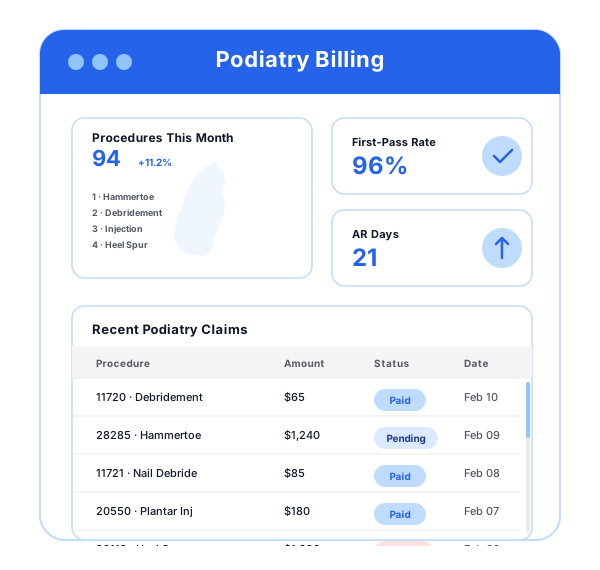
Podiatry Billing by the Numbers
Measurable outcomes from podiatry practices using CureMed for their billing and coding.
First-Pass Acceptance Rate
Denial Rate Reduction
Revenue Increase
Average Days in A/R
Podiatry Billing Comes with Unique Challenges
Podiatry billing involves routine care exclusions, coverage modifiers, and payer restrictions that cause a disproportionate share of preventable denials.
of podiatry claims are denied due to routine foot care coverage restrictions and incorrect coverage modifiers.
AAPCin average annual revenue lost per provider from missed procedures, undercoding, and incomplete medical necessity documentation.
of podiatry claim denials are caused by medical necessity documentation gaps or errors in distinguishing routine from non-routine care.
AMAPodiatry billing requires coders who understand routine care exclusions, systemic condition documentation, DME authorization workflows, and the modifier rules that determine whether a foot care claim pays or gets denied.
What's Included in CureMed Podiatry Billing
End-to-end billing tailored to your podiatry practice's procedures, DME orders, and payer mix.
Routine Foot Care Coverage
Accurate coding and modifier application for routine foot care tied to systemic conditions like diabetes and PAD.
Nail & Wound Procedures
Proper coding for nail surgery, debridement, and wound care with correct CPT and ICD-10 alignment to medical necessity.
Custom Orthotics & DME
Complete billing for custom orthotics, diabetic shoes, and prosthetics with full documentation and prior auth support.
Diabetic Foot Care
Specialized coding for LOPS exams, ulcer care, and preventive diabetic foot services with correct frequency tracking.
Podiatric Surgery
Accurate global period billing for bunionectomy, hammer-toe repair, and reconstructive foot and ankle procedures.
Prior Authorization Management
Proactive authorization tracking for custom orthotics, advanced imaging, and surgical procedures to reduce denial risk.
How CureMed Podiatry Billing Works
A five-step process from practice audit to ongoing optimization, built specifically for podiatry.
Podiatry Practice Audit
We analyze your current claim patterns, routine foot care denial trends, and payer mix to build a custom billing strategy.
EHR Integration & Setup
Seamless connection with your podiatry EHR. We configure workflows for routine care, DME orders, and surgical procedures.
Specialty Coding & Submission
Podiatry-trained coders review every encounter, apply correct CPT/ICD codes with the right coverage modifiers, and submit within 24 hours.
Payment Posting & Denial Management
Every payment posted, every underpayment flagged, every denial appealed with podiatry-specific clinical documentation.
Ongoing Optimization
Monthly reviews covering routine care performance, DME claim trends, surgical billing analytics, and revenue optimization strategies.
Why Leading Podiatrists Choose CureMed
We tackle the real challenges podiatry practices face every day, from routine care exclusions to DME authorization complexity.
Routine Foot Care Coverage Verification
Routine foot care is often excluded unless tied to systemic conditions. We perform eligibility checks and pre-verification to confirm coverage before the visit.
DME & Orthotic Authorization
Custom orthotics and DME require prior authorizations. Our pre-auth team handles approvals and eligibility checks to avoid delays and denials.
Pre-Submission Documentation Audits
Claims get rejected without detailed clinical notes. We audit documentation before submission to ensure medical necessity is clearly established.
Proactive Compliance & Payer Monitoring
We track payer policy changes, coverage updates, and compliance requirements proactively, reducing A/R days and audit risk across your podiatry claims.
Podiatry CPT codes we handle every day
Q-modifier rules, laterality down to the individual toe, and wound care documentation. These twelve carry the volume in most practices.
| Code | Procedure | What to watch |
|---|---|---|
| 11055 | Paring of benign lesion, single | Corn or callus removal, one lesion. Cannot be billed alongside 11056 or 11057 in the same session. |
| 11720 | Nail debridement, 1 to 5 | Any method. Cannot be billed with 11721 the same session, and medical necessity has to be documented. |
| 11721 | Nail debridement, 6 or more | Higher reimbursement than 11720, and it needs the exact nail count in the note. |
| 11730 | Nail plate avulsion | Simple avulsion. The local block, 64450, is separately billable. |
| 11750 | Nail matrix excision | Matrixectomy for an ingrown toenail. Ten day global, and T-modifiers for laterality are required. |
| 11042 | Debridement, skin and subcutaneous | First 20 square centimetres. Wound measurements are what make this code stand up. |
| 28285 | Hammertoe correction | Including phalangectomy. Ninety day global, prior auth required. |
| 28296 | Bunionectomy with osteotomy | Distal osteotomy. Prior authorisation always required, ninety day global. |
| 28080 | Interdigital neuroma excision | Morton neuroma. MRI documentation is usually needed for the prior auth. |
| 29405 | Short leg cast | Below knee to toes. Materials separately billable under A4580 or the Q4030 series. |
| G0245 | Diabetic foot exam, LOPS | Loss of protective sensation evaluation. Medicare-specific, for diabetic peripheral neuropathy. |
| L3000 | Custom orthotics | Custom fabricated foot insert. Prior auth with most payers, and medical necessity documentation is mandatory. |
Where podiatry billing usually breaks
Three patterns account for most denials here. Our coders catch them before submission rather than after.
Missing Q-modifiers
Routine foot care denied for missing Q7, Q8 or Q9. Medicare requires them to prove at-risk foot care eligibility.
At-risk documentation
Medical necessity gaps for diabetic and vascular patients. The notes have to show the specific at-risk conditions.
Laterality errors
Toe modifier and RT or LT mistakes, especially on hammertoe and nail procedures across multiple digits.
Each podiatry sub-specialty bills differently. We handle all of them.
Coders matched to your sub-specialty rather than a generalist stretched across all of them. The rules are not the same.
Routine foot care
Nail and callus care for at-risk patients. Q-modifier documentation, class findings and diagnosis linkage all required for coverage.
Diabetic foot care
Preventive assessments, therapeutic shoes, ulcer care. Loss of protective sensation documentation drives coverage.
Wound care
Debridement, negative pressure therapy, skin substitutes. Depth, size and wound characteristics all have to be documented.
Podiatric surgery
Hammertoe, bunion, neuroma, Achilles procedures. Global periods with modifier 51 and 59 rules.
Orthotics and DME
Custom orthotics, therapeutic shoes, ankle braces. HCPCS Level II with prior auth on most items.
Sports medicine foot
Achilles injuries, plantar fasciitis, stress fractures. Overlaps with orthopedics but on podiatry's own terms.
Full-service podiatry billing
Everything the practice needs, from scheduling through final payment posting.
Q-modifier coding
Every routine foot care claim gets the right Q7, Q8 or Q9 from the class findings.
Wound care billing
Debridement depth, size and layer documentation captured for the right code.
Surgical coding
Hammertoe, bunion and neuroma. Toe modifiers and global period rules applied correctly.
Orthotic PA management
Custom orthotics and therapeutic shoes pre-authorised before dispensing.
Diabetic foot programmes
Therapeutic shoe and preventive assessment billing captured for diabetic patients.
Dedicated manager
The same person answers when you have a Q-modifier question or need an appeal filed.
How we make Medicare routine foot care actually get paid
Medicare denies routine foot care by default. Getting paid takes documented class findings, the right Q-modifier, and diagnosis linkage. This is the chain that keeps those claims clean.
- 1
Patient eligibility
Identify the systemic disease, diabetes, PVD or neuropathy, that qualifies the patient for at-risk foot care.
Pre-visit - 2
Class findings
The provider documents class A, B or C findings: absent pulses, sensation loss, dystrophic nails.
At the visit - 3
Q-modifier applied
Q7 for one class A finding, Q8 for two class B, Q9 for one class B plus two class C, chosen from the note.
Coding - 4
Diagnosis linkage
The primary systemic diagnosis, E11.42 or I73.9, linked to the CPT code and the Q-modifier.
Claim prep - 5
Clean payment
Claim submitted and paid on the first pass. No manual appeals for what should be routine reimbursement.
Same-day submit
The documentation template is deployed at onboarding. Class findings are captured at every visit without adding to the provider's workload: class A, B and C findings appear as options in the EHR rather than free text nobody fills in.
“We are a three-podiatrist practice, heavy on diabetic and geriatric patients. Our previous biller was getting almost half our routine foot care claims denied for missing Q-modifiers. CureMed rebuilt our documentation workflow and denials dropped 62 percent in three months.”
Frequently Asked Questions
Checking eligibility, deductibles, and coverage in advance avoids denials.
Complexities include coding for custom orthotics, frequency limits, and clarity on global periods for procedures.
Yes, such as specific CPT codes for nail surgery and custom orthotics, which CureMed's coders are familiar with.
Procedures like wound care, nail surgery, diabetic foot care, and X-rays are billed under podiatry.
By partnering with specialists who use the correct CPT/ICD codes for every procedure.
Services That Complement Podiatry Billing
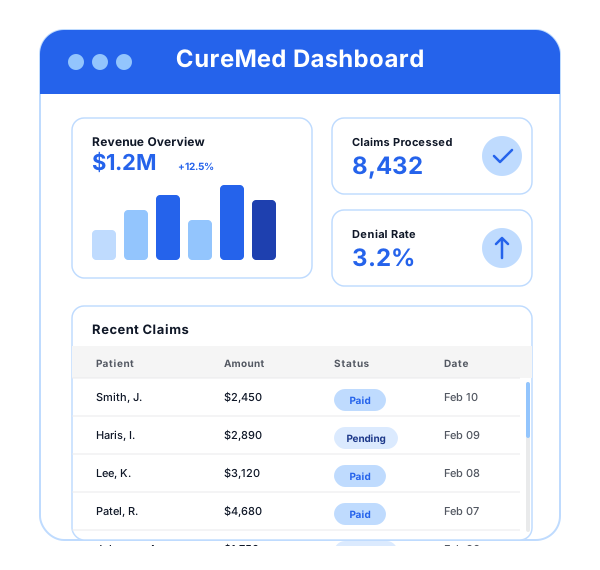
Medical Billing
Specialty-specific edit sets, built on real claims history — not pulled off a shelf.
Learn More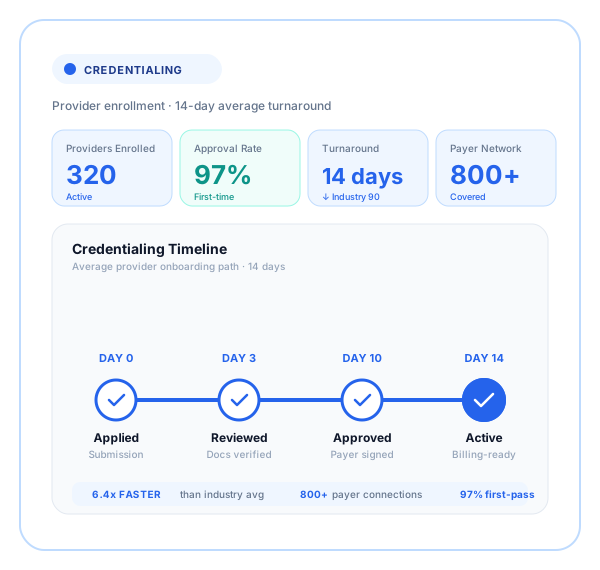
Credentialing & Enrollment
Provider enrollment without the hundred-and-twenty-day idle.
Learn More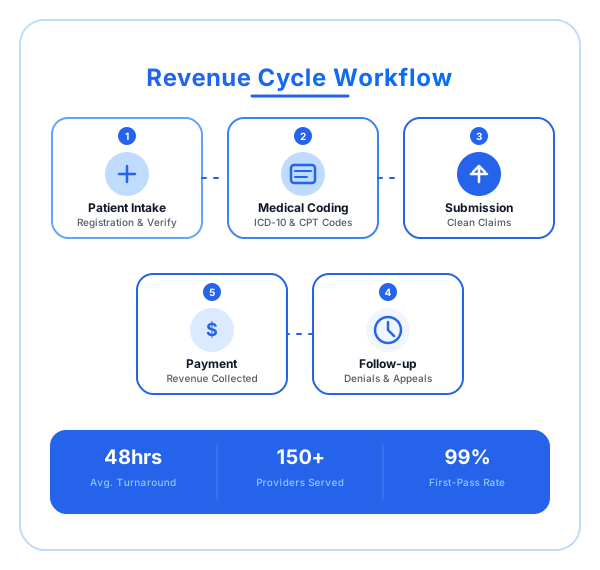
Revenue Cycle Management
End-to-end RCM ownership, from eligibility through last-dollar collected.
Learn MoreCurious what your revenue cycle is actually leaving on the table?
Spend 30 minutes with our revenue cycle team and we'll walk through your current setup, surface where money is leaking from denials, slow payer follow up, undercoded encounters, and quantify what cleaning it up is worth in your first 90 days. No prep, no slide deck, just a working conversation with people who do this every day.