Cutting Claim Rejections by 55% Through Clean Claim Submission for a Dermatology Group 55% fewer rejections
Service
Medical BillingIndustry
General DermatologyLocations
4 officesProviders
12 doctorsTimeline
3–6 monthsRegion
TaxesAbout This Project
A 12-doctor dermatology group operating four offices came to CureMed with a claim denial rate of 28 percent, roughly double the industry norm. The problem was not one bad habit but three reinforcing ones: inconsistent code use across locations, the complete absence of pre-submission review, and three disparate EHR systems running side by side with no shared oversight.
The timing made the situation urgent. The practice was expanding, and leadership understood that growth would multiply the damage rather than dilute it. Every additional physician and every new office would inherit the same fragmented workflows, and the denial backlog would grow with them. Adding volume to a broken billing process is one of the most expensive mistakes a growing practice can make, because rework costs scale directly with claim counts.
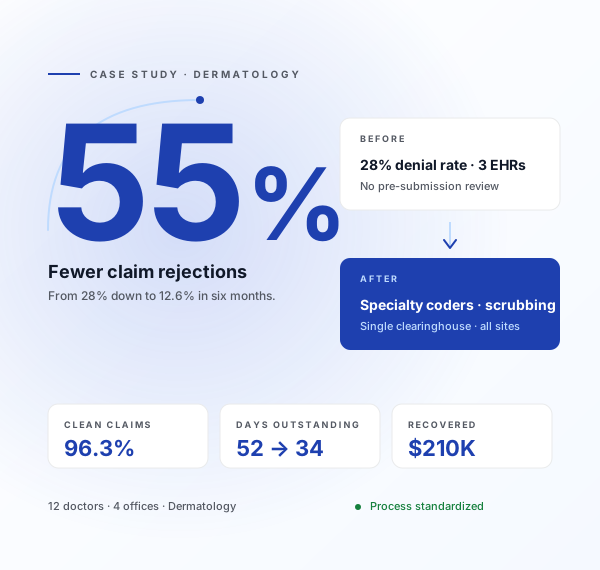
CureMed was engaged to overhaul the group's entire revenue cycle management operation, with a clear mandate: standardize billing across all four locations and drive the denial rate below 5 percent. Within six months, the practice had cut denials by 55 percent, reached a clean claim rate of 96.3 percent, shortened days outstanding from 52 to 34, and recovered $210,000 in revenue that had been sitting in the denial pile.
This case study walks through what was going wrong, what CureMed changed, and why the fixes held up as the practice continued to grow.
Why Dermatology Medical Billing Is Easy to Get Wrong
Dermatology occupies an unusual position on the billing spectrum. Encounters are short, but they are dense with billable events. A single visit can include an evaluation and management service, several biopsies, a destruction of premalignant lesions, and an excision, each with its own coding logic and its own payer edits. That density is exactly what makes dermatology medical billing unforgiving: there are more decisions per claim than in most specialties, and each decision is a chance to trigger a rejection.
A few examples illustrate why generalist billers struggle with this specialty:
- Same-day procedures and office visits. When a provider performs a procedure and a significant, separately identifiable evaluation on the same day, the visit must carry the correct modifier. Miss it and the E/M line is denied; apply it carelessly and the claim invites an audit.
- Biopsy bundling rules. Multiple biopsies in one session are not simply billed as repeated line items. Payers expect primary and add-on codes, and unbundling them incorrectly is one of the most common dermatology denials.
- Excision coding. Excisions are coded by anatomic site, lesion size including margins, and whether the lesion is benign or malignant, which often cannot be finalized until the pathology report returns.
- Mohs micrographic surgery. Mohs is billed by stage and by block count, and the surgeon must act as both the operator and the pathologist for the codes to apply. Documentation that fails to support this structure is a reliable source of rejections.
There is also a laboratory dimension that many practices underestimate. Nearly every biopsy and excision generates a specimen, and the professional and technical components of pathology work follow their own billing rules. Groups that process specimens in-house effectively run a small laboratory billing operation inside a dermatology practice, with all the code-pairing and modifier requirements that implies.
None of this is obscure knowledge to a dermatology-trained coder. But for a practice staffed with generalist billers spread across four offices and three software systems, the error surface is enormous. That was precisely the position this group was in.
The Challenges
CureMed's engagement began with a structured billing audit of the group's recent submissions and denials. The review confirmed that the 28 percent denial rate was not driven by a single failure point. It was the compound product of three problems, each feeding the others.
Incomplete and incorrect claims
Claims were leaving the practice missing patient demographic data, carrying CPT/ICD mismatches, and lacking the dermatology-specific modifiers required for procedures like Mohs and biopsies. Because nothing was reviewed before submission, every one of these errors traveled all the way to the payer before anyone noticed.
Each rejection then triggered an 18-day rework cycle: the denial had to be identified, routed to a biller, researched, corrected, and resubmitted. Multiply an 18-day loop across more than a quarter of all claims and the cash-flow consequence becomes obvious. Days outstanding sat at 52, meaning the practice waited nearly two months on average to convert completed clinical work into cash.
Three EHRs and no single source of truth
The four offices ran on three disparate EHRs, each with its own claim workflow, its own coding conventions, and its own submission path. The same procedure could be coded three different ways depending on which office performed it. The practice manager had no way to compare performance across locations, no consolidated view of claim status, and no mechanism for pushing a correction made at one office out to the other three.
In effect, the group was operating four separate billing departments that happened to share a tax ID. Fragmentation of this kind does not just cause errors; it hides them, because no one can see the full pattern.
High staff turnover
Frequent turnover among billing staff meant institutional knowledge was constantly walking out the door. Each departing biller took undocumented payer quirks and coding fixes with them, and each new hire repeated the same mistakes their predecessors had already made and solved. There was no documented playbook to break the pattern, so the practice kept paying the tuition for the same lessons over and over.
Taken together, the three problems formed a loop: fragmentation produced errors, missing review let errors reach payers, turnover erased whatever was learned from the denials, and the cycle restarted.
The Solution: Clean Claim Submission as a System
A clean claim is one the payer accepts and adjudicates on first submission, with no manual intervention and no resubmission. Raising the clean claim rate is therefore a prevention problem, not a rework problem: every error has to be caught before the claim leaves the building, not after the payer bounces it back. CureMed rebuilt the group's process around that principle, in four workstreams.
1. A dermatology-specialized billing team
Certified medical billers with dermatology experience were assigned from day one. They understood Mohs staging and block-count rules, the bundling logic for multiple biopsies, and excision modifier requirements before the first claim went out the door. Rather than learning the specialty on the practice's dime, the team arrived already knowing which payer edits govern which procedure combinations.
Just as important, the team applied one coding standard across all four offices. The same procedure was now coded the same way regardless of location, which eliminated the cross-office inconsistency the audit had flagged as a root cause.
2. Automated pre-submission claim scrubbing
Every claim was routed through an automated scrubber that checked it against payer-specific guidelines before submission. The scrubber validated demographic completeness, CPT/ICD alignment, modifier presence, and payer-specific edit rules, flagging exceptions for a biller to resolve the same day rather than eighteen days later.
Scrubbing works best when the data feeding it is accurate at the front end, so the workflow also tightened intake: confirming coverage through patient eligibility verification before the visit means the demographic and insurance fields the scrubber depends on are correct from the start. A scrubber cannot fix a claim built on a lapsed policy or a mistyped member ID; it can only catch it, and catching it before the appointment is cheaper than catching it before submission.
The combined effect was to move error detection from the payer's mailroom to the practice's own workflow, which is the entire difference between a 28 percent denial rate and a 96.3 percent clean claim rate.
3. One centralized clearinghouse across all four offices
CureMed placed a single clearinghouse in front of all four facilities, regardless of which underlying EMR a given location used. Claims from every office now flowed through one pipe, giving the practice one source of truth for claim status and one place to manage submissions, rejections, and resubmissions.
The clearinghouse layer also decoupled the billing process from the EHR fragmentation problem. The practice did not need to rip out and replace three software systems on day one to get unified billing; the consolidation happened downstream, where it mattered most.
4. Live rejection dashboards and a documented playbook
CureMed set up live rejection dashboards for the practice manager, breaking denials down by payer, by provider, and by procedure. For the first time, the group could see exactly which area was generating which rejections. If one payer started bouncing a particular procedure combination, the dashboard surfaced it within days, and the fix was applied to every office at once.
Every workflow, edit rule, and payer-specific exception was also written into a standardized, documented billing process. Because the operation now ran through the centralized clearinghouse against a written playbook, billing-staff turnover stopped being a continuity risk. The process no longer depended on any one biller's institutional knowledge.
Reworking the existing denial backlog
While the preventive system was being built, a parallel effort attacked the accumulated denials. Through rigorous review, correction, and resubmission of previously denied claims, CureMed recovered $210,000 that the practice had effectively written off. Backlog recovery matters in engagements like this one for a practical reason: it funds the transition and demonstrates value while the structural improvements take hold.
Results
Six months after the engagement began, the practice's metrics looked like this:
| Metric | Result | What changed |
|---|---|---|
| Claim rejection rate | 55% drop | From 28% down to 12.6% in six months. |
| Clean claim rate | 96.3% | Up from a fragmented, untracked baseline. |
| Days outstanding | 34 days | Down from 52 days, 18 days faster to payment. |
| Revenue recovered | $210,000 | Recaptured through reworked and resubmitted claims. |
| Staff redeployment | Immediate | Rejection-management staff moved to patient-facing work. |
A few notes on reading these numbers honestly:
- The denial rate is a trajectory, not a finish line. The engagement's stated goal was a denial rate below 5 percent. At the six-month mark the rate stood at 12.6 percent, a 55 percent reduction from the starting point, with the same preventive infrastructure now carrying the practice toward the target.
- The clean claim rate is the leading indicator. At 96.3 percent, the vast majority of claims were being accepted on first pass. Denial rates lag behind clean claim rates because older, dirtier claims are still working through adjudication; as those cycle out, the two measures converge.
- The A/R improvement compounds. Cutting days outstanding from 52 to 34 does not just move one month's revenue forward; it permanently shortens the gap between clinical work and payment for every claim thereafter, which changes what the practice can plan and invest against.
- The staffing effect was immediate. Staff who had spent their days chasing rejections were redeployed to patient-facing work, converting a pure cost center into front-office capacity without a single new hire.
Why It Worked
What looked like a coding problem was actually a systems problem. The practice did not have bad coders so much as it had no standardization, no pre-submission verification, and no visibility across locations. Any one of those gaps produces denials; all three together produced a 28 percent rejection rate.
CureMed's fix addressed the system rather than the symptoms. Specialty-trained coders brought the dermatology-specific knowledge that Mohs, biopsy, and excision claims demand. Automated scrubbing moved error detection ahead of submission, where corrections cost minutes instead of an 18-day rework cycle. The centralized clearinghouse gave the practice manager oversight of all four locations from a single screen, and the documented playbook made the whole operation resilient to the staff turnover that had previously erased every improvement.
The end state is the real deliverable: a billing operation that runs the same way across every location, every coder, and every claim, and that keeps improving because its own dashboards show it where to look next.
For dermatology groups facing similar numbers, the pattern generalizes. High denial rates in a multi-site practice are rarely a personnel problem and almost always a process problem, and process problems respond to standardization, prevention, and measurement. CureMed's dermatology billing services combine those three elements (specialty-trained coders, pre-submission scrubbing, and unified reporting) as part of its broader medical billing offering, so practices can scale clinical operations without scaling their denial rate along with them.
Curious what your revenue cycle is actually leaving on the table?
Spend 30 minutes with our revenue cycle team and we'll walk through your current setup, surface where money is leaking from denials, slow payer follow up, undercoded encounters, and quantify what cleaning it up is worth in your first 90 days. No prep, no slide deck, just a working conversation with people who do this every day.