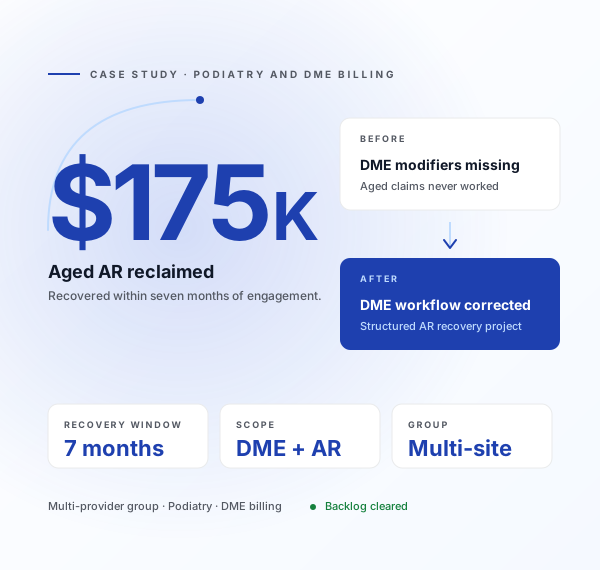
How a Podiatry Group Reclaimed $175,000 in Aged Receivables in Seven Months
Service
AR Recovery & DenialsIndustry
PodiatryProviders
Multi-provider groupTimeline
6+ monthsAbout This Project
A multi-provider podiatry group approached CureMed with a revenue problem that had been building quietly for a long time: $175,000 sitting in aged accounts receivable, most of it tied to durable medical equipment claims for custom orthotics, therapeutic footwear, and related items. Claims were being denied for missing or invalid modifiers, documentation that never made it into the claim file, and follow-up work that simply was not happening. The backlog was not the result of one bad decision. It was the compound interest on hundreds of small billing errors that nobody had connected into a pattern.
The group's clinical operation was healthy. Its physicians managed a busy caseload of diabetic foot care, wound care, biomechanical work, and surgical follow-up, and dispensing orthotics and DME items was a routine part of patient care. The billing operation had not kept pace. The in-house team handled professional claims competently but had never been trained on the distinct rulebook that governs DME billing, and the gap showed up exactly where it usually does: in the aging report.
CureMed's engagement ran on three connected tracks. First, a structured billing audit to identify the error patterns behind the denials. Second, a rebuild of the DME billing workflow so that new claims went out clean. Third, a targeted AR recovery project to work the aged backlog claim by claim. The group chose CureMed specifically for its specialty depth, since generic billing vendors rarely understand the modifier and documentation rules that make podiatry billing services a distinct discipline. The outcome that mattered most to the owners: $175,000 in aged receivables reclaimed within seven months.
Engagement at a glance:
- Client: multi-provider podiatry group with a heavy orthotics and DME caseload
- Problem: $175,000 in aged AR driven by systematic DME billing errors and stalled follow-up
- Approach: billing audit, DME workflow redesign, and a phased AR recovery project
- Result: $175,000 in aged receivables reclaimed within seven months
Where the Backlog Came From
Podiatry occupies an unusual position in medical billing. A single practice bills evaluation and management visits, procedures, wound care, and surgery, and then also acts as a supplier of durable medical equipment. Those two worlds run on different rules. Professional claims and DME claims have different documentation standards, different modifier logic, and in the Medicare world, different contractors reviewing them. A billing team that is strong on the professional side can still fail consistently on the DME side, and that is exactly what happened here.
The audit later confirmed what the aging report suggested: the professional claims were mostly fine, while DME claims were failing at a rate the practice had never quantified. Denials came back, were logged, and then sat. Some were resubmitted without correction and denied again for the same reason. Many were never touched at all. As balances rolled into the older aging buckets, the practical odds of collecting them fell, and appeal and timely filing windows quietly began to close.
Why DME denials go unworked
Three conditions let the backlog grow unchecked, and CureMed sees the same pattern in many podiatry medical billing engagements:
- Denial reasons were opaque to the team. Remark codes pointing to modifier or documentation issues were logged as generic "documentation denials" with no clear fix, so nobody knew what to correct.
- No one owned follow-up. Working denials was everyone's job in theory and no one's job in practice. There was no cadence, no assignment, and no escalation rule for claims crossing into the 90 and 120 day buckets.
- Reporting hid the problem. The practice reviewed monthly collections, which looked acceptable because visit volume kept rising. Nobody was reviewing the aging report by claim type, so the DME failure rate stayed invisible.
By the time the group sought outside help, leadership knew the number was large but could not say which claims made it up, which were still recoverable, or what was causing the denials in the first place. Answering those questions was the first phase of the work.
The Billing Audit: Finding the Error Patterns
CureMed's position from the outset was that collections could not come first. Recovering aged AR while the billing process keeps producing the same errors is like bailing a boat without patching the hull. So the engagement opened with a structured medical billing audit covering a representative sample of DME and professional claims across the group's payer mix, with every denial traced back to a root cause rather than a surface-level remark code.
The audit surfaced a set of systematic, repeating errors concentrated in the DME claim stream:
- Missing or invalid KX modifiers. The KX modifier attests that the coverage criteria in the applicable policy have been met and that supporting documentation is on file. The team was applying it inconsistently: omitted where required, and in some cases appended where the chart did not actually support it, which is a compliance risk as well as a denial driver.
- Missing LT/RT modifiers. Orthotics and footwear are frequently bilateral. Claims for paired items were going out without laterality modifiers, or with both units on a single line where the payer required separate line items, triggering automatic rejections.
- Missing proof-of-delivery documentation. DME suppliers must be able to produce proof of delivery. The practice dispensed items in the office but had no consistent process for capturing a signed delivery record, so when payers requested it, there was often nothing to send.
- Incomplete medical-necessity documentation. Chart notes documented care thoroughly as clinical narrative, but the specific elements payers require to establish medical necessity for orthotics and therapeutic footwear were scattered, implied, or missing from what accompanied the claim.
- Claims aging without follow-up. Across every category, the audit found denials that were correctable and appealable but had simply never been worked.
Segmenting the $175,000
Alongside the error analysis, CureMed classified every dollar of the aged AR by payer, aging bucket, denial reason, and recoverability. A substantial share of the backlog was still workable: claims within appeal windows, claims that could be corrected and resubmitted, and older claims where a reopening request was justified. A smaller share was genuinely at risk from expired deadlines. That segmentation became the recovery roadmap, because it told the team where speed mattered most.
Rebuilding the DME Medical Billing Workflow
Before scaling up recovery, CureMed rebuilt the workflow that had produced the backlog. Every fix targeted a specific error pattern from the audit, and each was designed to live inside the practice's normal routine rather than as an extra task bolted on afterward.
Modifier logic at charge entry
CureMed built a modifier decision checklist specific to the DME items the group actually dispensed. Before any DME claim could be released, the biller confirmed whether KX applied and whether the documentation supported it, and verified LT/RT coding and line structure for paired items. The checklist turned tribal knowledge into a repeatable step and created an audit trail for every modifier decision.
Proof of delivery captured at dispensing
The fix for missing proof-of-delivery records had to happen at the front of the process, not in the billing office. CureMed worked with the clinical staff to standardize a delivery documentation form completed and signed at the moment an item was dispensed, then scanned into the patient record. Claims for dispensed items could not be released until the delivery record was on file, which converted a chronic retrospective scramble into a routine checkpoint.
Medical-necessity documentation templates
For orthotics and therapeutic footwear, CureMed developed concise documentation templates that prompted physicians to capture the qualifying condition and clinical rationale in a structured, findable format. The goal was never longer notes. It was making sure the elements a payer needs to adjudicate a DME medical billing claim appear explicitly instead of being buried in narrative prose. The templates took physicians moments to complete and removed the most common documentation denial triggers at the source.
Denial routing and follow-up cadence
Finally, CureMed installed the discipline that had been missing: every denial routed to a named owner with a required action and a deadline, a weekly denial worklist, and escalation triggers for any claim approaching an aging threshold. These controls were folded into the group's day-to-day medical billing operations so that no claim could age silently again. Within the first quarter of the engagement, new DME claims were going out under the corrected workflow, and the inflow of fresh denials fell sharply.
The AR Recovery Project
With the workflow repaired, the AR recovery project could run at full speed without new denials refilling the backlog behind it. CureMed executed the recovery in deliberate waves based on the audit's segmentation, prioritizing the claims where deadlines created urgency.
- Wave one: claims still within appeal windows. These carried the best recovery odds and the tightest clocks. CureMed's team rebuilt each claim from the original encounter documentation and filed appeals that answered the specific denial reason, attaching the proof of delivery, modifier correction, or medical-necessity support the payer had found missing. Appeals grouped by denial reason used tailored templates rather than generic medical-necessity language, which materially improved overturn results.
- Wave two: correctable resubmissions. Where payers permitted corrected claims instead of formal appeals, claims were fixed and resubmitted with the proper modifiers and line structure. Many of these were straightforward once the error pattern was understood.
- Wave three: aged and complex claims. For older claims past standard appeal deadlines, CureMed pursued reopening requests where a defensible basis existed, such as clerical errors in the original submission or documentation that existed at the time of service but was never submitted. Claims that could not be supported honestly were written off rather than forced.
- Patient balance reconciliation. As payer claims resolved, patient balances that had been created downstream of incorrect denials were recalculated and corrected, protecting patient trust while the payer work concluded.
Compliance guardrails
Recovery work on this scale only holds up if it is defensible. CureMed's team worked from a firm rule set: no clinical documentation was created or altered after the fact to support an appeal, late entries followed formal amendment procedures with accurate dating, and any claim lacking genuine documentation support was written off instead of appealed. The practice finished the project with its receivables recovered and no new compliance exposure created along the way.
Throughout the seven months, the recovery team tracked progress weekly by segment: dollars resolved, appeals pending, and aging bucket movement. The oldest high-value claims were always worked first, because every week of delay narrowed the remaining options.
Results
The engagement delivered on its headline goal: $175,000 in aged receivables reclaimed within seven months, alongside a billing operation that no longer manufactures the next backlog.
| Metric | Result | What changed |
|---|---|---|
| Aged receivables reclaimed | $175,000 | Segmented, deadline-driven AR recovery worked the backlog in waves by denial reason and appeal window |
| Time to resolution | Seven months | Parallel tracks meant recovery never waited on the workflow rebuild, and vice versa |
| DME claim quality | The large majority of new DME claims now clear on first submission | Modifier checklist, proof-of-delivery capture at dispensing, and medical-necessity templates removed the systematic error patterns |
| AR oversight | Standing monthly aging review with named ownership | Escalation triggers and denial routing ensure no claim ages without follow-up |
Beyond the recovered dollars, the group's aging profile changed shape. New claims stopped feeding the older buckets, denials were worked within days instead of drifting for months, and the monthly aging review gave leadership a management tool it had never had: visibility into receivables by claim type, payer, and age, reviewed on a fixed cadence with clear accountability. The audit-first sequencing here mirrors the approach in CureMed's gastroenterology billing audit engagement, where fixing root causes before chasing balances produced durable results rather than a temporary bump.
Why It Worked
Three decisions drove this outcome. The first was refusing to treat the backlog as a collections problem. The $175,000 was a symptom; the disease was a DME billing workflow producing predictable, repeating errors. Auditing first meant every recovered dollar stayed recovered instead of being offset by fresh denials.
The second was specialty depth. Podiatry billing lives at the intersection of professional claims and DME supplier rules, and the details that sank this group's claims, KX modifier criteria, LT/RT line structure, proof-of-delivery requirements, and structured medical-necessity documentation, are exactly the details a generalist billing operation tends to miss. CureMed's podiatry billing team works inside these rules daily, which is why the audit found patterns the in-house team had been staring past for months.
The third was disciplined execution. Segmenting the backlog, working the tightest deadlines first, tailoring appeals to specific denial reasons, and tracking movement weekly turned a demoralizing pile of old claims into a finite project with a finish line.
For practice owners watching their own aging report creep upward, the lesson is simple: aged AR rarely fixes itself, and the options shrink every month a denial sits unworked. CureMed's AR recovery and billing audit services exist for exactly this situation, finding the error patterns, repairing the workflow that created them, and reclaiming the revenue that is still within reach.
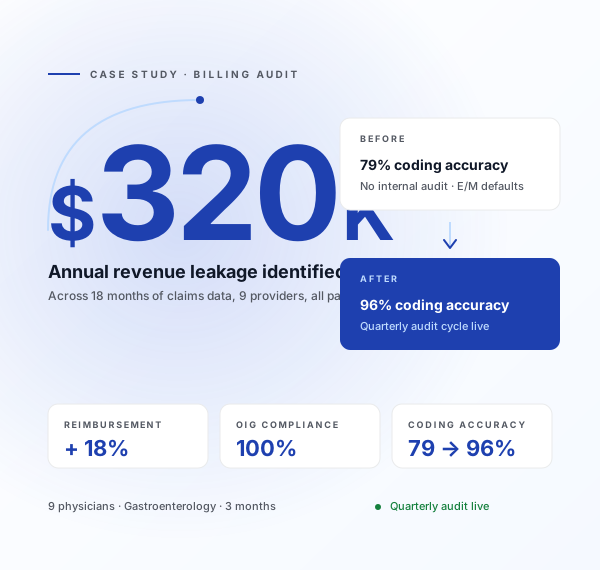
Recovering $320K in Annual Revenue Leakage Through a Comprehensive Medical Billing Audit for a Gastroenterology Practice
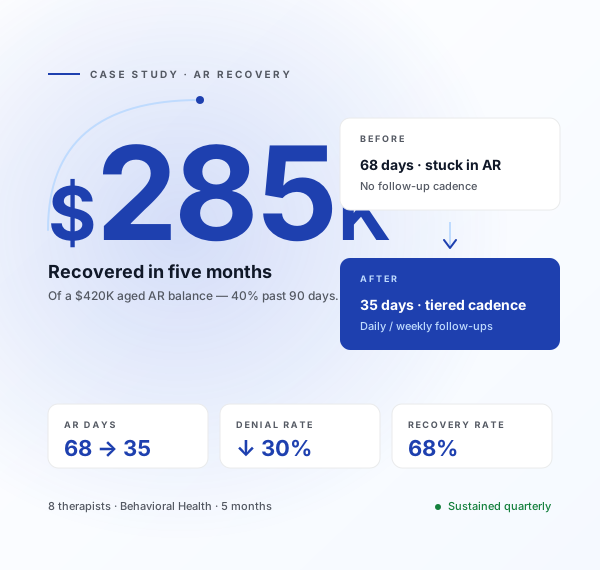
Reducing AR Days from 68 to 35 for a Behavioral Health Provider with Proactive Follow-Ups
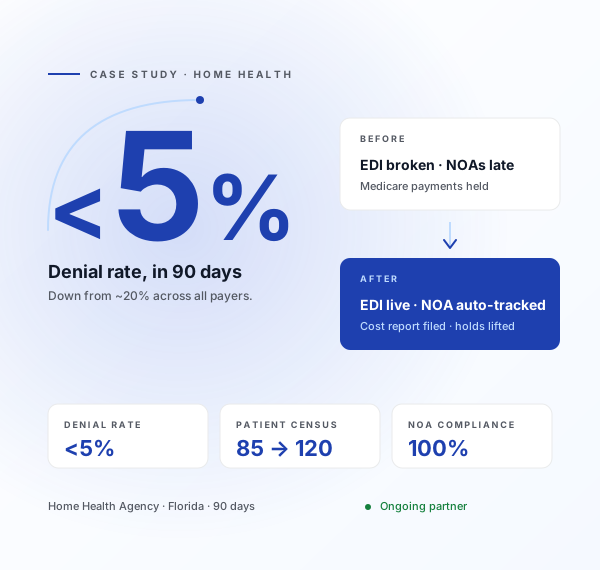
End-to-End Resolution of Home Health Agency Payment Holds, Late NOA Denials, and EDI Enrollment Issues
Curious what your revenue cycle is actually leaving on the table?
Spend 30 minutes with our revenue cycle team and we'll walk through your current setup, surface where money is leaking from denials, slow payer follow up, undercoded encounters, and quantify what cleaning it up is worth in your first 90 days. No prep, no slide deck, just a working conversation with people who do this every day.