End-to-End Resolution of Home Health Agency Payment Holds, Late NOA Denials, and EDI Enrollment Issues Home Health Agency Payment
Service
Revenue Cycle ManagementIndustry
Home Health AgencyLocations
4Providers
32Timeline
Under 3 monthsRegion
FloridaExecutive summary
This case study explains how a dedicated team of revenue cycle management (RCM) professionals uncovered, addressed, and remedied a series of challenging billing, compliance, and operations issues at a Medicare-certified home health agency (HHA) in Florida. Prior to the engagement in 2025, the agency faced significant interruptions to its cash flow due to incorrect EDI enrollment configuration, unresolved NOA denial claims, Medicare payment suspension, and EVV system failures.
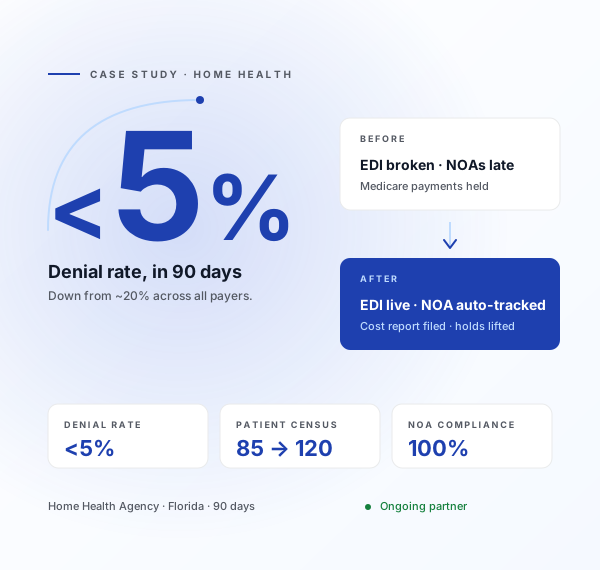
Following a careful audit and intervention across all four problem areas, the RCM team restored claim payments, recovered revenue that had been denied, and built a fully integrated, sustainable billing system. The agency now serves about 120 patients with a sub-5% denial rate and fully synchronized EDI, EVV, and EHR systems.
Client profile
The client is a Medicare-certified home health agency based in Florida, delivering a wide variety of home healthcare services — skilled nursing visits, physical therapy, occupational therapy, pharmacotherapy, and other home-based medical services. The patient base is mostly elderly Medicare beneficiaries with multiple chronic conditions, plus a smaller cohort of Medicaid members requiring personal-assistance services.
Prior to engaging our RCM consulting services in Q1 2025, the agency relied on an internal billing coordinator with limited expertise in Medicare home-health billing requirements, CMS regulations, and 21st Century Cures Act–mandated EVV. Claims were processed through an EHR that could not be integrated with either the EVV system or Medicare's EDI submission pipeline, producing numerous denials and a high A/R balance.
At the time of engagement the agency was serving around 85 active patients and was struggling under increasing backlogs and denials, with open questions about its provider status at Medicare.
Situation background and organizational context
Home health billing is among the most administratively challenging areas of medical claims. Unlike facility-based care, home health requires high-quality documentation and submission, plus strict compliance with the Medicare Conditions of Participation. Failure to follow proper billing — documentation, submission deadlines, electronic-submission processes — produces payment delays and other downstream issues.
A significant development in home-health reimbursement was the introduction of the Patient-Driven Groupings Model (PDGM) in January 2020. PDGM moved reimbursement from volume-based to clinically based, making accurate coding, episode management, and patient-needs documentation harder for providers. On top of that, the EVV requirements introduced by the 21st Century Cures Act created additional compliance demands, especially for personal-care and home-health-aide services.
In this regulatory environment, the agency had been operating without a proper RCM system. It lacked the training, knowledge, and skills to meet its obligations — and it had accrued multiple instances of non-compliance as a result.
Key challenges identified
In the early phase of the assessment, our RCM specialists conducted an in-depth review of the agency's billing data, payer registrations, claims-filing history, EVV tracking, and EHR configuration. The analysis surfaced four fundamental causes, each independently impacting financial performance.
Challenge 1: Incorrect EDI enrollment and Submitter ID configuration
EDI enrollment is the initial process by which a healthcare provider registers with Medicare to send electronic claims through an approved clearinghouse. The agency's EDI enrollment had been started but never completed — the Submitter ID was inactive, mapped incorrectly, or not recognized at all by the MAC responsible for the agency's state.
As a result, claims generated from the EHR could not reach the clearinghouse. They were either bounced for connectivity issues, failed payer validation, or rejected as invalid claims submitted under an unknown or inactive Submitter ID. The submission pipeline was effectively broken at the source. Billers had been re-sending claims to Medicare repeatedly, unaware of the underlying problem, only to create duplicate-transaction entries.
In addition, the agency's Trading Partner Agreement with the clearinghouse had expired — meaning Medicare claims could not be processed through the pipeline at all.
Challenge 2: Late NOA denials affecting multiple episodes
The Notice of Admission (NOA) is a regulatory requirement in Medicare home-health billing. It must be submitted within five days of the start of service. Non-compliance triggers a per-day payment reduction until the NOA is received by Medicare; late or missing NOAs can result in outright claim denial.
The audit found a significant number of episodes — both active and completed — for which NOAs had been submitted late or not submitted at all. The lapses traced back to insufficient awareness on the clinical side about NOA timing, the absence of any workflow that triggered billing notification when care started, and a lack of EHR alerts for missed deadlines.
The financial consequences were immediate and persistent. Several claims were denied for late NOAs, and some were declined entirely.
Challenge 3: Medicare payment holds on newly submitted claims
Medicare can place a payment hold on a provider's claims for program-integrity issues, unfiled cost reports, and other compliance gaps. In this case, the agency's payments were on hold because the annual Medicare Cost Report had not been filed. Under the home-health prospective payment system, an HHA must file an annual Cost Report on form CMS-1728-20, recording the agency's costs of delivering home-health services for the period.
Because the required Cost Report had not been filed within the prescribed window, an automatic hold was placed on all claim payments — every claim submitted during the reporting period was held, regardless of its accuracy. The agency's billing department was unaware of the requirement; no one inside the agency had been designated as responsible for filing the report.
Challenge 4: EVV system configuration failures and EHR integration gaps
EVV requires capturing visit-level information for each episode of care: patient identity, services rendered, dates of service, service location, caregiver identity, and start/end times. This data must be collected through an approved EVV application and transmitted to the state Medicaid agency for monitoring.
The agency had purchased an EVV solution but had never configured it correctly for its patient base. The EVV application had not been linked to the EHR, so visit data could not flow automatically from EVV into the billing system. Caregivers were also using the EVV solution inconsistently — visits were sometimes documented manually instead.
The result: personal-care service claims were being filed without the EVV validation Medicaid required, and were systematically denied. In other cases, claims were sent to the wrong insurer because of enrollment-mapping mistakes in the EHR — denied by the wrong payer and never resubmitted to the right one. Together, these gaps meant the agency's personal-care billing system was effectively broken.
Root cause analysis
Beneath the visible problems were deeper root causes that systematic analysis surfaced. Several characteristics of the agency's processes had let these problems develop and compound.
Absence of dedicated RCM expertise
The billing operation was staffed by generalists rather than specialists in Medicare home-health billing. The complexities of home-health payment — PDGM episodes, NOAs, Cost Reports, EVV — are too intricate to be managed without dedicated training or consultation. As a result, billing decisions were being made on instinct rather than rule.
Technology without an implementation strategy
The agency had purchased EHR and EVV software, but had no plan for operating it effectively. Buying software without configuring it or training staff to use it well is a common — and expensive — pattern in healthcare. In this case, despite owning the right tools, the agency lacked the ecosystem to use them.
Lack of internal compliance monitoring
There was no internal process for catching billing errors before submission. NOA deadlines were not monitored. There was no system reminding anyone about Cost Report submissions. EDI transactions were not monitored. Without monitoring, problems were only found after the fact — once denials or holds had already occurred.
Insufficient payer enrollment management
Payer-enrollment processes — EDI configuration, Trading Partner Agreements, provider credentialing — require continuous maintenance. Clearinghouse changes, MAC changes, or system upgrades can silently break previous settings. No single person or process at the agency was responsible for keeping payer enrollments current.
Strategic interventions
After the diagnostic phase, we built a remediation strategy organized into four concurrent workstreams. Each workstream was assigned to a specialist with the relevant expertise and run on its own schedule.
Work stream 1: EDI enrollment correction and Submitter ID activation
The enrollment team performed a complete re-enrollment with the agency's MAC, including collecting and validating all relevant documents — agency NPI, Medicare provider number, ownership details, and authorized-official credentials. Re-enrollment was completed via PECOS, together with the necessary EDI enrollment forms.
In parallel, the team renewed the Trading Partner Agreement with the clearinghouse and re-mapped a correctly configured Submitter ID against the agency's NPI and Medicare provider number. Connectivity tests were run in the clearinghouse's test environment, and the EHR's claim-submission settings were updated to use the new valid Submitter ID.
After the MAC validated and approved the enrollment, an initial set of denied claims was resubmitted through the corrected EDI path. Acknowledgment messages (997 and 999) were checked to confirm receipt. Submission steps were then formalized as part of the agency's standard procedures.
Work stream 2: Late NOA exception filing and claim reprocessing
Medicare offers a formal exception process for organizations that missed an NOA deadline due to circumstances beyond their control or operational disruption. For each eligible episode, the team prepared and filed an exception request based on the reasons for late filing, evidence that the agency was Medicare-certified, and the exception guidance from CMS.
Requests were submitted to the MAC's Provider Contact Center together with supporting clinical documentation establishing patient eligibility and the correct start-of-care date. Once exceptions were granted, the claims were resubmitted with corrected NOA dates and reimbursed in full — including the per-day reductions that had originally been applied.
In parallel, the team built an NOA-tracking process in the EHR. The process automatically alerts the billing team whenever a new patient encounter is opened, reminds them of the five-day filing window, and acknowledges receipt once Medicare has processed the NOA. This monitoring approach prevents future late-NOA filings.
Work stream 3: Medicare Cost Report preparation and submission
Lifting the Medicare payment hold required preparing and submitting the overdue Cost Report on form CMS-1728-20. The Cost Report is a detailed statement of the agency's expenditures in delivering home-health services, broken down by cost center and matched against Medicare payments for the reporting period.
The team partnered with a Medicare Cost Report specialist to compile the report from the financial information provided by the agency's finance department — payroll, supplies, overhead, and visit data — in line with the Medicare Provider Reimbursement Manual.
Once the MAC accepted the Cost Report, the payment hold was lifted. The team also worked with agency leadership to create a recurring schedule for Cost Report submission, with quarterly financial-data checkpoints to ensure future filings would never depend on last-minute work.
Work stream 4: EVV system configuration and EHR integration
The EVV denials were addressed through both technical integration and caregiver training. On the technical side, the team coordinated with the EVV vendor and the EHR implementation team to enable bi-directional data transfer between the two systems. Patient demographics, scheduled visits, and caregiver assignments were configured to flow from the EHR directly into the EVV system without manual input.
On the return path, completed visit data captured in the EVV application — clock-in and clock-out, GPS verification, caregiver identity — was set up to flow back into the EHR, producing automated claim generation for verified visits.
On the operational side, all home-health aides and personal-care workers were trained on correct use of the EVV mobile application: signing in at the patient's site on the mobile device, documenting services through to visit end, and reporting any application issues to the billing department before the end of the service week. EVV compliance was monitored weekly, and supervisors were notified immediately if a caregiver did not register an electronic clock-in or clock-out.
The team also reviewed payer-enrollment mapping in the EHR to make sure personal-care services were routed to the correct Medicaid managed care organization based on each patient's enrollment plan.
Measurable results and financial impact
The combined output of all four workstreams produced noticeable improvements across every dimension of the agency's revenue cycle, visible within the first 90 days of engagement.
Medicare payment recovery
Once the Cost Report issue was resolved and EDI enrollment was re-established, the MAC released the payments that had been on hold. The agency received a lump sum covering several months of delayed Medicare reimbursement and was able to make payroll without external borrowing.
NOA denial recovery
Through the exception process, the team recovered most of the cases that had incurred late-NOA penalties. Claims that had originally been denied were resubmitted following exception approval. New episodes hit 100% NOA compliance in the first month of using the automated tracking system.
Denial rate reduction
Pre-engagement, the agency was running an average claim denial rate of up to 20% across all payers. Within two months of correcting the EDI route, the NOA process, the EVV process, and payer mapping, that rate dropped below 5%. The improvement reflects both the underlying fixes and the introduction of proactive claim scrubbing that catches errors before submission.
EVV compliance and personal-care billing restoration
Once the EVV/EHR interface was in place and caregivers were trained on documentation, personal-care service claims started arriving with full EVV data attached. After the first cycle following EVV go-live, denials for missing visit verification stopped entirely. The managed care organization received and processed the resubmitted claims.
Ongoing RCM operations and performance management
After stabilizing the agency's billing, we shifted from remediation to ongoing RCM management. As the agency's revenue cycle partner, we now oversee every phase of the billing process — from eligibility verification through final payment posting and denial management.
The patient census has grown from about 85 patients at the start of the partnership to roughly 120 — an indicator of the agency's increased confidence in accepting referrals and of its restored financial stability. New referrals are accepted only after benefits verification has confirmed insurance coverage, plan details, and any prior-authorization requirements.
Authorization for home-health services is now obtained before services begin for every patient that requires one. We maintain a real-time prior-authorization log synchronized with the EHR scheduling system, so we never deliver services beyond the authorized visit limit without renewal — eliminating that category of denial.
Monthly performance reports cover claims clearance rate, denial rate by payer and reason, days outstanding in A/R, first-pass resolution rate, and cash collected against estimated net revenue. These reports drive informed decision-making and surface performance trend changes early.
Key takeaways and lessons learned
The engagement surfaces several lessons for home-health agencies dealing with Medicare and Medicaid claims complexity.
EDI enrollment is not a one-time event. It needs to be monitored, renewed, and periodically reverified. New clearinghouses, MAC changes, and provider-enrollment changes can break an existing EDI configuration silently — often for a long time before anyone notices.
NOA compliance is both a clinical and an administrative issue. The billing department owns monitoring and submission, but the trigger for the process lives in clinical care initiation. Sustained NOA compliance requires a workflow that spans from clinical operations into billing.
The Medicare Cost Report is a compliance requirement, not routine paperwork. Organizations that miss filing deadlines risk having their Medicare payments held — regardless of care quality or claim accuracy. A defined annual Cost Report preparation process is essential.
EVV deployment demands change in both technology and culture. EVV is not solved by installing software — it requires real behavioral change in caregiver documentation practice, supported by education and supervision. Without ongoing caregiver engagement, EVV data will be incomplete and claims will continue to fail.
A proactive approach to revenue cycle management prevents accumulation of problems. Each of the issues above had existed for a long time before the engagement began; intervening earlier would have made the impact much smaller. A proactive RCM strategy — detecting compliance red flags as they emerge — is far cheaper than mitigating the consequences of payment denials and delays after the fact.
Conclusion
This project is a complete turnaround for the billing process at a home-health agency that was facing real financial and operational risk. By diagnosing the root causes, solving them, and establishing the processes and systems needed to keep them solved, the agency moved from financial vulnerability to compliance, efficiency, and sustainability.
Resolving failed EDI enrollment, NOA denials, Medicare payment holds, and EVV setup problems requires both expertise across all those areas and the discipline to work the existing problems through. The results — restored Medicare payments, sub-5% denial rate, growing patient roster, and a billing infrastructure ready for expansion — show what that combination can produce.
Many home-health agencies in the US face issues that resemble those described here. With the right RCM expertise and a methodical approach to the obstacles, even billing problems that seem insurmountable can be resolved.
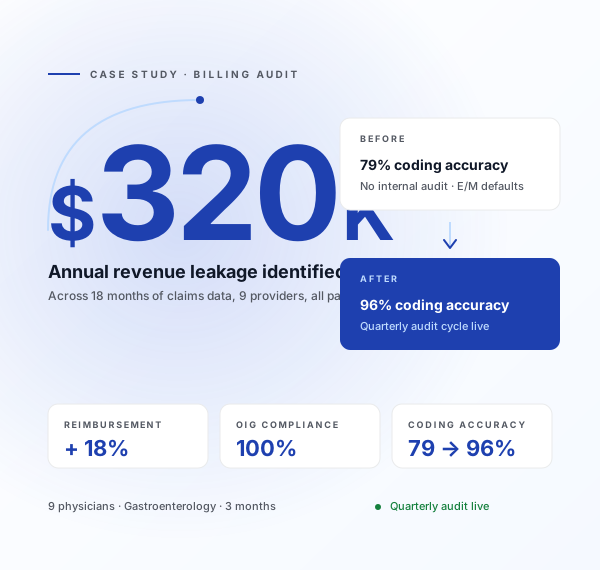
Recovering $320K in Annual Revenue Leakage Through a Comprehensive Medical Billing Audit for a Gastroenterology Practice
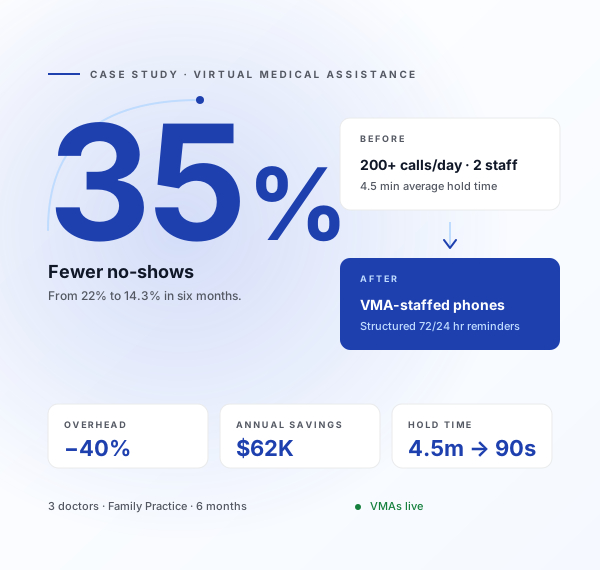
Reducing No-Show Rates by 35% and Cutting Front-Desk Overhead by 40% with Virtual Medical Assistants for a Family Practice
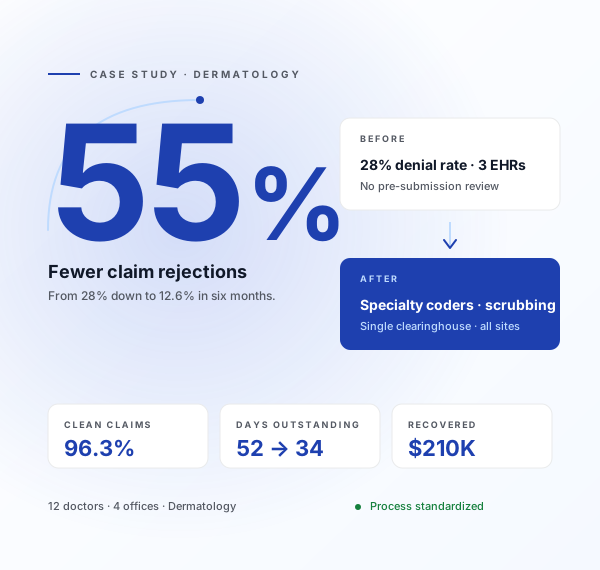
Cutting Claim Rejections by 55% Through Clean Claim Submission for a Dermatology Group
Curious what your revenue cycle is actually leaving on the table?
Spend 30 minutes with our revenue cycle team and we'll walk through your current setup, surface where money is leaking from denials, slow payer follow up, undercoded encounters, and quantify what cleaning it up is worth in your first 90 days. No prep, no slide deck, just a working conversation with people who do this every day.