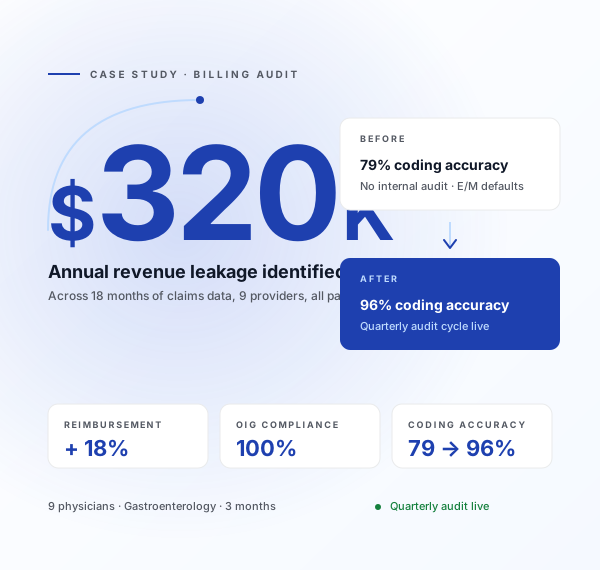
Recovering $320K in Annual Revenue Leakage Through a Comprehensive Medical Billing Audit for a Gastroenterology Practice $320K leakage identified
Service
Medical Billing AuditIndustry
GastroenterologyLocations
2Providers
9 physiciansTimeline
Under 3 monthsRegion
CaliforniaAbout This Project
A nine-physician gastroenterology practice was watching its reimbursement decline quarter after quarter, and nobody could explain why. Patient volume was steady. Procedure schedules were full. The physicians were performing the same colonoscopies, upper endoscopies, and office visits they always had. Yet the revenue coming in kept shrinking relative to the work going out.
Practice leadership suspected coding and compliance problems, but suspicion is not a diagnosis. The group had no certified coding auditor on staff, no benchmarking data to compare itself against, and no internal process for reviewing claims after they were paid. Management knew something was wrong; they simply had no way to see what.
CureMed was engaged to run a comprehensive medical billing audit covering 18 months of claims data across all patients and all payers. The brief was direct: figure out where the money was going, quantify the loss in dollars, and build a plan to stop it.
What the audit uncovered was $320,000 in annual revenue leakage, traced not to one catastrophic failure but to a handful of everyday coding habits that had quietly compounded for years. Within 90 days of implementing the corrective measures, reimbursement per encounter rose 18 percent. Coding accuracy climbed from 79 percent to 96 percent, and the practice reached full compliance with OIG guidelines.
This case study walks through what the audit found, how the corrections were implemented, and why the gains held instead of eroding back to baseline.
What Revenue Leakage in Healthcare Actually Looks Like
Revenue leakage in healthcare rarely announces itself. It is not a denied claim sitting in a work queue or an unpaid balance flagged on an aging report. Those problems are visible, and visible problems eventually get worked. Leakage is different: it is revenue the practice earned but never billed correctly, so no system ever flags it as missing.
The most common sources will be familiar to anyone who has managed a specialty practice:
- Under-coding, where a lower-value code is submitted for a higher-value service that was actually performed and documented.
- Missed charges, where a billable service appears in the medical record but never makes it onto the claim.
- Modifier errors, which trigger payer bundling edits and quietly reduce payment on otherwise clean claims.
- Documentation gaps, which force coders to code conservatively because the record cannot support the service the physician actually delivered.
Each individual instance may be worth only a modest amount. None of them, on its own, would justify an investigation. Spread across nine physicians and thousands of encounters, however, they compound into six figures a year. And because the claims are paid rather than denied, routine revenue cycle management reporting never surfaces them. The practice's dashboards showed claims going out and payments coming in. What no dashboard could show was the gap between what was paid and what should have been paid.
That gap is precisely what a medical billing audit is designed to measure. For this practice, the gap turned out to be $320,000 a year.
The Challenges: Four Patterns Draining Revenue
The audit did not find a single villain. It found four distinct patterns, each reinforcing the others, and none of them visible from inside the practice's day-to-day operations.
Systematic under-coding of endoscopy procedures
Physicians were defaulting to evaluation and management (E/M) codes instead of the specific procedure codes for complex endoscopy work: colonoscopy, EGD, and polypectomy. That single pattern alone was costing the practice more than $200,000 a year.
This is one of the most common failure modes in gastroenterology medical billing, and it usually starts innocently. Providers under time pressure select familiar codes from EHR favorites lists. Some deliberately code conservatively because they fear payer audits, on the mistaken assumption that coding low is a compliance safe harbor. It is not. A sustained pattern of miscoding in either direction signals a documentation integrity problem, and it costs the practice the difference between an office-visit payment and a procedure payment on every affected encounter.
Modifier and bundling errors
Gastroenterology routinely involves multiple procedures in a single session, such as a colonoscopy with biopsy performed alongside a snare polypectomy at a different site. Payer bundling rules, driven by the National Correct Coding Initiative edits, determine which combinations are payable separately and which require an appropriate modifier to indicate a distinct service.
At this practice, multi-procedure claims were frequently missing the correct modifiers, and bundling edits were not being considered before submission. Procedures that should have been billed separately were being billed together, forfeiting legitimate reimbursement. Procedures that should have been bundled were sometimes billed separately, creating denials, rework, and compliance exposure. Both directions of the error cost money; only one of them was ever visible as a denial.
Documentation gaps on high-revenue treatments
For certain high-revenue treatments, the medical records were not consistently substantiating the level of service performed. When documentation cannot support the code, the practice faces a double exposure: it either bills lower than the work performed and absorbs the underpayment, or it bills accurately and risks a payer or OIG finding that the record does not support the claim. This practice was living with both risks at once.
No internal audit mechanism
Perhaps the most consequential finding was structural rather than clinical. There was no process, pre-claim or post-claim, for catching any of these issues. No sampling, no benchmarking, no periodic review. The mistakes had been accumulating for years, invisible to leadership because no one was looking for them. A practice cannot correct a pattern it has never measured.
The Solution: A Structured Medical Billing Audit
CureMed's engagement moved through three phases: measure, explain, and prevent.
1. A statistically significant claims audit
CureMed analyzed a representative sample of claims spanning the full 18-month window, across every provider and every payer. The sampling approach mattered: auditing a handful of convenient charts produces anecdotes, while a statistically valid sample produces findings that can be extrapolated into credible annual dollar figures.
Coding patterns were benchmarked against national gastroenterology averages. Code utilization curves make under-coding visible at a glance: when a GI practice's claim mix shows E/M levels and procedure code frequencies far below specialty norms for a comparable case mix, something is being left on the table. The benchmark comparison is what converted a vague sense that "reimbursement seems low" into a specific, defensible figure of $320,000 in annual leakage.
Where the audit surfaced underpaid claims still within payer correction windows, those became candidates for corrected claims and resubmission, the same discipline that drives dedicated AR recovery work. But the primary goal was forward-looking: stop the leak at its source rather than mop the floor indefinitely.
2. Provider scorecards and a corrective-action plan
Findings were translated into provider-specific scorecards. Each of the nine physicians received a report quantifying their individual coding accuracy, the most common mistakes appearing in their claims, and the financial impact of those mistakes in dollars.
Scorecards changed the conversation inside the practice. General statements like "we have coding problems" invite defensiveness and inertia. A scorecard that shows a specific provider defaulting to E/M codes on polypectomy encounters, with the annualized cost attached, invites action. It also gave leadership a fair, data-driven way to direct education where it was needed most instead of retraining everyone on everything.
The full audit report came with a corrective-action plan and a compliance roadmap aligned to OIG guidelines: solutions, not just a list of problems. Every finding was paired with a concrete corrective measure, an owner, and a way to verify the fix.
3. Provider education and a quarterly audit cycle
CureMed then delivered training on documentation requirements specific to gastroenterology codes, focused on the areas the audit had flagged: colonoscopy, EGD, and complex E/M coding. Education built around a provider's own claims data is far more effective than generic coding seminars, because every example is one the provider recognizes.
Finally, CureMed established a quarterly audit process so that new issues are caught and addressed before they can become another revenue drain. One-time audits decay; habits drift back, staff turns over, payer rules change. A recurring cycle is what makes the improvement permanent.
A Medical Billing Audit Checklist Drawn From This Engagement
Practices that want to evaluate their own exposure can adapt the structure of this engagement into a working medical billing audit checklist. The steps below mirror the process CureMed followed:
- Define the scope. Set the timeframe, the providers, and the payers under review. This engagement covered 18 months of claims for all nine providers and all payers; narrower scopes are valid but limit what you can conclude.
- Pull a statistically valid sample. Random, representative sampling across providers and payers is what allows findings to be extrapolated into annual dollar figures.
- Benchmark code utilization. Compare E/M level distribution and procedure code frequency against national norms for your specialty. Outliers in either direction deserve scrutiny.
- Re-code against documentation. Have a qualified auditor independently code each sampled encounter from the medical record, then compare against what was billed.
- Check modifiers and bundling edits. Review multi-procedure claims against NCCI edits and payer-specific bundling rules, looking for both missed modifiers and improper unbundling.
- Verify documentation sufficiency. Confirm that the record substantiates the level of service billed, especially for high-revenue procedures.
- Quantify every finding in dollars. Accuracy percentages inform; annualized dollar impact motivates. Both belong in the report.
- Build a corrective-action plan aligned to OIG guidance. Pair each finding with an owner, a fix, and a compliance rationale.
- Schedule the next audit before closing this one. A quarterly cadence turns a project into a protection mechanism.
A checklist is a starting point, not a substitute for expertise. Re-coding gastroenterology encounters accurately requires certified coders who know the specialty, and practices that outsource their medical billing should expect their billing partner to run exactly this kind of review on its own work rather than waiting to be asked.
Results
The audit produced findings; the corrective plan produced outcomes. Within one quarter, the financial picture of the practice had measurably changed.
| Metric | Result | What changed |
|---|---|---|
| Annual revenue leakage identified | $320,000 | Quantified in the first audit across 18 months of claims data and traced to specific coding practices. |
| Reimbursement per encounter | +18% | Increase recorded within 90 days of implementing corrective measures. |
| Coding accuracy | 79% → 96% | 17-point improvement following provider education and workflow corrections. |
| OIG compliance | 100% | Practice met full compliance with OIG guidelines post-audit. |
| Ongoing protection | Quarterly audits | Continuous audit cycle prevents future revenue erosion from accumulating undetected. |
Two of these numbers deserve emphasis. The 18 percent gain in reimbursement per encounter came without a single additional patient; the practice was simply paid correctly for work it was already doing. And the jump from 79 to 96 percent coding accuracy did not just recover revenue, it removed compliance risk, because the same discipline that captures legitimate reimbursement also prevents overbilling.
The practice also gained something harder to tabulate: visibility. Provider scorecards and the quarterly audit cycle mean leadership now sees coding performance as routinely as it sees the schedule.
Why It Worked
Most audits produce a report. This one produced a financial outcome, and the difference came down to three decisions.
Specificity over generality. Where much audit work cites generic non-compliance, this audit named the exact procedures, the exact providers, and the exact dollar amounts involved, then paired each finding with an actionable corrective measure. Specific findings get fixed; vague ones get filed.
Education tied to evidence. Providers changed their coding behavior because they were shown their own claims, their own documentation, and the cost of their own habits. That is a fundamentally different experience from sitting through a generic compliance lecture.
A recurring cycle instead of a one-time event. The quarterly audit cadence is what makes the gains permanent. Without it, old habits return, the same mistakes recur, and the same losses accumulate again, just in smaller increments that are even harder to notice.
Specialties like gastroenterology are particularly prone to revenue leakage because of the complexity of procedure coding, modifier requirements, and documentation rules. There are many places for errors to hide, and none of them are visible without an audit process built to surface them. The same audit-first approach translates across specialties; CureMed applied a comparable methodology in its internal medicine revenue recovery engagement with similar results.
For practices seeing reimbursement drift downward without an obvious cause, the lesson from this engagement is straightforward: the money is usually recoverable, but only after someone measures where it is going. CureMed's medical billing audit service exists to do exactly that, and to make sure the leak, once fixed, stays fixed.
Curious what your revenue cycle is actually leaving on the table?
Spend 30 minutes with our revenue cycle team and we'll walk through your current setup, surface where money is leaking from denials, slow payer follow up, undercoded encounters, and quantify what cleaning it up is worth in your first 90 days. No prep, no slide deck, just a working conversation with people who do this every day.