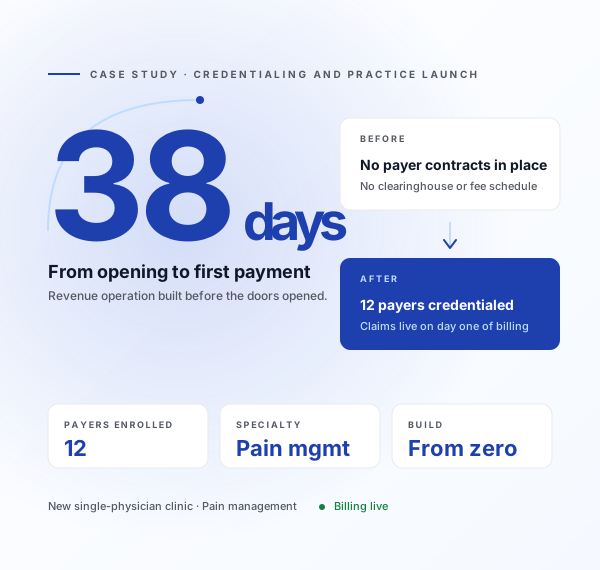
New Pain Management Clinic Collects Its First Insurance Payment 38 Days After Opening
Service
Credentialing & EnrollmentIndustry
Interventional Pain MedicineProviders
1 physician (new clinic)Timeline
Under 3 monthsAbout This Project
Most CureMed case studies begin with a practice that already has a revenue cycle, usually a broken one. This engagement started earlier than that. A physician preparing to open a brand-new single-physician pain management clinic engaged CureMed months before the doors opened, with nothing in place: no payer contracts, no clearinghouse connection, no practice management configuration, no fee schedule, and no billing workflow of any kind.
The assignment was to build the entire revenue operation from scratch and have it working before the first patient walked in. That meant credentialing and enrollment across 12 payers, clearinghouse and practice management setup, a defensible fee schedule, an eligibility and prior authorization workflow suited to interventional pain procedures, and first claim submissions timed carefully to each payer's enrollment effective dates.
The outcome that matters most to any new practice owner is simple: when does the first real dollar arrive? For this clinic, the first insurance payment received 38 days after opening confirmed that the infrastructure worked end to end, from patient registration through eligibility, coding, claim submission, and remittance. All 12 payers credentialed through the engagement moved from application to active billing status without a single application being returned for missing or inconsistent information.
For physicians researching pain management billing services while planning a launch, this case study walks through what the build actually involved, why new practices so often stall financially in their first months, and what made this launch different.
The Challenge: Starting a Medical Practice with No Revenue Infrastructure
Starting a medical practice is one of the most demanding transitions in a physician's career, and the revenue side is consistently the part that gets started too late. The clinical preparation is familiar territory. The administrative machinery behind getting paid is not, because employed physicians almost never see it. Health systems handle credentialing centrally, billing happens in a department the physician never visits, and the entire apparatus stays invisible until the day it has to be built from nothing.
Three structural problems make new practice launches financially risky.
Credentialing timelines cannot be compressed by effort alone
Payer credentialing verifies a physician's licensure, malpractice coverage, training, and practice history before the payer will treat the physician as in-network and pay claims at contracted rates. Commercial payer credentialing commonly takes 90 to 120 days, and some payers take longer. Medicare enrollment runs through PECOS on its own timeline, and state Medicaid programs each maintain separate portals with their own documentation demands. None of these clocks start until a complete application is received, and an incomplete application does not save time, it loses time, because payers routinely pause or restart review when they have to request corrections.
A physician who signs a lease and then begins credentialing has already committed to a period of seeing patients without the ability to bill most of them in-network. Rent, staff salaries, and malpractice premiums do not wait for payer committees.
Credentialing approval is not the same as billing readiness
Even after a payer approves a provider, claims do not flow on their own. The practice needs a clearinghouse connection that has been enrolled and tested with each payer, electronic remittance advice (ERA) enrollment so payments post into the practice management system, and electronic funds transfer (EFT) enrollment so money lands in the bank rather than in paper checks. Each of these has its own paperwork and processing window. Practices that treat them as an afterthought discover a second waiting period hiding behind the first one.
Pain management draws extra payer scrutiny
Interventional pain is not credentialed like a routine office-based specialty. Payers look harder at DEA registration, board certification, and the planned service mix because the specialty combines controlled substance management with high-cost procedures such as nerve blocks, radiofrequency ablation, and spinal cord stimulation. Coverage policies for these procedures are detailed and change regularly, and many of them require prior authorization on every case. A pain clinic that launches without a working authorization process will generate denials from its very first procedure day.
Taken together, these constraints define the problem CureMed was hired to solve: sequence a large volume of interdependent administrative work so that nothing sits idle, nothing gets submitted incomplete, and the practice opens with a functioning revenue engine rather than a stack of pending applications. It is the same discipline that drives effective revenue cycle management in an established practice, applied here before a single encounter existed.
Building the Revenue Operation Before Opening Day
CureMed structured the engagement as parallel tracks rather than a sequence. Credentialing, clearinghouse setup, and fee schedule work all began in the first week, because each track had external waiting periods that could overlap instead of stacking.
A verified data foundation
The first days of the engagement went into building a complete, source-verified provider profile: medical education and training, every state license, DEA registration, board certification, full malpractice policy history, NPI records and taxonomy codes, plus the practice-level details of tax identification, business structure, and service address. Every element was checked against primary sources before anything was submitted anywhere. A mismatch as small as a name spelled differently on a license than on an application can add weeks to a payer's review, so the cheapest place to catch discrepancies is before submission, not after a payer flags them.
The 12-payer credentialing campaign
With the profile locked, CureMed's provider credentialing services team prepared and submitted applications across all 12 target payers, selected with the physician based on the local market: Medicare, the state Medicaid program, the dominant regional commercial carriers, and the managed care organizations with the strongest employer-sponsored presence in the area. The team at CureMed's medical credentialing service built each application to the individual payer's format rather than recycling one template, because submission channels genuinely differ: some payers pull from the CAQH profile, some require proprietary portals, and Medicare enrollment runs through PECOS with its own forms for the individual physician and the practice entity.
Medicare and Medicaid went in earliest precisely because they tend to run longest. Every commercial application then went into a proactive follow-up cadence, with a coordinator checking status on a fixed schedule. Follow-up does not make payers review faster, but it surfaces stalled files and clarification requests early, before they quietly add weeks to the timeline.
Clearinghouse, practice management, and fee schedule build
While applications moved through payer review, the billing infrastructure took shape. CureMed established the clearinghouse account in the first week of the engagement, completed payer-by-payer EDI enrollment, and ran test claims against the planned procedure and diagnosis mix before any live claim existed. Testing confirmed correct routing for each payer, validated provider identifiers in the claim data, and verified that remittance files would post cleanly into the practice management system. Skipping test claims is a common shortcut in new practices, and it is an expensive one, because a configuration error found in production repeats on every claim until someone notices.
The fee schedule was built from the current Medicare Physician Fee Schedule for the clinic's locality, with charges set using standard commercial market conventions for the specialty so that no contracted rate would ever be capped by an artificially low charge. The schedule covered the full planned service mix: evaluation and management visits, the interventional procedure codes, fluoroscopic guidance, and the add-on codes that routinely accompany primary procedures in interventional pain. Charge capture rules, place of service logic, and a modifier decision framework for bilateral and multiple-procedure scenarios were configured directly into the system, so clean claims would be the default output rather than something the front desk had to engineer visit by visit.
ERA and EFT enrollments were filed alongside the credentialing applications for every payer, so that the moment a payer's approval landed, electronic remittance and direct deposit were ready to switch on rather than starting a fresh waiting period.
Eligibility and Prior Authorization for Interventional Pain
For a pain management clinic, eligibility and authorization are not back-office details. They are the difference between a procedure schedule that generates revenue and one that generates denials.
Interventional pain procedures sit near the top of most payers' prior authorization lists. Coverage policies specify which diagnoses qualify, how much conservative treatment must be documented first, and how many repeat procedures a payer will approve in a given period. A claim for a technically perfect procedure still dies if the authorization was never obtained or the policy criteria were not reflected in the documentation.
CureMed built the front-end workflow before opening day so the clinic never had to improvise it:
- Every scheduled patient goes through insurance eligibility checks before the visit, confirming active coverage, plan type, deductible position, and specialist copay, using the same process that powers CureMed's patient eligibility verification service.
- Procedure scheduling triggers an authorization review: staff check whether the planned code requires prior authorization under that patient's plan, and requests are submitted with the clinical documentation the payer's policy actually asks for.
- Approved authorizations are logged against the visit so the authorization number travels onto the claim automatically.
- Documentation prompts, reviewed and approved by the physician before launch, make sure procedure notes capture the elements payer policies look for, such as the medical necessity for fluoroscopic guidance, without dictating clinical judgment.
Because the workflow existed on day one, the clinic's earliest procedure claims went out with valid authorizations attached, which is precisely where new pain practices without support tend to take their first heavy denial losses.
Timing First Claims to Enrollment Effective Dates
The subtlest part of a new practice launch is not getting approved, it is knowing exactly when each payer will actually pay and sequencing claims accordingly.
Payers do not all approve at once. Some commercial carriers confirmed participation relatively quickly; government programs and a few slower carriers took longer, which is normal. CureMed tracked the effective date for every payer as approvals arrived and managed submissions against three rules:
- Bill immediately where active. As each payer's enrollment became effective and ERA was confirmed, that payer moved to active billing status, and claims for its members went out on normal daily cycles with no batching delay.
- Hold and release where retroactive provisions apply. Many payers will pay claims for services performed after the credentialing application date once the approval lands, a provision often described as billing back to the application date. Visits in that window were documented, coded, and queued, then released in a structured sequence as each approval arrived, so that gap-period work converted into revenue instead of write-offs.
- Schedule with the pipeline in mind. During the earliest weeks, the scheduling team steered patients toward payers that were already active where clinically appropriate, and the front desk communicated clearly with patients whose plans were still pending.
This is the discipline that produced the headline result. The clinic opened, saw patients, and submitted claims from the first days of operation instead of accumulating a backlog. The first remittance followed in just over five weeks, a timeline that reflects normal payer adjudication speed applied to claims that were clean, authorized, and routed correctly the first time. CureMed has applied the same sequencing playbook in other launch scenarios, including an urgent care provider enrollment engagement where enrollment timing carried similar financial weight.
Results
The engagement is best measured against what usually happens to new practices: months of unpaid visits, surprise out-of-network denials, and a revenue cycle assembled reactively while clinical volume grows.
| Metric | Result | What changed |
|---|---|---|
| First insurance payment | Received 38 days after opening | The revenue cycle produced cash within weeks of launch instead of the multi-month drought common to new practices |
| Payer network | 12 payers credentialed | Medicare, Medicaid, and the region's major commercial and managed care plans moved from zero contracts to active billing status |
| Billing infrastructure | Live and tested before opening day | Clearinghouse routing, ERA and EFT enrollment, fee schedule, and charge capture were validated with test claims before any live encounter |
| Front-end workflow | Eligibility and prior authorization operational at launch | Interventional procedures went out with valid authorizations attached, avoiding the denial wave that typically hits new pain practices |
Beyond the table, the qualitative results were what the physician noticed day to day. Claims went out on the same daily rhythm from the first week. Gap-period visits were recovered through retroactive submission as approvals arrived, rather than written off. Denials in the early months stayed low enough to be handled as routine exceptions instead of a crisis project. And the practice never had to divert clinical attention to diagnose a billing system built in a hurry, because the system had been built, tested, and validated before it was needed.
Why It Worked
Three decisions drove this outcome.
First, the work started before opening day. Credentialing timelines are governed by payer processes, not effort, so the only real lever is starting early with complete, verified applications. Every week of pre-opening lead time converted directly into earlier effective dates.
Second, everything ran in parallel. Credentialing, clearinghouse enrollment, ERA and EFT setup, fee schedule construction, and the eligibility and authorization workflow all progressed simultaneously, so no external waiting period stacked on top of another.
Third, the build respected the specialty. Pain management billing has its own coverage policies, authorization burdens, modifier logic, and documentation expectations, and the infrastructure was designed around them from the start rather than patched afterward.
For a physician starting a medical practice, this is the practical takeaway: treat the revenue operation as launch-critical infrastructure with the same lead time as the lease and the equipment. CureMed's credentialing, enrollment, and pain management medical billing services exist to carry that build so the physician's attention stays where it belongs, on the first patients through the door. A new clinic that collects its first insurance payment within weeks of opening is not lucky. It is the predictable result of a revenue operation built properly, before it was needed.
Curious what your revenue cycle is actually leaving on the table?
Spend 30 minutes with our revenue cycle team and we'll walk through your current setup, surface where money is leaking from denials, slow payer follow up, undercoded encounters, and quantify what cleaning it up is worth in your first 90 days. No prep, no slide deck, just a working conversation with people who do this every day.