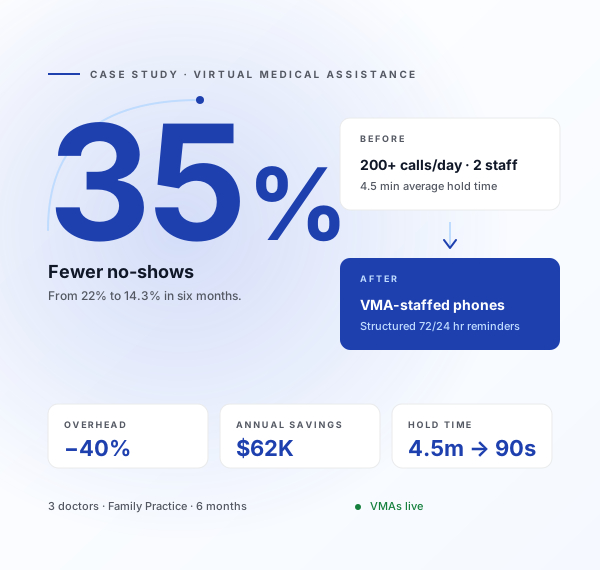
Reducing No-Show Rates by 35% and Cutting Front-Desk Overhead by 40% with Virtual Medical Assistants for a Family Practice 35% fewer no-shows
Service
Virtual Medical AssistanceIndustry
Family MedicineLocations
5Providers
3 doctorsTimeline
3–6 monthsRegion
MidwestAbout This Project
A three-doctor family practice came to CureMed with a problem that will sound familiar to almost any independent primary care group: the phones never stopped, the front desk could not keep up, and appointment slots were going unused because patients simply did not show up.
The numbers told the story clearly. The practice was fielding more than 200 patient calls per day with only two front-desk receptionists. Hold times stretched to 4.5 minutes on average, voicemails piled up, and the no-show rate had climbed to 22 percent. On top of that, the physicians themselves were spending 30 to 45 minutes every day on prescription refills, referral paperwork, and lab-result review, which is administrative work that pulled them directly out of clinical time.
The practice had already considered the obvious fix, hiring more front-desk staff, and ruled it out. Local market rates for experienced medical receptionists made additional in-house headcount unaffordable for a group of that size, and recruiting, training, and retaining front-office staff is a persistent struggle for small practices even when the budget exists.
CureMed was engaged to solve the problem a different way: by deploying trained virtual medical assistants (VMAs) who could absorb the phone volume, own the scheduling and reminder workflow, and take the routine administrative tasks off the physicians' plates. Within six months, the engagement produced a 35 percent reduction in no-shows, phone wait times under 90 seconds, and roughly $62,000 per year in front-desk labor savings.
This case study walks through what the practice was up against, how the virtual medical assistant program was structured, and why the results held up over time.
The Challenge: A Front Desk Stretched Past Its Limit
Family practices sit at the high-volume end of ambulatory care. Short visits, frequent follow-ups, and a broad patient panel mean the front office handles an enormous amount of communication relative to the size of the clinical team. When that communication layer breaks down, the damage shows up everywhere: in patient satisfaction, in physician time, and ultimately in revenue.
For this practice, the strain showed up in four distinct ways.
Call volume the team could not absorb
Two receptionists handling 200-plus calls a day works out to a call every few minutes per person, all day long, on top of checking patients in and out, collecting copays, verifying demographics, and managing the schedule. During peak hours, calls rolled to voicemail, and voicemails were not returned in a timely manner. Patients regularly complained that they could not reach the office at all. Some of those frustrated callers were trying to confirm, reschedule, or cancel appointments, which fed directly into the no-show problem.
A 22 percent no-show rate
More than one in five booked appointments ended with an empty exam room. For a three-physician practice, that is a meaningful revenue leak: the overhead of the visit slot, including staff time, facility costs, and physician availability, is spent whether or not the patient arrives. No-shows also disrupt continuity of care, since the patients most likely to miss appointments are often the ones who most need consistent follow-up.
Physicians doing administrative work
The doctors were personally spending 30 to 45 minutes each day on prescription refill requests, referral coordination, and lab-result review. Much of that work does not require a physician's judgment at every step. Refill requests need to be gathered, verified against the chart, and queued for approval. Referrals need paperwork assembled, records sent, and appointments tracked. When physicians do the clerical portion themselves, the practice is paying its highest-cost clinicians to do its lowest-complexity work.
No room in the budget for more staff
The conventional answer to all of the above is to hire. But front-desk overhead is one of the largest fixed administrative costs in a small practice, and each additional full-time employee brings salary, benefits, payroll taxes, training time, and turnover risk. The practice needed more administrative capacity without the cost structure of more in-house headcount, and it needed that capacity to flex with call volume rather than sit idle during slow periods.
These operational problems also had a downstream financial dimension. Missed calls and rushed check-ins lead to incomplete insurance information, and incomplete insurance information leads to denied claims. Front-office breakdowns are one of the most common root causes of avoidable denials in medical billing, which meant the practice's phone problem was quietly becoming a billing problem too.
The Solution: Virtual Medical Assistant Services Built Around the Practice
CureMed's answer was a dedicated team of virtual medical assistants working as a remote extension of the practice's front office. The engagement was built through CureMed's virtual medical assistant services, but the important design decision was that the VMAs were not treated as a generic call center. They were trained, supervised, and integrated as if they were practice employees who happened to work remotely.
Training on the practice's own systems
Before taking a single call, the VMAs were fully trained on the practice's EHR and on its scheduling and communication policies. That meant they could see the same schedule, the same patient records, and the same task queues as the in-house team. It also meant they answered the phone the way the practice wanted its phone answered, with the practice's greeting, its escalation rules, and its documentation standards. A virtual medical assistant is only as effective as their integration into the practice's workflows, so this onboarding phase was treated as the foundation of the entire program.
A defined scope of ownership
The VMAs took full ownership of a specific set of administrative functions rather than acting as overflow help:
- Inbound and outbound patient calls. The VMAs became the first line for the phone, answering inbound calls during business hours and making outbound calls for confirmations, follow-ups, and callbacks on voicemails.
- Appointment scheduling. New appointments, reschedules, and cancellations were handled directly in the EHR's scheduling module, following the practice's booking rules for visit types and provider preferences.
- Insurance pre-authorization. The VMAs prepared and submitted pre-authorization requests and tracked them to resolution, so patients arrived with coverage questions already answered. This is the same discipline that drives effective patient eligibility verification: confirming coverage and authorization requirements before the visit, not after the claim is denied.
- Referral management. Outgoing referrals were assembled, transmitted, and tracked by the VMAs, including the record-gathering and status follow-up that had previously landed on the physicians.
- Prescription refill coordination. Refill requests were collected, verified against the chart, and queued for physician approval, cutting the clerical portion of the task out of the doctors' day.
Restoring physician time
Moving referral management and refill coordination to the VMAs directly recovered the 30 to 45 minutes per day each physician had been losing to administrative work. That time went back into patient care, and just as importantly, it went back into on-time schedules. Physicians who are not stepping out between visits to chase paperwork run their sessions closer to plan, which improves the patient experience and keeps the day's capacity intact.
Relieving the in-house team
The two in-house receptionists did not lose their jobs to the VMAs; they were finally able to do their jobs. With the phone volume absorbed remotely, the on-site team could focus on the in-person work that genuinely requires physical presence: greeting patients, managing check-in and check-out, collecting payments, and handling walk-in questions. The front desk went from a bottleneck to a functioning part of the visit workflow.
The Reminder Cadence That Reduced Patient No-Shows
The single biggest driver of the no-show improvement was not any one technology. It was a structured, multi-touch reminder cadence executed consistently by the VMA team.
The cadence worked in three steps:
- 72 hours before the appointment: the patient received a text message and an email reminder with the appointment details and simple instructions to confirm, reschedule, or cancel.
- 24 hours before the appointment: a second text and email went out to every patient who had not yet responded.
- Personal call to unconfirmed patients: any patient who still had not confirmed after the automated touches received a personal phone call from a virtual medical assistant.
That third step is where most practices fall short, and it is where this program separated itself. Automated reminders are cheap to send and easy to ignore. A live phone call is neither. When a VMA reached an unconfirmed patient, three useful things could happen. The patient confirmed, and the slot was secure. The patient needed to reschedule, and the VMA rebooked them on the spot instead of letting the slot die as a silent no-show. Or the patient canceled outright, and the practice now had advance notice to fill the opening from its waitlist.
In every one of those outcomes, the practice ends up better off than with an unconfirmed appointment. The cadence effectively converted no-shows, which are pure loss, into confirmations, reschedules, and backfillable cancellations, which are all recoverable.
Two practical details made the cadence sustainable. First, because the VMAs were already handling outbound calling as part of their core scope, the confirmation calls did not require new staff or overtime; they were absorbed into existing capacity. Second, because the VMAs worked inside the practice's EHR, every confirmation, reschedule, and cancellation was documented in real time, so the in-house team always saw an accurate schedule.
For any practice trying to reduce patient no-shows, the underlying lesson is that cadence and follow-through matter more than the messaging channel. Texts and emails do the inexpensive first pass; a human phone call closes the gap that automation leaves behind.
Results: Fewer No-Shows, Faster Phones, Lower Front-Desk Overhead
The engagement produced measurable improvement across all three problem areas in under six months.
| Metric | Result | What changed |
|---|---|---|
| No-show rate | 22% down to 14.3% (a 35% reduction) | Three-step reminder cadence: text and email at 72 and 24 hours, then a personal VMA call to unconfirmed patients |
| Average phone wait time | 4.5 minutes down to under 90 seconds | VMAs absorbed inbound call volume as the first line for the phones |
| Front-desk labor cost | Roughly $62,000 saved per year (a 40% reduction in administrative overhead) | Virtual medical assistant coverage replaced the need for additional in-house hires |
| Physician administrative time | 30-45 minutes per day returned to clinical work | VMAs took ownership of refill coordination, referrals, and pre-authorization legwork |
Each metric reinforces the others. Faster phone response made it easier for patients to confirm and reschedule, which supported the no-show reduction. Fewer no-shows meant fewer wasted slots and steadier daily revenue. And because the added capacity came from virtual medical assistant coverage rather than new employees, the practice cut its front-desk overhead by 40 percent, worth roughly $62,000 a year, while its service levels improved rather than degraded.
It is worth underlining what the no-show number means financially. A drop from 22 percent to 14.3 percent means that for every 100 booked appointments, roughly eight additional patients now arrive as scheduled. For a three-physician family practice booking high visit volumes week after week, recovered appointment slots compound into significant annual revenue, and they do so without adding a single new patient to the panel. Filling slots the practice had already booked is among the most efficient forms of revenue cycle improvement available, because the cost of acquiring those visits was already paid.
What Practice Owners Can Take From This
The specifics of this engagement belong to one family practice, but the pattern generalizes. A few takeaways stand out for practice owners and administrators evaluating similar problems.
- Diagnose before hiring. This practice's instinct was to add front-desk staff. The actual constraints were phone capacity, reminder follow-through, and misallocated physician time, and none of those required an in-house hire to fix.
- Give remote staff real ownership. The VMAs succeeded because they owned complete workflows, including scheduling, pre-authorization, referrals, and refills, inside the practice's own EHR. Overflow-only arrangements, where remote staff handle whatever spills over, rarely produce this kind of change.
- Treat no-shows as a process problem. A 22 percent no-show rate is not a patient behavior problem to be tolerated; it is a follow-up process waiting to be built. Layered reminders with a human final touch consistently outperform automation alone.
- Front-office health protects the back office. Accurate scheduling, verified coverage, and completed pre-authorizations flow downstream into cleaner claims and fewer denials, which is why front-office operations are inseparable from revenue cycle management as a whole.
- Administrative relief is a physician retention tool. Returning 30 to 45 minutes a day to each physician is not just a productivity gain. Administrative burden is a leading contributor to physician burnout, and reducing it makes the practice a better place to work.
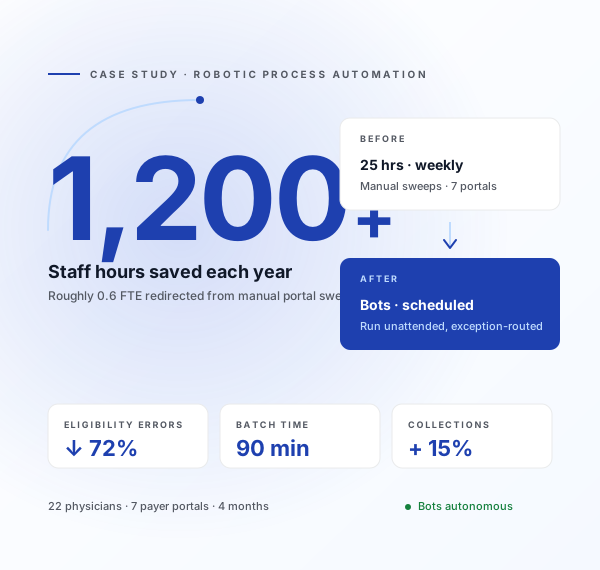
Practices whose bottleneck is data-entry volume rather than phone volume can pair human VMAs with software automation; CureMed documented that approach in a related engagement covering RPA for eligibility checks and claims processing.
Why It Worked
This engagement worked because it matched the right kind of capacity to the right kind of work. The practice did not need another body at the front desk. It needed reliable phone coverage, a disciplined reminder process, and someone to own the administrative tasks that were consuming physician time. Trained virtual medical assistants provided all three at a fraction of the cost of in-house hiring.
The results speak plainly: a no-show rate down from 22 percent to 14.3 percent in under six months, phone waits cut from 4.5 minutes to under 90 seconds, and about $62,000 a year in front-desk labor savings, which amounts to a 40 percent reduction in administrative overhead. None of it depended on exotic technology. It depended on trained people, clear workflows, and consistent execution inside the practice's own systems.
CureMed's virtual medical assistant services give practices a low-cost path to that kind of administrative support without adding internal headcount. For any practice weighed down by call volume, no-shows, or front-desk overhead, this case demonstrates that the fix can be operational rather than structural, and that it can pay for itself quickly.
Curious what your revenue cycle is actually leaving on the table?
Spend 30 minutes with our revenue cycle team and we'll walk through your current setup, surface where money is leaking from denials, slow payer follow up, undercoded encounters, and quantify what cleaning it up is worth in your first 90 days. No prep, no slide deck, just a working conversation with people who do this every day.