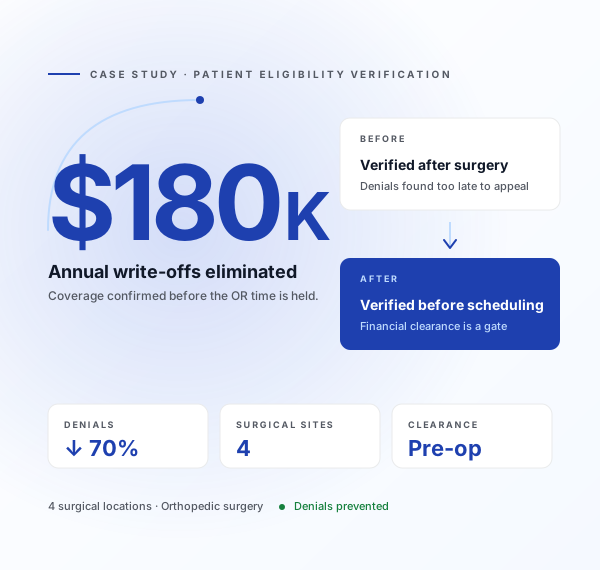
Pre-Surgery Eligibility Verification Eliminates Roughly $180,000 in Annual Write-Offs
Service
Patient Eligibility VerificationIndustry
General OrthopedicsLocations
4 surgical locationsTimeline
3–6 monthsAbout This Project
An orthopedic surgery group operating 4 surgical locations came to CureMed with a revenue problem that had nothing to do with the quality of its clinical work. The group had no reliable process for validating patient insurance coverage before surgery. Cases were scheduled, procedures were performed, and claims went out the door before anyone had confirmed that the patient's plan was still active, that the procedure was a covered benefit, or that the required authorization remained valid. When payers denied those claims, the practice had no realistic recourse. The care had already been delivered, and the revenue was already gone.
CureMed, which provides orthopedic billing and revenue cycle support for surgical practices across the United States, designed a pre-surgery patient insurance eligibility verification program for the group. The program rested on three commitments: a real-time eligibility check for every scheduled case, confirmation of benefits and prior authorization before any scheduling hold was finalized, and a defined escalation path for cases where payer responses came back incomplete or inconclusive.
The results were direct and measurable. The program eliminated roughly $180,000 in annual write-offs and reduced eligibility-related denials by 70%.
At a glance:
- Client: orthopedic surgery group, 4 surgical locations
- Problem: no dependable pre-surgery insurance validation, producing post-procedure denials the practice could never collect
- Solution: a pre-surgery insurance eligibility verification program with real-time checks, benefit and authorization confirmation before scheduling holds, and structured escalation for unclear results
- Outcome: roughly $180,000 in annual write-offs eliminated, and eligibility-related denials reduced by 70%
The Challenge: Denials That Arrived After Surgery Was Done
Orthopedic surgery sits at the expensive end of both outpatient and inpatient care. Joint replacements, spinal procedures, rotator cuff repairs, and ligament reconstructions each carry facility, surgeon, anesthesia, and implant costs that routinely reach five figures per case. That cost profile changes the math on every billing failure. In lower-cost specialties, a denied claim is usually a nuisance that gets corrected and resubmitted. In surgical care, a claim denied because the patient's coverage was never valid on the date of service is frequently a total loss.
That was the pattern this group kept living through. A patient would be seen in consultation, a procedure would be recommended, and the case would be scheduled weeks out. On the day of surgery, the clinical team performed exactly as planned. Then, weeks later, the remittance arrived: coverage terminated, benefit not covered under the current plan, authorization expired, patient not eligible on the date of service. Whatever the specific denial language, the practical meaning was the same. The payer would not pay, the patient usually could not, and the balance moved to write-off.
These losses behaved differently from ordinary aged receivables. An old claim with a fixable error can often be rescued through disciplined A/R recovery work: corrected, appealed, resubmitted, and eventually paid. An eligibility failure discovered after surgery offers no such path. There is no valid coverage to appeal to. The billing team could document, call, and escalate all it wanted; the money was simply not collectible.
Because the group operated four surgical locations, the problem also hid well. No single site produced enough of these denials to look like a crisis on its own. Each location wrote off a handful of cases and moved on. Only when leadership reviewed denial patterns across the whole organization did the scale become clear: the combined annual write-off from eligibility failures had grown into six figures, and it was recurring every year like a fixed cost.
There was a quieter operational cost as well. Billing staff spent a substantial share of each week working denials that were never winnable, drafting appeals for claims with no coverage behind them, and fielding frustrated calls from patients who had received balances they did not expect. The effort produced almost nothing, and it crowded out work on claims that genuinely could be recovered.
Where the Process Was Breaking Down
Before proposing a fix, CureMed's team mapped the group's scheduling and billing workflow from first consultation through claim submission. The review surfaced four structural gaps. None of them reflected careless staff. All of them reflected a process that had never been designed for surgical lead times.
Verification happened once, weeks too early
The front desk checked insurance at the initial consultation, which is standard practice in medical offices of every kind. The problem was what happened next: nothing. Surgical cases are commonly scheduled six to twelve weeks out, and coverage is anything but stable across a window that long. Patients change employers, employers change carriers, plans terminate for nonpayment, dependents age off policies, and Medicaid eligibility lapses. A check performed at consultation says very little about coverage status on the day of surgery, yet that early check was the only one the group performed.
Surgery pre-authorization was treated as one-and-done
Surgery pre-authorization is among the strictest requirements in orthopedics. Most major procedures need payer approval before they are performed, and those approvals carry expiration dates, specific procedure codes, and site-of-service terms that must match the claim exactly. The group's staff obtained authorizations diligently, then filed them and moved on. Nobody rechecked an authorization against the actual surgery date, so approvals that had quietly expired, or that no longer matched a rescheduled procedure, went unnoticed until the denial arrived.
Four locations, four informal workflows
Eligibility verification in medical billing only works when it is somebody's explicit job. At this group, verification, scheduling, and authorization tracking were split among different staff members at each of the four locations, and each site had developed its own informal habits. There was no shared standard, no checklist, and no named owner. When a step was skipped, everyone reasonably assumed someone else had handled it.
Nobody could see the exposure
Leadership had no forward view of the financial risk sitting on the surgical schedule. Eligibility problems surfaced only in remittance data, weeks after procedures were performed, when nothing could be done about them. As with many gaps in medical billing operations, the cost was being measured in hindsight instead of managed in advance.
The Solution: Pre-Surgery Insurance Eligibility Verification
CureMed's recommendation rested on a simple principle: the only useful time to discover a coverage problem is before the procedure, while the practice can still act on it. The team built the group a mandatory pre-surgery verification program through CureMed's patient eligibility verification service, applied uniformly to every case at all four locations.
Real-time checks against payer systems
Instead of relying on staff to log into individual payer portals, CureMed ran insurance eligibility verification through direct electronic transactions with payers. Every scheduled case was checked in real time in the days leading up to the procedure, close enough to the surgery date that the answer reflected current coverage rather than a snapshot from weeks earlier. Each check confirmed that the policy was active, that the scheduled procedure was a covered benefit under the patient's current plan, and where the patient stood on deductible, copay, and out-of-pocket obligations. Removing the manual portal work mattered as much as the data itself: when verification is slow and tedious, it gets skipped under schedule pressure, and this group's schedules were always under pressure.
Benefits and authorization confirmed before scheduling holds
The program moved verification upstream of the operating room calendar. Before a scheduling hold was finalized, benefits for the specific procedure had to be confirmed and any required surgery pre-authorization had to be verified as current, unexpired, and matched to the correct procedure code and site of service. If a case was rescheduled, the authorization was rechecked against the new date. In effect, financial clearance became a condition of holding OR time rather than an afterthought that trailed behind it.
Escalation for inconclusive results
Payer responses are not always clean. Some come back incomplete, some conflict with what the patient reported, and some flag pending plan changes that have not yet taken effect. Rather than letting ambiguous cases drift toward the surgery date, the program defined a firm escalation path. Any inconclusive result was routed to a designated CureMed specialist who contacted the payer directly, resolved the discrepancy, and documented the outcome. Cases that could not be cleared were flagged back to the practice, which could then reschedule, secure an updated authorization, or arrange a self-pay agreement with the patient before the procedure took place.
A documented, auditable trail
Every eligibility response, benefit confirmation, and authorization check was recorded with a timestamp in the patient's account. When a payer later questioned a claim, the practice could point to documented proof of the coverage confirmation it had received before surgery. That record strengthened appeals in the rare disputes that still arose, and it gave leadership confidence that the checkpoint was actually being completed, not just assumed.
Implementation Across Four Surgical Locations
Rolling out a mandatory verification checkpoint in a busy surgical group is as much an operational change as a technical one, and CureMed treated it that way.
The engagement began with workflow mapping at each location, documenting who touched a case from consultation to claim submission and where the handoffs failed. The findings shaped a single standardized workflow that replaced the four informal ones, with clear ownership built in: at each site, a named coordinator became accountable for confirming that every case on the upcoming surgical schedule had completed verification before it reached the OR.
CureMed trained front-office and billing staff on the new checkpoint, including the harder conversations it would sometimes require: telling a patient that coverage had lapsed, walking through updated benefit details, or discussing self-pay terms before surgery rather than sending a surprise balance afterward. Shared scripts and checklists kept those conversations consistent from one location to the next, so a patient heard the same explanation regardless of which site handled the case.
The rollout was phased deliberately. The first location served as the pilot, where edge cases were worked through and the escalation process was tuned against real payer behavior. The refined workflow was then extended to the remaining sites, each starting from a process that had already been tested rather than a theory. Alongside the rollout, CureMed delivered reporting that gave practice leadership a forward view it had never had: which upcoming cases were verified, which were pending, and which were flagged, along with the estimated dollar value at stake in each column. Eligibility management shifted from a retrospective accounting exercise to a daily operating discipline.
Results
The change in the group's denial pattern was visible within the first full quarter of the program and held steady afterward. Coverage problems did not disappear; patients still switched plans mid-year and authorizations still aged toward expiration. What changed is where those problems surfaced. They now appeared on a work queue before surgery, while the practice could still reschedule, renew an authorization, or set financial expectations with the patient, instead of appearing on a remittance after the revenue had already become unrecoverable.
| Metric | Result | What changed |
|---|---|---|
| Annual write-offs from eligibility failures | Roughly $180,000 eliminated | Coverage issues were caught before surgery, while the practice could still act |
| Eligibility-related denials | Reduced by 70% | Real-time checks plus benefit and authorization confirmation before scheduling holds |
| Verification consistency | One standard across 4 locations | A named owner and a mandatory checkpoint replaced informal site-by-site habits |
| Patient financial conversations | Moved ahead of surgery | Accurate benefit details supported upfront estimates and point-of-service collections |
Beyond the headline numbers, the group saw operational gains that compounded over time. Billing staff spent far less of the week appealing denials that were never winnable and redirected that time toward claims that genuinely needed attention. Point-of-service collections improved because patients arrived understanding their cost-sharing responsibility instead of discovering it on a statement. And the surgical schedule itself became more dependable: cases that would previously have produced unpayable claims were identified and resolved in advance, so OR time was spent on procedures the practice would actually be paid for.
Why It Worked
Three decisions made this engagement succeed where informal fixes had failed before.
First, the program verified at the right moment. Checking coverage at consultation is easy and nearly useless for surgical cases; checking in the days before the procedure is what actually protects revenue. For this group, the timing of insurance eligibility verification mattered more than any individual tool.
Second, verification became a gate rather than a suggestion. Tying benefit and authorization confirmation to scheduling holds meant the checkpoint could not be skipped under schedule pressure, which is precisely when it had been skipped in the past.
Third, ambiguity had an owner. Most eligibility failures do not come from checks that were never run; they come from unclear results that nobody chased down. The escalation path gave every inconclusive payer response a named person and a deadline, so uncertainty was resolved before the patient reached the OR instead of after.
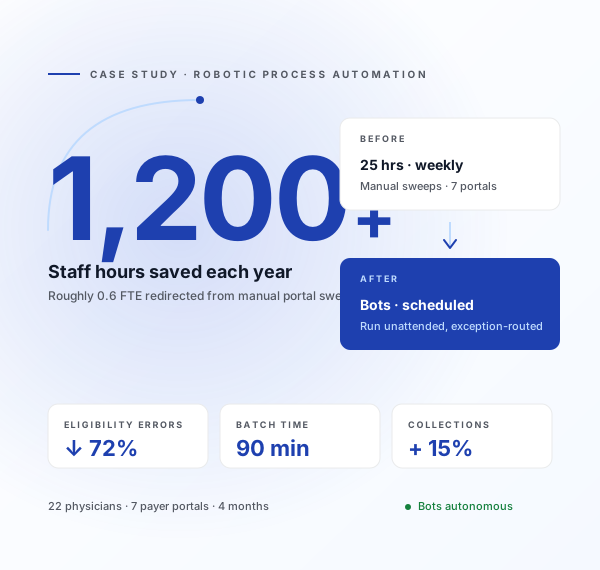
None of this required exotic technology. It required a specialty-aware process, applied without exceptions, by a team accountable for the outcome. That is the model behind CureMed's patient eligibility verification service, and it scales well beyond orthopedics: the same discipline drives engagements like CureMed's RPA-driven eligibility and claims automation project, where verification logic was automated for even higher claim volumes.
For surgical practices, the lesson is blunt. Every case that reaches the operating room without verified coverage is a gamble with five-figure stakes. A structured pre-surgery verification program turns that gamble into a routine administrative step, and the return, as this orthopedic surgery group found, shows up directly on the bottom line.
Curious what your revenue cycle is actually leaving on the table?
Spend 30 minutes with our revenue cycle team and we'll walk through your current setup, surface where money is leaking from denials, slow payer follow up, undercoded encounters, and quantify what cleaning it up is worth in your first 90 days. No prep, no slide deck, just a working conversation with people who do this every day.