Postpartum AR Down to 18 Days: Global Maternity Billing Rebuilt for a 5-Physician OB/GYN Group
Service
Revenue Cycle ManagementIndustry
OB/GYN BillingProviders
5 physiciansTimeline
3–6 monthsRegion
Mid-AtlanticAbout This Project
A 5-physician OB/GYN practice in the Mid-Atlantic came to CureMed with a problem that most obstetric groups will recognize. The clinical side of the practice was healthy: full prenatal schedules, steady delivery volume, and a busy gynecology calendar alongside it. The billing side told a different story. Global maternity billing had become a source of constant friction, and nobody could say with confidence which pregnancy episodes were open, which services belonged inside the global obstetric package, or why delivery claims kept stalling at the payer. Postpartum accounts receivable dragged on long after patients had finished their care, and the team spent more time reconstructing episodes after the fact than managing them as they unfolded.
CureMed took over the practice's revenue cycle with a specific mandate: rebuild the global OB workflow from end to end. That meant establishing episode tracking from the first prenatal visit, drawing a clean line between global and non-global services, tightening delivery claim submission, and putting disciplined follow-up behind every claim that aged without payment. The engagement drew on the same playbook CureMed applies across its OB/GYN billing services, tuned to this group's payer mix and clinical workflows.
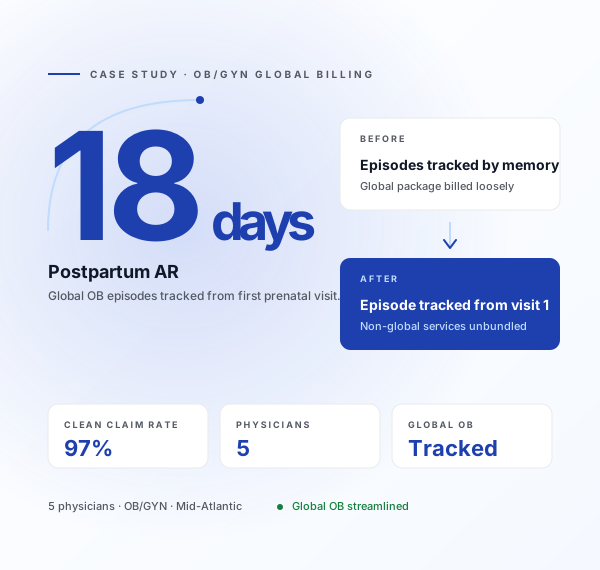
Two outcomes anchor this case study: postpartum AR reduced to 18 days, and a 97% clean claim rate across the practice's claim volume. Neither came from a single clever fix. Both came from treating each pregnancy as a managed billing episode rather than a loose collection of encounters. The sections below explain what was breaking, what CureMed changed, and why the changes held once the initial cleanup was done.
Why Global Maternity Billing Is Hard to Get Right
Most physician billing follows a simple rhythm: the patient is seen, the visit is coded, the claim goes out, and payment follows within weeks. Obstetrics breaks that rhythm. The global obstetric package bundles antepartum care, the delivery itself, and routine postpartum care into a single claim, typically submitted after the postpartum visit. The episode spans roughly ten months, which means the practice carries the cost of care for the better part of a year before the claim that pays for most of it can even leave the building.
What the global obstetric package covers
Under the standard CPT structure, global codes such as 59400 (vaginal delivery with antepartum and postpartum care) and 59510 (cesarean delivery with antepartum and postpartum care) wrap routine prenatal visits, the delivery, and routine postpartum care into one reimbursable unit. Payers layer their own rules on top: how many antepartum visits the package assumes, whether they require notification that a pregnancy is under care, how transfers between providers should be billed, and what documentation supports each delivery type. When a patient receives only part of her antepartum care from one practice, antepartum-only codes such as 59425 and 59426 apply instead, selected by visit count.
Where this practice was losing ground
The practice was not failing at medicine. It was failing at episode management, and the symptoms showed up in four places:
- No reliable episode tracking. There was no single record showing when each pregnancy episode opened, how many antepartum visits had accrued, or when the package was ready to close. Visit counts were reconstructed from the schedule at billing time.
- Bundling errors in both directions. Separately payable services, such as problem visits unrelated to the pregnancy and certain diagnostic services, were being swallowed into the global package and never billed. At the same time, some routine prenatal visits went out as standalone claims that payers denied or flagged as part of the package.
- Stuck delivery claims. Delivery claims routinely sat in edit queues or came back for more information because documentation did not clearly support the specific delivery code billed.
- Postpartum AR drift. Once the final global claim went out, follow-up was ad hoc. Claims aged quietly, and appeals were filed late or not at all.
None of this is unusual. Generalist medical billing processes treat every encounter as its own event, and that model works for most specialties. Obstetrics requires the opposite: a longitudinal view of a single episode that stretches across many months, many encounters, and often more than one provider. Without that view, even a diligent billing team ends up guessing.
Rebuilding Episode Tracking from the First Prenatal Visit
CureMed started with a working audit rather than a report. The team reviewed the practice's open pregnancy episodes and aged receivables, identified claims that were still viable, and separated cleanup work from process work. The cleanup mattered, but the durable change was the episode tracking system built alongside it.
Under the new workflow, a global OB episode record opens at the first prenatal visit, not at delivery. Each record carries the information the billing team needs to manage the episode proactively:
- Coverage confirmed up front. Insurance is verified at the first prenatal visit and rechecked as the pregnancy progresses, because coverage changes during a ten-month episode: patients switch employer plans, Medicaid eligibility shifts, and plan years roll over. CureMed's patient eligibility verification process runs these checks on a set cadence so a coverage change never surfaces for the first time on a denied delivery claim.
- A running antepartum visit count. Every prenatal encounter increments the count, which drives correct code selection when an episode closes early or a patient transfers in or out of the practice.
- An expected delivery window. The record flags when a delivery is approaching, which cues documentation review and payer notification requirements before the claim is ever created.
- Transfer and co-management flags. Patients who transfer in mid-pregnancy, transfer out for high-risk management, or receive co-managed care are flagged at intake so the billing path is decided early instead of debated at delivery.
- Payer-specific rules attached to the episode. Notification requirements, filing deadlines, and package definitions for the patient's specific plan travel with the record.
The practical effect was visibility. For the first time, the practice and CureMed's team could see every open episode, its visit count, its payer requirements, and its expected close date on one worklist, reviewed on a weekly cycle. Problems that used to surface months later as denials now surfaced in real time as flags.
Unbundling the Services That Never Belonged in the Global Package
The second workstream tackled the boundary between global and non-global services, which is where OB/GYN practices quietly lose revenue in both directions.
The global obstetric package covers routine care associated with an uncomplicated pregnancy. It does not cover everything a pregnant patient receives. Services that generally sit outside the package, and are separately billable when documented and coded correctly, include:
- Visits for problems unrelated to the pregnancy
- Diagnostic ultrasounds and fetal non-stress tests
- Laboratory services
- Management of complications that goes beyond routine antepartum care
- Additional visits beyond what the payer's package definition assumes
Before the engagement, a substantial share of these services never generated a claim at all. The encounters were documented, but because the patient was pregnant, the charges defaulted into the global episode and disappeared. The reverse error existed too: routine prenatal visits occasionally went out as standalone evaluation and management claims, which payers denied as included in the package and which created recoupment exposure where they were paid in error.
CureMed addressed the boundary with three changes. First, the team built payer-specific coding guidance defining exactly which services each major payer considers inside and outside its global obstetric package, since definitions vary. Second, charge review rules were added so that any service billed during an open episode is checked against that guidance before submission, catching both missed unbundling and improper separate billing. Third, providers and front-office staff received short, targeted guidance on documenting the reason for each encounter, because a clear diagnosis narrative is what allows a non-global service to stand on its own.
Split-care situations got their own protocol. When a patient transferred in or out mid-pregnancy, the episode record already held the visit count, so the team could select the correct antepartum-only code and support it with documentation instead of defaulting to a full global code and hoping the payer would not look closely.
Clean Delivery Claims and Disciplined AR Follow-Up
Delivery claims were the most visible pain point, and the fixes were unglamorous but effective.
Getting delivery claims out clean
Most of the stuck claims traced back to specificity. Obstetric delivery coding distinguishes between vaginal delivery, primary cesarean, repeat cesarean, and vaginal birth after cesarean, and payers expect the documentation to support the distinction without ambiguity. CureMed worked with the physicians to standardize the delivery documentation so the details coders need, including delivery type and relevant prior obstetric history, are captured consistently at the point of care. Claims are scrubbed against payer edits before submission, and the final global claim is prepared as soon as the postpartum visit is complete rather than waiting for a batch cycle.
The submission discipline matters as much as the coding. Under the new workflow, closing claims go out within days of the postpartum visit, and no episode can silently sit in a completed-but-unbilled state, because the episode tracker surfaces it until the claim is on file.
Working the AR instead of watching it
Postpartum AR had been drifting because nothing forced action on aging claims. CureMed replaced passive aging reports with active work queues: every unpaid claim enters a follow-up cadence with defined touchpoints, payer contact is logged and dated, and denials are categorized by root cause so patterns feed back into the process instead of being appealed one at a time. Older balances that predated the engagement were worked through a structured AR recovery effort in parallel, so legacy receivables did not distort the picture of how the new workflow was performing.
The combination is what moved the number. Claims that go out clean get paid faster, and claims that hit a snag get attention in days instead of months.
The Results
Within the first quarter of the rebuilt workflow, the practice could see the difference in its weekly reports, and the gains held as the new process became routine.
| Metric | Result | What changed |
|---|---|---|
| Postpartum AR | 18 days | Final global claims submitted within days of the postpartum visit and worked on a fixed follow-up cadence |
| Clean claim rate | 97% | Episode tracking, payer-specific package rules, and pre-submission scrubbing on every claim |
| Episode visibility | Every open pregnancy tracked | A single episode record from the first prenatal visit through the closing claim |
| Bundling denials | Substantially reduced | Non-global services billed separately and package claims coded to each payer's definition |
The headline figures deserve context. Postpartum AR reduced to 18 days means the practice now collects on its largest claims, the global delivery claims, in under three weeks on average, where those balances had previously aged for months. For a group that carries the cost of each pregnancy episode for most of a year, shortening the tail on the final claim directly improves cash flow and reduces the working capital the practice needs to operate.
The 97% clean claim rate is the leading indicator behind that AR figure. When nearly every claim passes payer edits and adjudicates on first submission, the follow-up workload shrinks, denials become exceptions rather than a category of work, and the billing team's time shifts from rework to prevention. The practice also saw qualitative gains that do not fit in a table: fewer surprise coverage issues at delivery, fewer requests for records on delivery claims, and far less end-of-quarter archaeology to figure out which episodes were still open.
Why It Worked
Nothing in this engagement required exotic technology. It required treating the pregnancy episode, not the individual encounter, as the unit of billing work, and then building the discipline to manage every episode the same way: verified coverage at the start, a running visit count in the middle, a clean and specific claim at the close, and relentless follow-up after submission.
That framing is what generalist billing operations tend to miss. OB/GYN medical billing punishes improvisation because the global obstetric package stretches a single reimbursement across ten months of care, several payer touchpoints, and multiple opportunities for services to be bundled or unbundled incorrectly. A team that understands those mechanics can design the workflow once and run it consistently. A team that does not will keep rediscovering the same denials.
For this Mid-Atlantic group, the payoff was concrete: postpartum AR reduced to 18 days, a 97% clean claim rate, and a billing operation the physicians no longer have to think about between deliveries. The same approach, specialty-aware processes wrapped in day-to-day operational discipline, is the core of CureMed's revenue cycle management service. Practices that suspect their global maternity billing is leaking revenue usually do not need a bigger billing team. They need an episode-driven workflow and a partner who has already built one.
Curious what your revenue cycle is actually leaving on the table?
Spend 30 minutes with our revenue cycle team and we'll walk through your current setup, surface where money is leaking from denials, slow payer follow up, undercoded encounters, and quantify what cleaning it up is worth in your first 90 days. No prep, no slide deck, just a working conversation with people who do this every day.