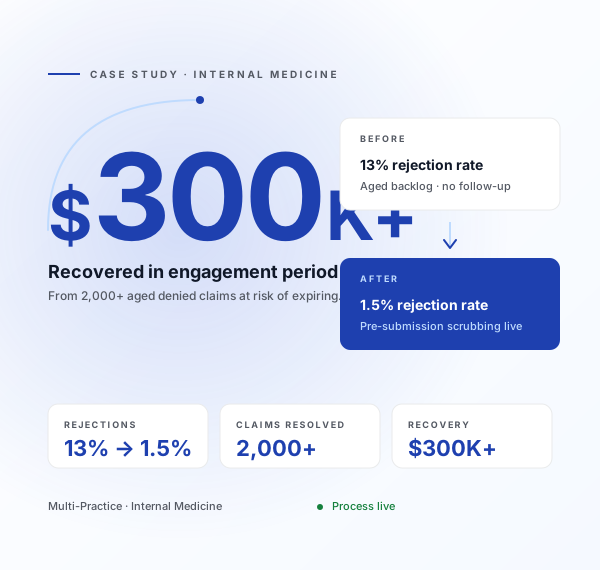
Recovering $300K+ and Cutting Rejections from 13% to 1.5% for an Internal Medicine Practice $300K+ recovered
Service
Medical BillingIndustry
Internal MedicineLocations
11Providers
42Timeline
3–6 monthsRegion
FloridaAbout this engagement
The client is an internal medicine practice serving a wide and diverse patient population in a multi-practice setting. Patients range from those with acute and chronic diseases to healthy individuals requiring general checkups, as well as people with complicated health problems. Internal medicine practices are among the toughest billing environments because of the variety of services involved — annual wellness visits, vaccines, infusions, diagnostics, and more.
Prior to CureMed, this practice was sustaining compounded losses from multiple billing issues that had gone untreated for long periods. Pending denials were accumulating faster than they could be resolved. More than two thousand claims were either rejected or denied and sitting in aging buckets without any follow-up plan. Meanwhile, the underlying causes — incorrect coding, missing data fields, payer setup issues, and ineligibility — were continuing to produce new failures.
CureMed was contracted to conduct a thorough audit and assessment of the revenue cycle and to develop a structured program for remediation and optimization. The process started with a forensic assessment of the practice's coding, claims processing, payer setup, and denials management. This audit provided the foundation for a strategic approach to addressing the backlog of denied claims.
Challenges
The audit exposed problems at every level of the revenue cycle. The issue was not a single mistake but the accumulation of mistakes over time across multiple processes, creating a denial situation that could not be managed without help.
Coding errors across multiple dimensions
Coding mistakes were the most prevalent and costly problem found during the audit. Unlike other issues, these were not isolated to one mistake or one provider — they reflected the absence of any coding control system, which allowed several types of error to coexist within the billing department.
Improper choice of CPT codes was apparent in many claims. In some cases, procedures were billed using codes that fell outside the payer's coverage policies — technically correct per the CPT manual but invalid for billing — resulting in automatic denials.
Errors in unit measurement also contributed. Some procedure codes — especially those for infusions and injectable drugs — require accurate units based on the length or amount of service performed. Inaccurate units caused claims to be rejected for exceeding the allowable maximum, or underpaid when the units billed did not match the units performed.
Modifier usage was inconsistent and often inaccurate. Modifier 59 — which identifies a distinct procedural service that should not be reported separately under routine circumstances — was either omitted when it should have been applied, or appended to claim lines that did not qualify. Modifier JZ — which indicates that there was no drug wastage from a single-use vial — was missing from claims where payers required it. Both gaps generated automatic payer denial edits.
Other errors involved billing multiple CPT codes on the same claim when the services should have been bundled under a single parent code per insurer policy. Without correct modifiers and supporting clinical documentation, these claims were automatically denied. Correction required both a coding review and a documentation review to establish that the services were genuinely distinct.
Missing and incomplete data elements
A considerable number of denials stemmed from missing information that payers needed to determine validity and compliance. Two kinds of missing data had an outsized effect.
The first was the absence of National Drug Code (NDC) numbers on a large number of claims for medication administrations. Insurance carriers covering injectables and infusions need the NDC to confirm that the drug billed matches the procedure code. Without it, claims are automatically denied as incomplete — even if the procedure code and clinical necessity are correct.
The second was missing or incorrect taxonomy codes, which identify the specialty of the billing or rendering physician. Taxonomy codes play an important role in verifying providers in the payer's system. If the taxonomy on the claim does not match the specialist's credentialed specialty, claims are automatically rejected during eligibility and enrollment verification — before medical review even begins. This category of rejection is entirely avoidable with correct system configuration.
Payer selection and credentialing discrepancies
A recurring problem was claims being sent to the wrong payer. In some cases this was due to outdated patient insurance data, incomplete enrollment in payer listings, or the absence of any pre-billing check for payer enrollment. Claims submitted to the wrong payer are automatically rejected, and they have to be rerouted to the correct payer before their eligibility lapses.
Conflicts between taxonomy coding and payer enrollment data also drove denials. When a provider's taxonomy code in the practice management system did not match the specialty designation on file with a given payer, the claim was denied — even when the procedure was coded correctly and was on the payer's coverage list. These denials accumulated because no comparison process between the practice's provider configurations and the payers' enrollments was being run.
Absence of pre-submission eligibility verification
The most structural finding was the failure to verify eligibility before claim submission. Patient insurance status was not consistently checked prior to claims being filed, with far-reaching implications.
Without confirming eligibility before service, the practice had no way to know whether the patient's policy had expired, whether the patient had switched plans, whether the deductible threshold had been reached, or whether prior authorization was required. All of these are easily detectable through eligibility verification — and the failure to do so produced a steady stream of denials.
Billing configuration and provider assignment errors
The audit also surfaced an ongoing problem with how claims were filed in terms of billing configuration. Claims were being submitted under a servicing provider whose contracted rate for those services was lower than the rate of the provider who actually performed the work. In other cases, the facility designation on claims was changed without considering whether the reimbursement rate shifted between facility and non-facility settings.
These billing errors did not always lead to outright denial. Sometimes they produced an underpayment that looked like a legitimate payment unless the contracted rate was compared against what was actually paid. Identifying underpayments requires systematic comparison between reimbursement and contract rates — a step that was missing from the practice's billing process.
Systemic backlog and absence of denial follow-up
Combined, all of the above produced a backlog of more than two thousand denials and rejections that had received no further processing. From a recoverability standpoint, this needed prompt attention before claims hit their timely-filing deadlines. Every payer has its own timely-filing window, and any claim past that deadline cannot be recovered — regardless of merit.
The practice had no structured denial-management process, no infrastructure to address the backlog, and no system to prevent further denials from occurring. Staff were not focused on the recoverability of individual claims or on approaching deadlines. There was no written appeals process, and incoming payer correspondence was not being followed up.
Solutions
In response to the audit findings, CureMed implemented a multi-phase intervention aimed at solving both the existing backlog and the process weaknesses that caused it. Two streams of work ran in parallel: active denial recovery on old claims, and process correction for future claims.
Comprehensive coding review and correction
The first step was a line-by-line review of the rejection backlog to identify the coding issue causing each rejection. This was performed by certified coders with internal-medicine billing experience, working from official coding and reporting guidelines and from each payer's coverage policy.
Non-covered CPT codes were switched to the correct code that satisfied the payer's coverage policy while still describing the true nature of the service performed. Unit measures for all infusions and injections were re-evaluated against the medical record. Modifier 59 was applied wherever documentation supported a distinct procedural service, and modifier JZ was applied to drug-administration claims where a single-dose vial was used.
A two-stage correction process addressed bundling: rejected claims were first reviewed to determine whether the clinical documentation justified reporting the services as separate, independently billable procedures. Where unbundling was justified, the appropriate modifier was appended along with an explanation. Otherwise, the claims were corrected and refiled under the correct billing code.
NDC and taxonomy code integration
Where NDC data was missing, values were entered from the drug-administration documentation that was already linked to the encounter record. Procedures were put in place to make NDC entry a mandatory step in charge entry for any drug administration or infusion.
For taxonomy mismatches, the provider configuration in the practice billing software was compared against each payer's enrollment database. Where there were differences, the taxonomy code was corrected in the billing software and claims were resubmitted. Where the payer's database held outdated provider information, CureMed contacted the payer's provider relations department directly to verify and correct the credentialing record.
Payer information correction and claim rerouting
Each claim filed to the wrong payer was identified, corrected using updated patient eligibility information, and resent to the right payer. This work was time-sensitive — claims approaching their filing deadline at the correct payer were prioritized.
Where network status was unclear — for example, when a provider's network status had changed or a payer's network had been reorganized — CureMed contacted the payer's provider relations department directly to confirm in-network status and justify resubmission of claims that had been denied for network reasons.
Implementation of pre-submission eligibility verification
A mandatory eligibility verification process was instituted at scheduling and intake. Insurance coverage is now verified electronically when a visit is scheduled and again on the day of service. Each verification result is recorded in the patient's account, creating an audit trail that can be referenced at submission and used to support an appeal if a claim is later denied for eligibility reasons.
Verification was set up to surface specific coverage considerations — deductibles, coordination-of-benefits requirements, prior-authorization requirements, and plan types that affect billing-provider selection. Identifying these conditions before service lets the provider address them with the patient and the payer in advance, preventing denials.
Billing practice optimization and provider configuration review
The billing-provider configuration was examined and adjusted against the practice's payer contracts to ensure each claim was billed under the configuration that produced the highest contracted reimbursement. Where claims had been under-billed because of an inaccurate billing-provider configuration, those claims were rebilled under the correct configuration with supporting documentation.
Plan-type distinctions — particularly between PPO and other plan types — were reviewed against payer fee schedules to confirm that billing matched the plan type most advantageous to the practice given its current contracts. Where documentation and circumstances justified a different plan type, the change was made and its effect monitored.
Aggressive backlog recovery campaign
The 2,000+ denied or rejected claims were processed against two factors: proximity to timely-filing deadline, and dollar value. Claims at immediate risk of going beyond a payer's filing limit were prioritized so their reimbursement eligibility was not lost. Within each filing-deadline tier, claims were sorted by value.
Each claim was reviewed, resolved according to the appropriate remediation path identified in the audit, and refiled. Where formal appeal was required, an appeals letter was drafted and sent through the payer's specific appeal channel. Outcomes were monitored, and where a payer upheld a denial without valid grounds, the claim was escalated to peer-to-peer review or, where appropriate, to a state insurance commissioner complaint.
System configuration updates and process standardization
Alongside fixing individual claims, CureMed addressed the system weaknesses that had produced them. Payer settings within the practice management software were reviewed and updated for current payer-enrollment information, correct taxonomies, and accurate fee schedules. Pre-submission claim edits were configured to flag categories of error — missing NDCs, modifier misuse, bundling problems — before the claim left the practice's system, providing a quality check that let billing staff catch errors themselves rather than waiting for a payer rejection.
Standard operating procedures were developed for the processes most prone to error: verifying patient insurance, recording NDCs, applying modifiers to infusions and injections, and prioritizing denial follow-up.
Key deliverables and impact
The interventions produced results across multiple aspects of the revenue cycle.
Coding accuracy and compliance
All claims in the denial backlog due to coding errors were evaluated, updated, and resubmitted with accurate CPT codes, proper modifiers, and the necessary data elements. Corrections were not just one-off fixes — each was annotated with the type of error and the applicable coding guideline, building a reference set the team could use to prevent repeat mistakes.
Modifier application was standardized across the practice's most-billed procedures. Infusions, drug administrations, and the procedures with the worst modifier track record were flagged as high-risk, and the modifiers required by each payer's coverage policy were added to the billing team's reference materials.
Complete resolution of the denial and rejection backlog
All 2,000+ claims in the backlog were processed — appealed, written off with rationale, or resubmitted with corrections. No claim was closed without a documented status. The exercise not only recovered aged liability and revenue previously lost to implicit write-off; it also produced an inventory of denials that informed software configuration and process changes designed to prevent backlogs from accumulating again.
Eligibility verification infrastructure
The eligibility verification system was built into the practice's scheduling and intake workflow. The infrastructure consists of electronic eligibility inquiry integration, documentation of verification outcomes, and a process for communicating with patients or payers when coverage requires further investigation before the date of service. This is a permanent enhancement — its effect will continue to compound long after the engagement.
Revenue cycle reporting and performance monitoring
The engagement introduced systematic monitoring of revenue-cycle performance metrics. Clean claims rate, first-pass acceptance rate, denial rate by type, days in A/R, and net collection rate are now tracked and benchmarked. This lets practice leaders catch performance changes early, before they compound into the conditions seen at the start of the engagement.
Denial-trend reporting monitors recurring denial categories — coding errors, eligibility issues, missing data — so the team can act on patterns rather than individual claims.
Results
$300,000+ in recovered revenue
By resolving the 2,000+ claim backlog and correcting coding and billing errors, CureMed recovered more than $300,000 from outstanding claims. Much of this revenue was already approaching the last day on which it could be collected, sitting in denied or rejected buckets.
The recovered amount reflects the claims that were initially rejected, then reviewed, corrected, resubmitted, and ultimately processed for payment. Each one was analyzed for its denial reason, corrected, and refiled within the payer's filing window. In several cases the original denial was months old at the start of the engagement, making the timeline and the appeals path critical to recovery.
Beyond the immediate revenue recovery, the coding and billing changes produced ongoing improvement in revenue performance. Claims that previously would have been denied for repeat coding errors or missing elements are now submitted accurately on the first attempt.
Rejection rate reduced from 13% to 1.5%
Pre-engagement, claim rejections were running near 13% — substantially higher than the rate expected of a well-managed internal medicine practice. At that level, more than one in eight submissions failed to pass medical review on first pass, requiring rework and delaying payment for a substantial portion of the practice's volume.
After the recommended adjustments were implemented, the rejection rate dropped to 1.5%. Improving first-pass effectiveness by more than eleven percentage points means most submissions now move from origin directly to adjudication with minimal rework.
The ongoing target is below 1%, achievable through the pre-submission controls now in place.
Significant reduction in coding-related denials
The most frequent denial category at the start of the engagement — denials for CPT errors, modifier issues, improper bundling, and missing data — saw the biggest reduction. Payers that had previously rejected modifier-related claims now approve them on first submission.
Eligibility denials — another major category — fell sharply after pre-submission eligibility verification was introduced. Previously, claims had been submitted without confirming whether the insurance was active or what the coverage looked like, then denied for coverage lapses, deductibles, or coordination of benefits. These cases are now resolved upstream — either by addressing them before service or by counselling the patient on financial responsibility in advance.
Improved revenue cycle performance and processing speed
The cumulative impact of fewer denials, fewer coding-related denials, and the cleared backlog produced an overall increase in revenue-cycle efficiency. Properly coded, complete claims pass through adjudication faster than claims that need correction and resubmission. With less rework, billing staff spent more time on follow-up and less on error correction.
Days in A/R fell as the backlog cleared and the steady-state denial volume dropped. The A/R aging skewed toward more recent submissions, with fewer claims aging into older buckets — better cash flow, and lower exposure to filing-deadline risk.
Increased reimbursement through billing optimization
Correcting provider assignment and plan-type designation produced an ongoing improvement in reimbursement. Claims that had been processed under low-rate provider configurations were rebilled under the correct configuration, and the difference between original and corrected payment was tracked to evaluate impact. The same review surfaced underpayments where the payer had not applied the correct fee schedule despite the procedure being performed appropriately.
Conclusion
The internal medicine group's revenue-cycle revamp shows how far billing and coding expertise — applied consistently across an organization that has tolerated compounded inefficiency — can take a practice. The issues uncovered in the audit were not unusual; they reflected the typical problems experienced by many internal-medicine groups operating without a dedicated revenue-cycle team: complex coding, varied payer rules, and inefficient workflow.
What set the results apart was the combination of diagnostic forensics, specialty-specific coding expertise, and an intervention strategy that addressed both the existing backlog and its root causes. By resolving the backlog and the processes that produced it, the practice gained an advantage that will continue to pay dividends well past the initial intervention.
The numbers speak for themselves. Rejection rate down from 13% to 1.5%. Over $300,000 in revenue recovered from claims that were already in the backlog. A denial environment transformed by accurate coding, eligibility verification, and complete information at submission. These are not the outcomes of minor optimization — they are the result of a full intervention on the practice's revenue cycle, taking it from financial crisis to sustained profitability.
For other internal medicine practices facing similar denial backlogs, coding inaccuracies, or revenue lagging clinical activity, this case demonstrates both the magnitude of the problem and the magnitude of what is possible.
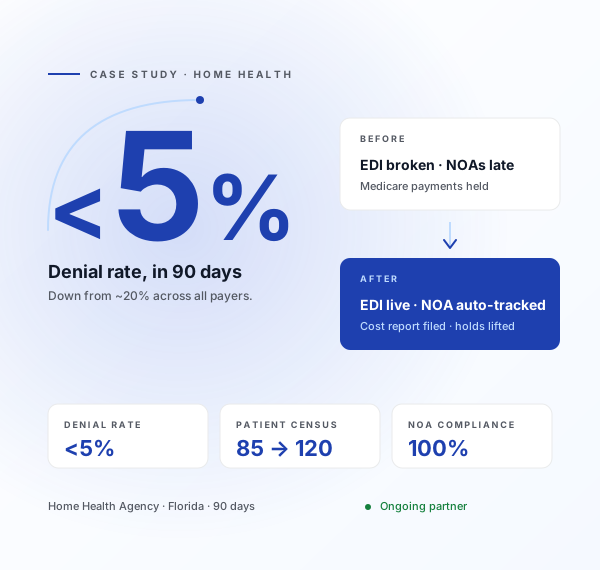
End-to-End Resolution of Home Health Agency Payment Holds, Late NOA Denials, and EDI Enrollment Issues
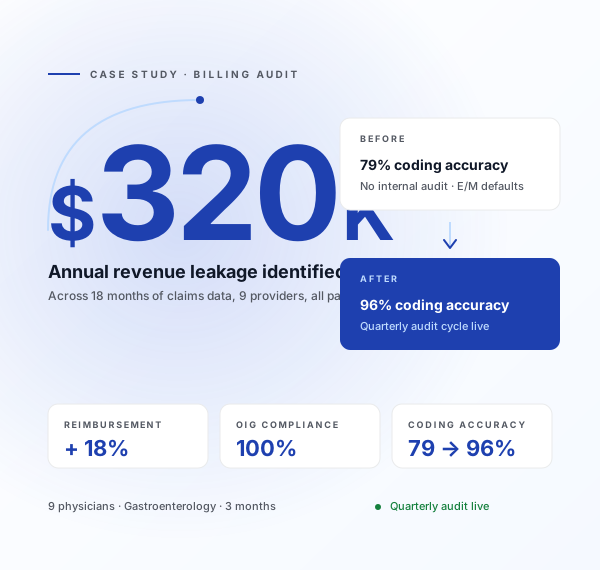
Recovering $320K in Annual Revenue Leakage Through a Comprehensive Medical Billing Audit for a Gastroenterology Practice
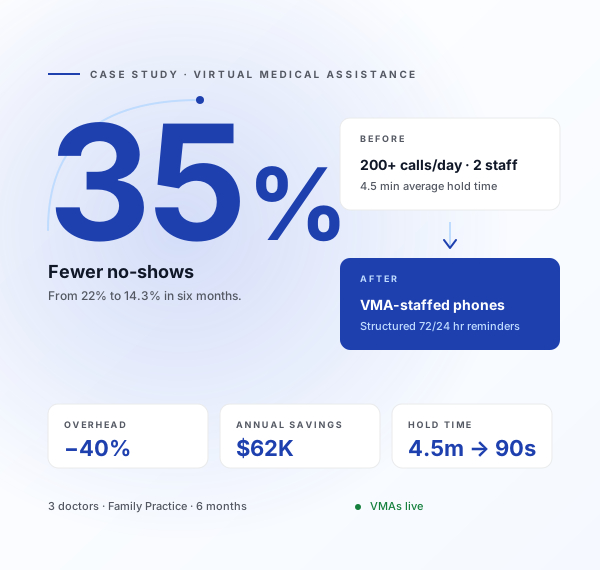
Reducing No-Show Rates by 35% and Cutting Front-Desk Overhead by 40% with Virtual Medical Assistants for a Family Practice
Curious what your revenue cycle is actually leaving on the table?
Spend 30 minutes with our revenue cycle team and we'll walk through your current setup, surface where money is leaking from denials, slow payer follow up, undercoded encounters, and quantify what cleaning it up is worth in your first 90 days. No prep, no slide deck, just a working conversation with people who do this every day.