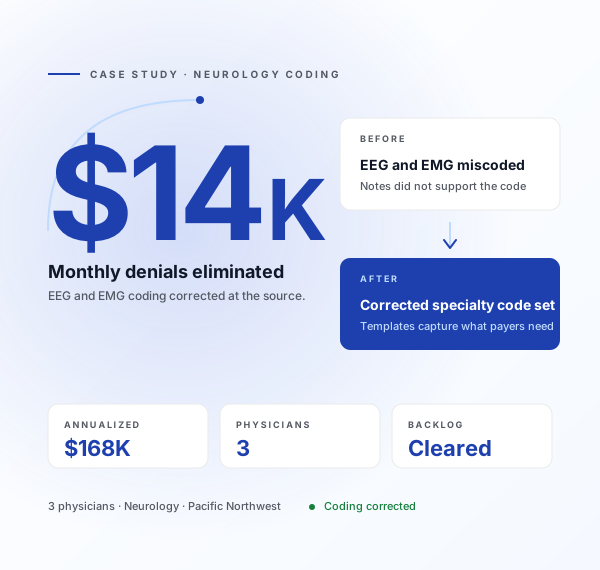
Eliminating $14,000 per Month in Denied Claims for a 3-Physician Neurology Clinic
Service
Revenue Cycle ManagementIndustry
General NeurologyProviders
3 physiciansTimeline
3–6 monthsRegion
Pacific NorthwestAbout This Project
A neurology clinic in the Pacific Northwest had built a busy outpatient practice around epilepsy care, neuromuscular medicine, and general neurology. Its three physicians performed a steady volume of electroencephalography (EEG) studies, needle electromyography (EMG), and nerve conduction studies in the office, and those procedures were supposed to be a reliable revenue engine. Instead, they had become the largest source of denials on the practice's aging report. By the time the clinic engaged CureMed, it was losing about $14,000 per month in denied claims (approximately $168,000 annually), and nearly all of that loss traced back to how EEG and EMG services were being coded and documented.
The engagement had a narrow, well-defined goal: find the specific coding failures behind the neurodiagnostic denials, fix them at the process level so they could not recur, and recover whatever portion of the existing denial backlog was still within payer appeal and resubmission windows.
- Client: neurology clinic, 3 physicians, Pacific Northwest
- Problem: recurring denials concentrated in EEG, EMG, and nerve conduction claims
- Root causes: wrong codes for study duration and complexity, missing units on nerve conduction studies, and documentation that did not support the billed level
- Engagement: specialty coding review, code set correction, documentation template redesign, denial backlog remediation
- Outcome: the recurring denial losses were eliminated and the backlog was worked to resolution
This case is a useful study in how neurology medical billing differs from general outpatient billing. The clinic's billing process was not careless. It was staffed by a capable coordinator, claims went out on time, and payments arrived. The problem was that neurodiagnostic procedures follow coding rules that do not exist anywhere else in medicine, and a generalist workflow had no way to catch the errors it was producing.
The Challenge: EEG and EMG Claims That Kept Coming Back Denied
When CureMed's team reviewed the clinic's denial history, the pattern was unusually clean. The denials were not scattered across the payer mix or the service mix. They clustered around three specific failure modes, each of which is common in practices that handle their own neurology billing without specialty coding support.
Wrong codes for study duration and complexity
EEG coding is built around distinctions that look minor on a code sheet but matter enormously to payers: whether the study was routine or extended, how long the recording ran, and what level of monitoring the study involved. The clinic was selecting EEG codes from a simplified internal reference that did not track those distinctions. Routine studies were sometimes billed with codes reserved for longer recordings, and extended monitoring studies were sometimes billed with routine codes that undervalued the work. Either direction created a problem. When the billed code implied a longer or more complex study than the documentation showed, payers denied the claim outright. When it implied less, the practice quietly collected below the value of the service it had actually delivered.
Missing units on nerve conduction studies
Nerve conduction study codes are unit-based: the number of units reported must reflect the number of studies actually performed and documented. A comprehensive neuromuscular workup can involve testing many individual nerves in a single encounter, and each one counts. The clinic's claims frequently reported fewer units than the procedure notes supported, and in some cases reported unit counts that did not match the documentation at all. Payers responded in the two ways payers always do: some denied the claims for inconsistency between the units billed and the record, and others simply paid on the understated units, leaving earned revenue uncollected with no denial to flag the loss.
Documentation that did not support the billed level
The third failure sat upstream of the coding itself. The physicians' interpretation reports and procedure notes were written to communicate clinical findings, not to satisfy payer adjudication rules. Reports for longer EEG studies often omitted the total recording time. Nerve conduction documentation did not consistently identify each nerve studied or the type of response measured. When a payer requested records to support a billed code, the documentation frequently could not carry the claim, even in cases where the service had genuinely been performed at the level billed. Those claims died in review, and each one took staff time with it.
Individually, none of these errors was dramatic. Together they produced a steady, compounding loss that the practice had normalized because no single denial ever looked alarming.
The Specialty Coding Review
CureMed opened the engagement with a structured medical billing audit focused specifically on the clinic's neurodiagnostic claims. Rather than sampling broadly across all services, the review team pulled the EEG, EMG, and nerve conduction claim history and examined it in three layers.
The first layer was code accuracy: for each claim, did the code submitted match the study that the documentation described, including duration, complexity, and unit counts? The second layer was denial root cause: for each denied claim, what was the payer's stated reason, and did that reason point to a code selection error, a unit mismatch, a documentation gap, or a payer-specific rule the practice had not been applying? The third layer was payment integrity: for paid claims, did the reimbursement match what the documented service should have produced, or had understated units and undervalued codes been suppressing payment without triggering any denial?
That third layer mattered. A meaningful share of the clinic's loss was invisible in its denial reports because the claims were being paid, just paid short. Only a line-by-line comparison of documentation against billed units surfaced it.
The review produced a findings report that categorized every failure mode, tied each one to the workflow step where it originated, and separated the backlog into claims that were still recoverable within payer deadlines and claims that were not. That separation kept the remediation effort honest: the practice knew from the start which losses could be pursued and which had to be treated as the cost of the old process.
Fixing EEG Billing and EMG Billing at the Source
Recovering old claims without fixing the process would have treated the symptom and left the disease. The core of the engagement was rebuilding the clinic's neurodiagnostic billing workflow so that clean claims became the default output rather than a lucky outcome. CureMed's medical billing team implemented three connected changes.
A corrected neurodiagnostic code set
CureMed replaced the clinic's legacy code sheet with a current, payer-aware reference covering the full EEG and EMG code families. The new code set mapped each study type the practice performs to the correct code based on recording duration, monitoring complexity, and study scope, and it spelled out the unit logic for nerve conduction studies so that units billed always derived from the documented studies rather than from habit. Payer-specific rules that had been living in the billing coordinator's memory were written into the reference so they would survive staff changes.
Documentation templates that support the codes
CureMed's team worked with the three physicians to revise the interpretation report and procedure note templates. The revised EEG template prompts for total recording time, study type, and specific findings, so the report itself substantiates the duration and complexity of the code billed. The nerve conduction template captures each nerve studied, the response type measured, and laterality, which gives coders the detail they need to report accurate units without guessing or defaulting low. None of this added meaningful clinical burden. The physicians were already doing the interpretive work; the templates simply capture it in a form that payers can adjudicate.
Charge entry safeguards and training
Finally, CureMed added a pre-submission check to the charge entry workflow: every neurodiagnostic claim is reconciled against its documentation before it goes out, with unit counts and study-duration codes verified rather than assumed. The billing coordinator received specialty-specific training on the EEG and EMG code families, and the physicians received a concise briefing on what payers actually look for in neurodiagnostic documentation. The goal was self-sufficiency in the daily workflow, with CureMed's neurology team handling escalations and payer disputes.
Denial Management for the Existing Backlog
While the process fixes went in, a parallel denial management effort attacked the accumulated backlog. CureMed triaged the denied claims by payer, denial reason, and remaining appeal or resubmission window, then worked the recoverable population in priority order.
Claims denied for code and documentation mismatches were corrected and resubmitted with the supporting record attached. Claims denied for unit inconsistencies were rebuilt from the procedure notes so the units billed matched the studies documented. Where payers had requested records the old documentation could not support, CureMed evaluated each encounter individually and appealed only the claims where the clinical record genuinely justified the billed service. Claims outside timely filing or appeal windows were written off transparently, with the loss quantified so the practice understood exactly what the old process had cost.
The backlog work also fed the process work. Every denial pattern the remediation team encountered was checked against the new code set and templates to confirm the root cause had already been closed. This is the same discipline CureMed applied in a related engagement resolving systematic claim rejections for an orthopedic group, where backlog recovery and process correction ran as a single coordinated effort rather than two disconnected projects.
By the end of the remediation phase, the clinic's neurodiagnostic denial queue had been worked to resolution: recovered, corrected and resubmitted, or documented as closed.
Results
The defining result was the disappearance of the recurring loss. The clinic had been losing about $14,000 per month to denied EEG, EMG, and nerve conduction claims. After the corrected code set, revised templates, and charge entry safeguards went live, that monthly loss was eliminated, removing approximately $168,000 annually in denials from the practice's revenue cycle.
| Metric | Result | What changed |
|---|---|---|
| Recurring denial losses | About $14,000 per month eliminated | EEG and EMG claims now coded to match documented duration, complexity, and units |
| Annualized impact | Approximately $168,000 | Process-level fixes prevent the denial pattern from recurring |
| Denial backlog | Worked to resolution | Recoverable claims corrected, resubmitted, or appealed within payer deadlines |
| First-pass claim quality | Substantially improved | Pre-submission reconciliation catches unit and duration mismatches before claims go out |
Beyond the headline number, the quality of the practice's claims changed in ways that compound over time. Within the first quarter after implementation, neurodiagnostic denials had fallen from the largest category on the denial report to a residual handful of routine issues such as eligibility and coordination of benefits. Payer records requests declined because the documentation now answers the questions payers ask before they ask them. And the billing coordinator, freed from a constant cycle of reworking denied claims, could focus on submission quality and follow-up instead of damage control.
Why It Worked
Nothing in this engagement required heroics. It required specialty knowledge applied systematically. EEG billing and EMG billing fail in predictable ways: duration and complexity distinctions that generalist code sheets flatten, unit rules that reward precision and punish guesswork, and documentation standards that clinical templates were never designed to meet. A team that has seen those failure modes across many neurology practices can identify them quickly, fix them at the workflow level, and know which backlog claims are worth pursuing.
Three principles carried the outcome. First, diagnose before correcting: the specialty coding review established exactly what was failing and where in the workflow each failure originated, so every fix targeted a verified root cause. Second, fix the process, not just the claims: templates, code references, and charge entry checks changed the daily workflow, which is why the losses stayed eliminated instead of creeping back. Third, run denial management and process correction together, so the backlog recovery validated the fixes in real time.
For this clinic, the difference between adequate billing and correct billing was approximately $168,000 annually. For any neurology practice seeing persistent neurodiagnostic denials, unexplained payment variation on nerve conduction claims, or payer records requests that documentation cannot answer, the same pattern is worth investigating. CureMed's neurology billing services combine specialty coding expertise with full revenue cycle management, from charge capture and clean claim submission through denial prevention and appeals, so that the clinical work neurologists perform is reimbursed at the level the documentation supports.
Curious what your revenue cycle is actually leaving on the table?
Spend 30 minutes with our revenue cycle team and we'll walk through your current setup, surface where money is leaking from denials, slow payer follow up, undercoded encounters, and quantify what cleaning it up is worth in your first 90 days. No prep, no slide deck, just a working conversation with people who do this every day.