How a Nephrology Group Recovered $240,000 in Underpaid Dialysis Claims
Service
Physician BillingIndustry
NephrologyLocations
2Providers
4 nephrologistsTimeline
3–6 monthsAbout This Project
A four-physician nephrology group came to CureMed with a problem that never showed up on a denial report. The group operates 2 locations, rounds at multiple dialysis facilities, and manages both in-center hemodialysis patients and a growing home dialysis program. Claims were going out, payments were coming in, and the internal reports looked stable. Yet the physicians had a persistent sense that collections were lighter than the volume of work justified, and nobody on the in-house billing team could explain why.
They were right to be suspicious. When CureMed's physician billing team audited the group's payment history, it found a pattern of systematic underpayment concentrated in three areas: monthly capitation payment (MCP) coding errors, incorrect place-of-service coding on home dialysis claims, and a large population of underpaid claims that had been posted and closed without anyone comparing the payment against the contracted rate.
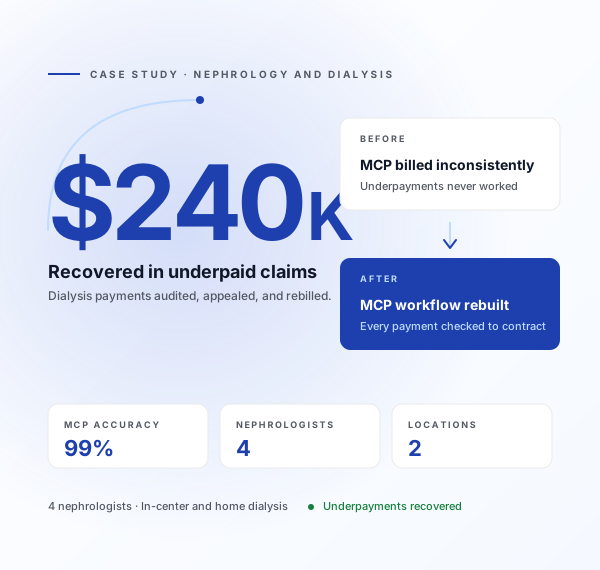
Over the course of the engagement, CureMed recovered $240,000 in underpaid dialysis claims through corrected rebills and payer appeals, then rebuilt the group's dialysis billing workflow so the same leaks could not reopen. The rebuilt process now runs at a verified 99% MCP billing accuracy, reconciled month over month against physician rounding logs.
Engagement at a glance:
- Client: nephrology group with 4 nephrologists across 2 locations
- Services: in-center hemodialysis and home dialysis
- Problem: systematic underpayment on dialysis claims that never surfaced as denials
- Scope: payment history audit, rebilling and appeals, full MCP workflow rebuild
- Outcomes: $240,000 recovered in underpaid dialysis claims and 99% MCP billing accuracy achieved
Where the Money Was Going
Dialysis billing does not behave like the rest of outpatient medicine. Instead of billing each encounter as a standalone event, nephrologists bill most ESRD-related care through the monthly capitation payment system: one claim per patient per month, with the code determined by the patient's age, the dialysis setting, and the number of face-to-face visits the physician completed that month. For adult in-center patients, CPT codes 90960, 90961, and 90962 correspond to four or more visits, two to three visits, and a single visit. Home dialysis patients are billed under their own monthly codes, and the physician must complete at least one face-to-face encounter during the month to support the claim.
That structure creates a specific kind of financial risk. A claim can be coded one tier too low, filed under the wrong place of service, or paid at a fraction of the contracted rate, and it will still appear in practice reports as a paid claim. Nothing flags it. The loss stays invisible unless someone deliberately compares what was billed and paid against what was documented and owed. In this group, nobody had ever run that comparison. CureMed's audit surfaced three distinct failure modes.
MCP codes billed at the wrong visit tier
The in-house team was assigning MCP codes without reconciling them against physician rounding logs. When visit counts were uncertain, the habit was to default to a lower tier because it felt safer. A patient seen four times in a month but billed at the two-to-three visit tier produces a paid claim and an underpayment at the same time. Because the shortfall on any single claim is modest, the pattern never triggered scrutiny. Repeated across a large dialysis census, month after month, it became the practice's single largest source of lost revenue. Mid-month transfers of care between the four nephrologists and months interrupted by hospitalization produced additional coding errors, some of which cut in the other direction and created refund exposure.
Wrong place of service on home dialysis claims
The home dialysis program was the group's fastest-growing service line and also its worst-billed. A substantial share of home dialysis claims went out carrying an in-center place-of-service code rather than one reflecting home-based care. Payers processed those claims under the wrong rules: some paid at reduced rates, some pended for information that nobody followed up on, and some were adjudicated against the wrong benefit entirely. Because most of these claims eventually paid something, the errors sat undetected in the payment history rather than accumulating in a denial queue where someone might have noticed them.
Underpayments posted and forgotten
The third failure lived in payment posting. Remittances were posted exactly as received, with no check against the payer's contracted allowable. When a payer paid a dialysis claim short because of a misloaded fee schedule, a miscalculated rate, or incorrect bundling logic, the shortfall was absorbed into the account balance and eventually adjusted off. There was no underpayment worklist, no variance report, and no appeal process. In practical terms, the group was accepting whatever payers chose to pay and treating it as final.
The Payment History Audit
Recovery work is only as good as the evidence behind it, so CureMed started with a structured medical billing audit of the group's payment history rather than jumping straight to rebilling. The audit followed five steps:
- Rebuild the expected-payment baseline. CureMed loaded the group's commercial payer contracts and the applicable Medicare fee schedule amounts into its variance analysis tooling, so every historical claim had a defensible "should have paid" figure next to it.
- Compare paid against expected on every dialysis claim. Each remittance in the audit window was matched to its claim and scored for variance. Claims paid below the contracted or published rate were flagged and categorized by payer and by root cause.
- Reconcile MCP codes against rounding logs. For the capitation claims, auditors cross-referenced the code tier billed each month against the physicians' documented visit counts, identifying every month where the claim understated (or occasionally overstated) the care delivered.
- Review place of service across the home dialysis population. Every home dialysis claim was checked for a place-of-service code consistent with home-based care, and mispriced claims were traced to the coding error that caused them.
- Triage by recoverability. Each underpaid claim was assessed against timely filing limits, corrected-claim windows, and payer appeal deadlines, so the recovery effort could start with the dollars most at risk of expiring.
The audit confirmed what the physicians had suspected and gave it a shape. The underpayment was not one dramatic mistake. It was thousands of small ones: a tier here, a place-of-service code there, a short payment quietly written off. Individually, none was large enough to notice. Collectively, they were material to the financial health of the practice. Just as important, the audit mapped each error to the process gap that produced it, which is what made the workflow rebuild in the final phase possible.
Recovering the Underpaid Claims
With the audit complete, CureMed worked the recoverable population systematically, using the same discipline it applies in dedicated A/R recovery engagements. The work ran along three tracks.
Corrected rebills. Claims where the practice's own coding caused the underpayment, wrong MCP tiers and wrong place-of-service codes chief among them, were corrected and resubmitted with supporting documentation. Rounding logs and encounter notes were attached where payers required proof of visit counts, so corrected claims paid on first pass instead of bouncing into review.
Underpayment appeals. Claims that were billed correctly but paid short were appealed against the contract. CureMed's appeal letters cited the specific contract terms and rate calculations, which matters with dialysis claims because payer processing errors on capitation codes are rarely reversed without a documented rate argument. Appeals that stalled were escalated through payer dispute channels and provider relations contacts.
Claim-level tracking. Every rebill and appeal was tracked to resolution, not just to submission. Recoveries were logged against the audit's original variance estimate, giving the practice a running, transparent view of what had been identified, what had been recovered, and what remained in process.
Integrity mattered as much as persistence. Where the audit surfaced months billed above the documented visit level, those claims were corrected too, because a recovery effort that only fixes errors in the practice's favor will not survive a payer audit. Every correction, in both directions, was reviewed with the physicians before submission. By the end of the recovery phase, the tracked total reached $240,000 recovered in underpaid dialysis claims, spanning MCP tier corrections, reprocessed home dialysis claims, and successful contract-based appeals.
Rebuilding the Monthly Capitation Payment Workflow
Recovered dollars solve last year's problem. The more valuable output of the engagement was a monthly capitation payment workflow that prevents the same underpayments from accumulating again. CureMed rebuilt the group's dialysis billing process around four controls:
- Rounding log reconciliation before claim release. Physician rounding logs from every dialysis facility are reconciled against the billing queue on a set cadence. No MCP claim is released until the visit count behind its code tier is verified, and mid-month transfers of care are documented so claims are split correctly between physicians.
- A monthly close checklist for every dialysis patient. Each patient's month is closed out affirmatively: visit count confirmed, code tier assigned, place of service validated against the care setting, and home dialysis face-to-face encounters verified before the claim goes out.
- End-of-month encounter alerts for home patients. Home dialysis patients approaching month end without a documented face-to-face visit trigger an alert to the practice, so the visit can be scheduled before the billing month closes rather than discovered as a gap afterward.
- Payment variance review on every remittance. Posting now includes an automatic comparison of each payment against the contracted allowable. Short payments land on an underpayment worklist and are appealed while the window is open, instead of being adjusted off in silence.
These controls were folded into the group's ongoing revenue cycle management routine, with monthly reporting that shows practice leadership visit-count accuracy, variance trends, and recovery activity in one view. Accuracy climbed quickly once the reconciliation discipline took hold, and within the first months of the new workflow the group reached the 99% MCP billing accuracy that it has sustained since. The physicians' role in this is deliberately small: they document their rounds the way they always have, and the workflow does the rest.
Results
The engagement was judged on two numbers the practice could verify independently, backed by workflow changes it could see operating every month.
| Metric | Result | What changed |
|---|---|---|
| Underpaid dialysis claims recovered | $240,000 | Payment history audit, corrected rebills, and contract-based appeals worked claim by claim to resolution |
| MCP billing accuracy | 99% | Visit counts verified against rounding logs before any monthly capitation claim is released |
| Home dialysis place of service | Corrected across the program | Place-of-service validation added as a hard stop in the monthly close checklist |
| Silent underpayment write-offs | Eliminated as a category | Every remittance now reconciled against contracted allowables, with short payments routed to an appeal worklist |
Beyond the headline figures, the quality of the group's receivables changed. Claims now pay at the contracted rate on first pass far more consistently, home dialysis revenue arrives predictably instead of erratically, and the practice no longer carries the quiet compliance exposure that comes with miscoded capitation claims. Leadership reviews a monthly scorecard instead of relying on instinct to sense whether collections match clinical effort.
Why It Worked
Three things separated this engagement from a generic billing cleanup.
First, specialty knowledge. The monthly capitation payment system rewards billers who understand its visit-tier logic, its home dialysis encounter requirements, and its place-of-service rules, and it quietly penalizes everyone else. A generalist team defaulting to "safe" lower tier codes was not being careless; it was doing what generalist teams do when the rules are unfamiliar. CureMed's nephrology medical billing specialists knew exactly which patterns to look for because they see them across dialysis practices nationwide.
Second, a payment-side lens. Most billing reviews start with denials, and this practice's denials looked fine. The losses were hiding inside paid claims, which is why the engagement started from remittance data and contracted rates rather than from rejection reports. Underpayment is a different disease from denial, and it needs a different diagnostic.
Third, recovery paired with prevention. Rebilling and appeals produced the $240,000, but the rebuilt MCP workflow is what protects the next dollar. A recovery project that ends with a check simply schedules the next recovery project a few years out. This one ended with a reconciliation discipline that holds accuracy at 99% without adding work for the physicians.
For nephrology groups that have never had their payment history examined by a team fluent in dialysis billing, the honest question is not whether underpayments exist but how large they have grown. CureMed's nephrology billing services were built for exactly this problem: capitation-heavy revenue, multi-site rounding, home dialysis growth, and payers who are content to keep the difference until someone asks for it back.
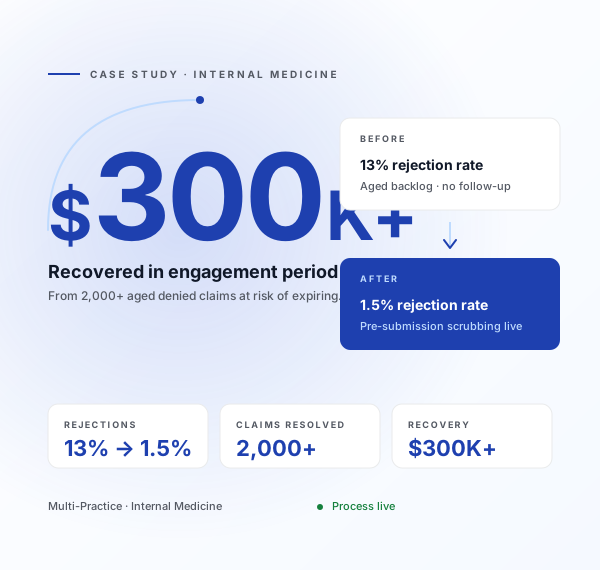
Recovering $300K+ and Cutting Rejections from 13% to 1.5% for an Internal Medicine Practice
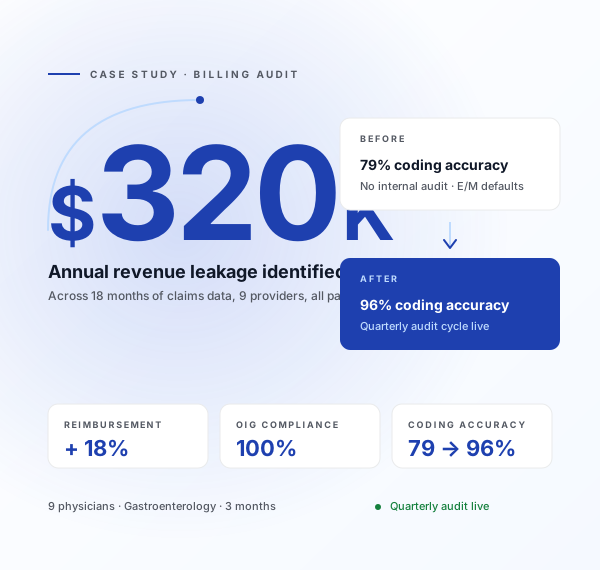
Recovering $320K in Annual Revenue Leakage Through a Comprehensive Medical Billing Audit for a Gastroenterology Practice
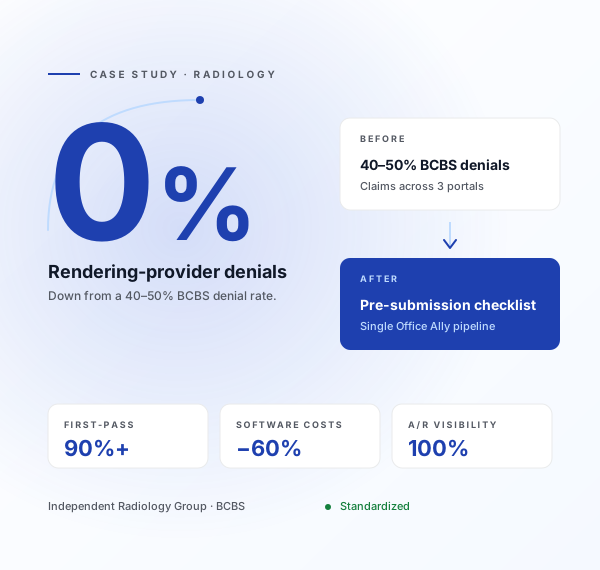
Eliminating BCBS Rendering-Provider Denials and Cutting Software Costs 60% for an Independent Radiology Group
Curious what your revenue cycle is actually leaving on the table?
Spend 30 minutes with our revenue cycle team and we'll walk through your current setup, surface where money is leaking from denials, slow payer follow up, undercoded encounters, and quantify what cleaning it up is worth in your first 90 days. No prep, no slide deck, just a working conversation with people who do this every day.