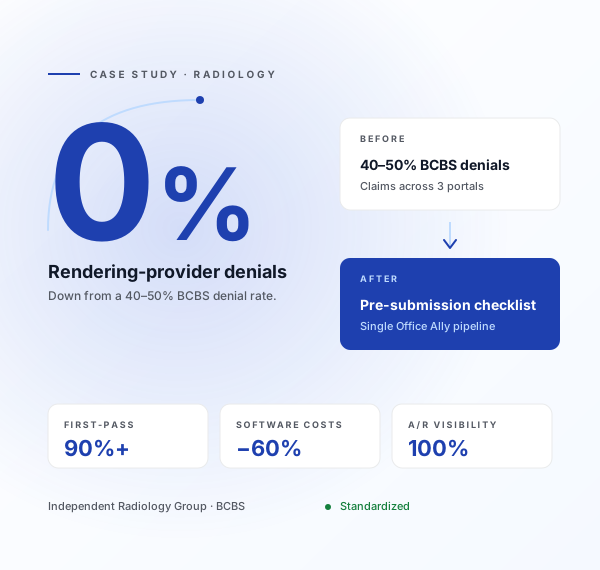
Eliminating BCBS Rendering-Provider Denials and Cutting Software Costs 60% for an Independent Radiology Group 0% rendering-provider denials
Service
AR Recovery & DenialsIndustry
Diagnostic RadiologyLocations
2Providers
27Timeline
Under 3 monthsRegion
TexasExecutive Summary
Effective revenue cycle management in radiology carries challenges that most other specialties never encounter. A single imaging study can involve a technical component, a professional component, an interpreting physician who differs from the ordering physician, and payer-specific rules about exactly which provider must appear on the claim. When any one of those data points is wrong, the claim is denied. And in radiology medical billing, a data error of that kind rarely affects one claim; it repeats silently across hundreds of claims before anyone notices the pattern.
This case study documents CureMed's engagement with an independent radiology group facing exactly that scenario: a denial rate of 40-50% with Blue Cross Blue Shield (BCBS), one of its largest commercial payers, driven by inaccurate or incomplete rendering-provider information. At the same time, the practice was paying premium licensing fees for billing software that underdelivered, and its claim data was scattered across multiple clearinghouses and portals with no unified tracking.
By applying the methodology described below, CureMed turned the situation around. Rendering-provider denials fell to 0%, software operating costs dropped by 60%, and the first-pass acceptance rate rose above 90%. What follows is a detailed account of the challenges, the three-phase solution, and the outcomes.
Client Background
The client is an independent radiology group providing diagnostic imaging across multiple modalities. As with many specialty practices, the billing function had grown organically over time. Tools were added reactively rather than strategically, and workflows evolved around workarounds rather than best practices. Nobody had designed the billing operation; it had simply accumulated.
That pattern is common in radiology because the specialty's billing profile is genuinely demanding. Radiology practices typically handle high claim volumes with modest per-claim dollar amounts, so small process defects multiply quickly. Claims may be billed globally or split into professional and technical components, and because the interpreting radiologist changes from shift to shift, the individual clinician attached to each claim varies constantly. That raises the stakes on provider data accuracy far beyond what a single-physician office ever experiences.
At the time of engagement, the practice was processing a substantial monthly claims volume across both government and commercial payers, with BCBS representing a significant portion of its payer mix. Despite a skilled clinical team and a well-established patient base, the billing operation was hemorrhaging revenue and creating compliance exposure the practice could no longer afford to ignore.
The practice relied on TalkEHR as its primary billing software, a platform that was feature-complete in some respects but carried a high licensing cost relative to its operational utility and offered limited workflow flexibility for a billing team managing a complex, multi-payer environment.
Challenges and Root-Cause Analysis
The engagement began with a comprehensive assessment of the entire billing operation, structured much like a formal medical billing audit: claim samples were pulled, denial reasons were categorized, submission pathways were mapped, and A/R aging was reconstructed from the available records. The assessment showed that the issues were not discrete. They were interrelated, with one deficiency exacerbating another. Six fundamental problems emerged.
1. High software cost with diminishing returns
The practice was paying a premium for TalkEHR but was not getting its money's worth. The cost-to-benefit ratio was out of line with the practice's volume and specialty mix, and the functions TalkEHR provided could be delivered better and faster by other applications. The tool added overhead without removing work.
2. A catastrophic BCBS denial rate of 40-50%
The most critical finding was a denial rate of 40-50% on BCBS claims. The root cause traced back to inaccurate or incomplete rendering-provider information on submitted claims.
It is worth pausing on what a rendering provider actually is, because the distinction is where this practice's revenue was leaking. The rendering provider is the individual clinician who personally performed or directly supervised the billed service. That person is distinct from the billing provider, which is usually the group entity that receives payment, and from the referring or ordering provider, who requested the study. On a professional claim, the rendering provider is reported with an individual NPI, and payers validate that NPI against their own enrollment records.
BCBS plans are known for enforcing this validation strictly. If the rendering provider's NPI is missing, mismatched, or not linked to the group's contract in the payer's system, the claim denies automatically, with no human review and no discretion. In a radiology group where a rotating roster of radiologists reads studies, every claim must carry the correct individual NPI for the physician who actually interpreted that specific study, and that physician must be enrolled and credentialed with the payer under the group's agreement. The practice had no reliable process for verifying any of that before submission.
Compounding the damage, there was no process for tracking denied claims, so it was impossible to say how long the issue had been running or how much financial impact it had already produced.
3. Fragmented claim data across multiple platforms
Claims were going out through several pathways: Availity, other clearinghouses, and direct submission to certain payers. No single tracking system showed whether a claim had been sent, accepted, denied, or followed up.
Without that single view, it was difficult to compile reports on denied claims, payer behavior, or A/R aging, leaving management unable to make informed decisions about the billing operation.
4. Compliance risks from inconsistent data handling
The lack of consistency in record-keeping created compliance risk. Entering data into multiple platforms without a uniform system increased the risk of errors: duplicate billing, misclassified procedures and modifiers, and similar problems. For a specialty that operates under ongoing CMS and commercial-payer scrutiny, those inconsistencies represent a real exposure, not a theoretical one.
5. No real-time eligibility verification
There was no process for verifying patient coverage in real time before services were provided. This was especially expensive for urgent visits, where insurance status or eligibility may have changed since the patient's last encounter. Claims submitted without eligibility verification are more susceptible to denial and underpayment, and in imaging the cost of the service is already incurred before the claim ever goes out.
6. No centralized tracking or accountability
Because claims were filed from various portals without an effective tracking system, there was no way to determine who was accountable for follow-up or which claims were aging. Stale claims accumulated quietly, and a 60-day-plus A/R bucket grew steadily as unowned claims drifted toward timely-filing deadlines.
The Solution: A Three-Phase Rebuild
Rather than addressing symptoms with tactical fixes, CureMed implemented a comprehensive strategy aimed at the underlying causes, executed in three deliberate phases: platform migration, data consolidation, and protocol standardization. The sequence mattered. Migrating platforms first created the technical foundation; consolidating data second created a single source of truth; standardizing protocols third locked the gains in place so they would survive staff turnover and volume growth.
Phase 1: Platform migration to Office Ally
After comparing options against the practice's payer mix, claims volume, and workflow needs, CureMed recommended migrating the billing operation from TalkEHR to Office Ally, a practice management and clearinghouse solution offering a substantially better cost position while retaining all needed functionality.
The migration itself was sequenced to protect cash flow. Payer EDI enrollments and electronic remittance agreements were established on the new platform before any production claims moved. Provider and fee-schedule data were loaded and validated against a test batch. Claims already in flight on the old pathways were processed in parallel during the conversion period, so no claim was orphaned mid-adjudication and no revenue gap opened during cutover.
The switch was completed with minimal disruption to the billing operation, and the practice saw an immediate 60-70% reduction in software costs. That money was redirected back into billing personnel and compliance processes rather than licensing fees. Office Ally also gave the team easier access to eligibility-verification services and a better claims-management interface, cutting the per-claim processing time billers spent.
Phase 2: Centralized data consolidation
One of the most consequential decisions in the project was to consolidate every claim file into one system. Each claim, regardless of which pathway originated it, was brought into Office Ally with full status documentation.
Consolidation was substantially more complex than importing data. The team first built an inventory of outstanding claims from each channel, then manually matched many claim files against remittance records and payer portals to establish their true status: paid, denied, pending, or never received by the payer at all. That last category is the most dangerous in a fragmented setup, because a claim that was never received generates no denial and therefore no signal.
Working alongside the practice's billing department, CureMed consolidated all of this information into a single source of truth: for the first time, the practice could see where every claim stood and who touched it last.
Phase 3: Protocol standardization and compliance hardening
With the platform and data infrastructure in place, attention turned to the workflows that governed how claims were prepared and submitted. The core focus was airtight protocols for rendering-provider information, the root cause of the BCBS denial problem.
Working closely with the practice's provider team, who proved to be highly responsive and committed partners throughout the engagement, CureMed implemented a pre-submission checklist that required verification of three things before any claim could be released: the rendering provider's NPI, the provider's credentialing status, and the provider's enrollment with the specific payer being billed. Because medical credentialing and payer enrollment lapse and renew on their own timelines, the checklist treated them as live data to be confirmed, not static facts to be assumed. The checklist was embedded directly into the billing workflow, making compliance the default rather than the exception.
Real-time patient eligibility verification became part of scheduling, so insurance coverage was confirmed before the patient arrived rather than reconciled afterward through denial correspondence. Specific workflows were developed for same-day and urgent appointment requests, where time is short but skipping verification is exactly what had been feeding the denial queue.
A formal denial-management workflow rounded out the phase. Every denial is now logged and categorized by reason code, assigned to a named owner with a follow-up deadline, and routed to correction and resubmission or to appeal as appropriate. Denial categories are reviewed for trends, so a recurring root cause gets fixed upstream instead of being reworked claim by claim.
Finally, the processes for eligibility verification, claim preparation, claim submission, denial management, and A/R follow-up were documented across the entire billing operation. The protocols serve two purposes: consistency across the billing team, and audit-readiness for any future payer review.
Key Deliverables
The engagement produced a set of concrete, durable assets for the practice:
- Migration to Office Ally, delivering a 60-70% reduction in software licensing costs
- 100% claim consolidation into a single source of truth for all billing activity
- A rendering-provider protocol that eliminated the primary cause of BCBS denials
- Real-time eligibility verification at scheduling, preventing eligibility-related denials at the point of service
- Standardized billing workflows for consistent, compliant operations across all billing staff
- A centralized A/R dashboard providing full visibility into claim status and aging
- A provider coordination framework for faster information flow and fewer submission delays
- Compliance documentation supporting audit-ready records and reduced regulatory exposure
Results and Outcomes
The engagement produced immediate, measurable results. Within one full billing cycle after implementation, the practice was hitting numbers it had not seen in years.
| Metric | Result | What changed |
|---|---|---|
| Rendering-provider denials | 0% (complete elimination) | Pre-submission verification of NPI, credentialing, and payer enrollment |
| BCBS denial rate | Down from 40-50% | Root cause removed rather than denials reworked |
| First-pass acceptance | Above 90%, sustained | Clean claims released once, accepted without correction |
| Claim visibility | 100% across the billing cycle | Every claim consolidated into one tracked system |
| 60+ day A/R bucket | Fully resolved | Aged claims matched, worked, and closed methodically |
| Software costs | Reduced 60-70% | TalkEHR replaced by Office Ally |
| A/R turnaround | Measurably faster | Reactive cleanup replaced by ongoing maintenance |
Rendering-provider denials: fully eliminated
The headline result was the complete elimination of denials related to rendering-provider information. Instead of a 40-50% denial rate on BCBS claims, the rate fell to 0%. This was more than revenue recovery; it resolved a problem that had been compounding, unmeasured, for an unknown length of time.
First-pass acceptance above 90%
The first-pass acceptance rate, meaning the share of claims a payer accepts without resubmission, appeal, or correction, rose above 90%. First-pass acceptance is one of the most telling measures of revenue-cycle health because it reflects the quality of everything upstream: eligibility checks, provider data, coding, and submission discipline. A sustained rate above 90% indicates a step-change in how the practice's billing operation actually runs, not a one-time cleanup.
Complete A/R visibility and aging resolution
With centralized tracking in place, the practice gained 100% visibility into every claim's status and age. Aging buckets were worked methodically, the 60-day-plus bucket was fully resolved, and A/R turnaround improved measurably as the operation shifted from reactive firefighting to routine maintenance.
Compliance and operational resilience
The practice was rebuilt not only on better performance metrics but on a billing process designed to keep performing. Efficiency no longer depends on any single individual's institutional knowledge; it is encoded in the workflows. The practice is now better equipped to onboard new billing staff, withstand payer reviews, and scale its imaging volume without scaling its denial rate alongside it.
Why It Worked
Revenue-cycle problems in specialty practices almost never come from a single cause. They build up through deficiencies at multiple levels, technological, procedural, and operational, that compound until the financial impact becomes too large to ignore. This engagement succeeded because it treated the practice's billing operation as one system: the software was matched to the practice's actual needs, the data was consolidated so problems became visible, and the protocols made clean claims the default output rather than a lucky outcome.
For radiology groups facing similar struggles, whether unexpected denial spikes, climbing A/R balances, compliance uncertainty, or simply the sense that billing is permanently reactive, the lesson is that real improvement starts with finding the true root cause. CureMed's medical billing team delivers exactly this kind of engagement through its radiology billing services: diagnosis first, then a sequenced fix, then protocols that hold the gains. The metrics in this case, 0% rendering-provider denials, first-pass acceptance above 90%, and a 60% software cost reduction, are what that discipline looks like in practice.
Curious what your revenue cycle is actually leaving on the table?
Spend 30 minutes with our revenue cycle team and we'll walk through your current setup, surface where money is leaking from denials, slow payer follow up, undercoded encounters, and quantify what cleaning it up is worth in your first 90 days. No prep, no slide deck, just a working conversation with people who do this every day.