How a 6-Cardiologist Practice Increased Net Collections 22% with End-to-End RCM
Service
Revenue Cycle ManagementIndustry
Interventional CardiologyProviders
6 cardiologistsTimeline
3–6 monthsAbout This Project
CureMed partnered with an interventional cardiology practice of 6 cardiologists whose revenue cycle had slipped into chronic underperformance. The group ran a busy catheterization and PCI schedule alongside a heavy volume of echocardiography, stress testing, and clinic visits. The clinical work was strong. The financial results were not. Claims went out with bundling errors, imaging interpretations went out without required modifiers, prior authorizations stalled for weeks, and denied claims aged in accounts receivable until many of them expired against timely filing limits.
The practice had already tried the obvious fixes: more oversight of the existing billing arrangement, more staff time spent chasing payers, more spreadsheets. None of it moved the numbers, because the underlying problem was not effort. It was the mismatch between generalist billing processes and a specialty where the coding rules are unusually dense and the payers are unusually aggressive. That failure pattern is one CureMed's cardiology billing services team encounters often, and it rarely resolves without a structural change in who owns the revenue cycle and how it runs.
The engagement covered the full cycle: specialty coding review, a rebuilt prior authorization workflow, structured denial management, and disciplined payment posting.
Engagement at a glance:
- Client: interventional cardiology practice, 6 cardiologists
- Scope: end-to-end revenue cycle management, from charge capture through final payment posting
- Core problems: cath and PCI bundling errors, missed modifiers on imaging claims, stalled prior authorizations, slow claim follow-up
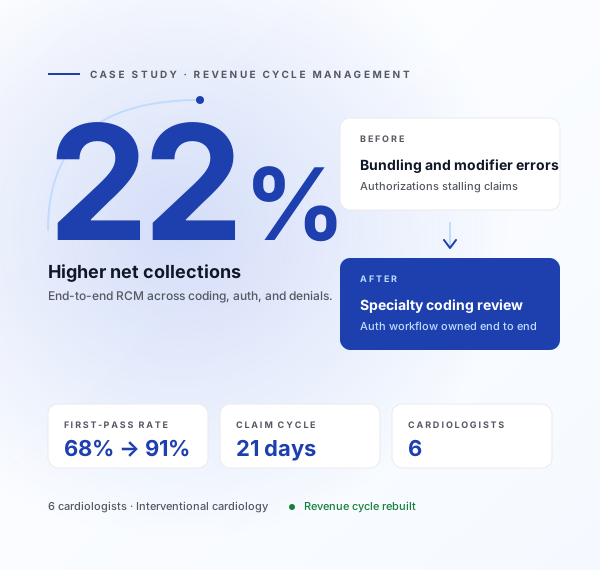
- Headline results: net collections increased 22%, the average claim cycle time reduced to 21 days, and first-pass acceptance improved from 68% to 91%
This case study walks through what was broken, how CureMed diagnosed it, what changed in each part of the cycle, and why the results held.
Where the Revenue Cycle Was Breaking Down
No single catastrophe explained the practice's cash position. Instead, four failure modes compounded each other, each one feeding work and delay into the next.
Bundling errors on cath and PCI coding
Cardiac catheterization and percutaneous coronary intervention sit inside some of the most tightly bundled code families in the CPT book. Left heart catheterization codes already include the contrast injections and imaging supervision performed during the same session. PCI coding follows its own hierarchy: a base code for the first major vessel treated, add-on codes for additional branches, and strict conditions governing when a diagnostic cath performed in the same session may be reported separately. Layered over all of it are NCCI edits that block many code pairs outright unless a bypass modifier is genuinely supported by the documentation.
The practice's previous billing arrangement handled these claims with generalist coders working from outdated rules. Component services that were already included in the primary procedure were billed separately. Add-on codes were applied inconsistently. Diagnostic caths that preceded an intervention were reported without the documentation a separate charge requires. Payers responded exactly as their edit systems are designed to respond: bundling denials, partial payments, and development requests that nobody had the time or the specialty knowledge to answer well.
Missed modifiers on echocardiography interpretations
The cardiologists read a steady stream of echocardiograms and stress studies, many of them performed in hospital settings where the facility owned the equipment. Those interpretations should have gone out with modifier 26 to identify the professional component, since the technical component belongs to the facility. A meaningful share of the practice's imaging claims instead went out either with no modifier at all or billed globally. The result was a mix of outright denials, payer recoupment risk, and payments that did not match the service actually delivered.
Prior authorizations that stalled
Elective cardiology services, including stress tests, certain echocardiograms, and non-emergent catheterizations, frequently require prior authorization under Medicare Advantage and commercial plans. At this practice, authorization work was scattered across front-desk staff, clinical staff, and the billing vendor, with no single owner, no tracking system, and no escalation path when a payer went quiet. Requests sat in queues for weeks. Some patients were rescheduled repeatedly. Some procedures were performed before approval ever arrived, and claims for unauthorized services were then denied under payer policy. Those denials are among the hardest in medical billing to overturn, because the appeal has to argue medical necessity retroactively and the documentation to support it was rarely assembled in advance.
Slow follow-up on denied and unpaid claims
The previous process treated denials as an afterthought. Claims sat untouched in accounts receivable long after the remittance arrived, appeals mostly restated the original claim instead of addressing the specific denial reason, and a portion of recoverable revenue quietly expired against filing deadlines. Payment posting lagged as well, which meant the practice's reports never showed a current, accurate picture of what had been paid, adjusted, or lost. Leadership knew collections were weak. Nobody could say precisely why.
The Diagnostic Review
Before moving a single workflow, CureMed ran a structured diagnostic across the practice's recent claims history: encounter data, remittances, denial codes, appeal outcomes, and authorization records. The purpose was root cause analysis, not a symptoms list. A denial rate tells you something is wrong. Only claim-level review tells you what is wrong, where it originates, and how much of it is preventable.
Three findings shaped everything that followed:
- The coding errors were systematic, not random. The same bundling and modifier mistakes repeated across hundreds of claims because they came from process rules, not individual slips. That was actually good news: fix the rule and the whole error class disappears going forward.
- Authorization failure was an operations problem wearing a billing costume. The delays originated in scheduling and clinical workflow, before a claim ever existed. No amount of back-end billing effort could fix a procedure performed without approval.
- A weak net collection rate was hiding recoverable money. The practice was writing off balances that properly constructed appeals could still collect, so the reported gap between charges and collections overstated the permanent loss and understated the fixable one.
The diagnostic gave CureMed and the practice a shared baseline, an agreed set of performance indicators, and a prioritized sequence for the work. It also set expectations honestly: some historical revenue was gone for good, a substantial share was recoverable, and the durable gains would come from preventing the same losses on every future claim.
Inside the Engagement: End-to-End Revenue Cycle Management
CureMed assumed ownership of the entire cycle, from the moment a procedure was scheduled to the day its payment posted. That end-to-end scope mattered. Each of the four failure modes lived in a different part of the cycle, and improving one stage while the others kept leaking would have produced motion without results. The practice's leadership evaluated the engagement the way CureMed structures its revenue cycle management service: one accountable partner, measured on outcomes across the whole cycle rather than activity within a slice of it.
Specialty coding review
Cardiology-experienced coders took over charge coding, supported by controls built for the practice's specific case mix:
- Every cath lab and PCI claim was screened against current NCCI edits before submission, with a second-level review for complex multi-code interventional cases.
- A modifier decision path was built into charge capture, forcing an explicit answer on every imaging claim: global service, professional component only, or technical component only.
- CureMed worked with the cardiologists to tighten interpretation documentation, so echo and stress study reports reliably supported the codes billed.
- Charge capture was reconciled against the procedure schedule, closing the gap through which performed-but-never-billed services had been escaping.
A rebuilt prior authorization workflow
CureMed centralized authorization work under dedicated coordinators who understood cardiology procedures and payer utilization review criteria:
- Authorization requests were initiated as soon as an elective case hit the schedule, not days later.
- A tracking log recorded every request, its status, and its age, with escalation to the payer's utilization management team whenever turnaround exceeded expected norms.
- Payer-specific medical necessity documentation was assembled up front, so first submissions contained everything reviewers needed to approve.
- Scheduling staff received realistic lead-time guidance by payer, so elective cases were booked with authorization timelines in mind rather than against them.
Within the first quarter, stalled authorizations stopped being a routine reason to reschedule patients, and procedures performed without approval became rare exceptions instead of a recurring write-off category.
Denial management and A/R recovery
Incoming denials were triaged daily by reason code and financial impact. Bundling denials on cath lab claims were appealed with the coding rationale the previous appeals had lacked. Modifier errors were corrected and resubmitted quickly, while the claims were still young. In parallel, CureMed worked the aged backlog as a structured A/R recovery effort, prioritizing the oldest recoverable claims ahead of their filing deadlines and reconstructing appeals around the specific reason each claim had originally been denied.
Just as important, every denial fed back into the front of the cycle. When a payer denied a claim for a preventable reason, the coding checklist or the authorization workflow was updated so the same error could not recur. Denial management stopped being a cleanup crew and became a feedback loop.
Payment posting discipline
Remittances were posted daily, with adjustments coded to distinguish legitimate contractual write-offs from preventable losses. Underpayments were flagged against expected reimbursement instead of being absorbed silently. This unglamorous work is what made the reporting honest: for the first time, the practice could see its true net collection rate rather than a figure distorted by posting backlogs and miscoded write-offs.
On top of that clean data layer, CureMed ran a monthly performance review with practice administration covering first-pass acceptance by procedure family, denial causes, authorization turnaround, receivables aging by payer, and collections trends, with the cardiologists joining periodically to connect the financial picture back to clinical operations.
Results: Net Collection Rate, Cycle Time, and First-Pass Acceptance
The engagement was judged against the baseline established during the diagnostic, and the movement was substantial on every agreed measure.
| Metric | Result | What changed |
|---|---|---|
| Net collections | Increased 22% | Accurate specialty coding at submission, plus recovery of aged, appealable claims |
| Average claim cycle time | Reduced to 21 days | Cleaner first submissions, faster authorizations, and daily payment posting |
| First-pass acceptance | Improved from 68% to 91% | Pre-submission NCCI screening and a mandatory modifier decision path for imaging claims |
Each number carries practical weight beyond the statistic itself.
The collections gain came from two distinct sources, and CureMed reported them separately so the practice could see its sustainable run rate. One source was structural: new claims coded correctly, authorized properly, and paid on first submission. The other was one-time: recovered revenue from the aged backlog of denied and underpaid claims. Separating the two mattered, because it demonstrated that the improvement was not a temporary bump from cleanup work but a durable change in how the practice converts clinical work into cash. Over the full engagement, net collections increased 22%.
Cycle time is a cash flow story. When the practice saw its average claim cycle time reduced to 21 days, money that had previously been trapped in the revenue cycle for well over a month became available within three weeks of the date of service. For a group carrying the fixed costs of an interventional practice, that acceleration eased pressure on operating cash without a single additional patient encounter.
First-pass acceptance improved from 68% to 91%, and this was the engine behind everything else. Every claim that pays on first submission is a claim nobody has to rework, appeal, or write off. As rework volume fell, the denial team could concentrate on the genuinely difficult cases: unusual payer behavior, coordination of benefits, and documentation edge cases that deserve expert attention.
The operational effects were quieter but just as real. Administrators stopped spending their weeks refereeing billing emergencies. Front-desk and clinical staff shed the ad-hoc authorization chasing that had crept into their jobs. The cardiologists noticed the change mostly through absence: fewer escalations, fewer patient billing complaints, fewer surprises.
Why It Worked
Four factors explain the outcome, and none of them is a secret.
Specialty expertise, applied at the point of coding. Cardiology medical billing punishes generalist processes. Bundling logic for cath and PCI claims, component billing for imaging, and payer-specific authorization criteria all change on a regulatory calendar, and a coding operation that does not actively maintain that knowledge will make the same expensive errors indefinitely. Putting cardiology-fluent coders and reviewers at the front of the cycle removed the error source rather than treating its symptoms.
End-to-end ownership. The practice's problems spanned scheduling, coding, submission, denial follow-up, and posting. Because CureMed owned the entire chain, a lesson learned anywhere in the cycle could be enforced everywhere in the cycle, and no failure could hide in the seams between vendors and departments.
Feedback loops instead of firefighting. Every denial became an input to prevention. That is the difference between a billing operation that works hard and a revenue cycle that improves.
Honest measurement. Clean posting and root-cause reporting meant the practice's leadership always knew the real net collection rate, the real denial drivers, and the real trend line, which made every monthly decision better informed than the last.
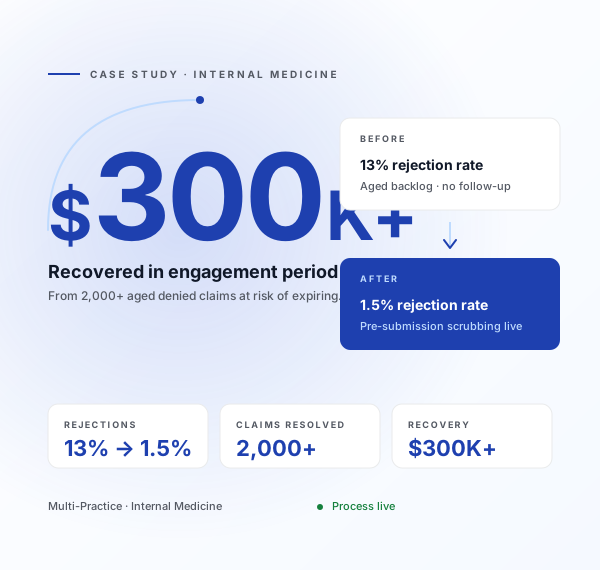
The pattern is not unique to cardiology. CureMed applied the same diagnostic-first, end-to-end approach in an internal medicine revenue recovery engagement with comparable results, because the underlying discipline transfers even when the code sets change. For practices whose collections have drifted below what their clinical volume should produce, this engagement shows what a specialty-led revenue cycle management partner can change, how quickly the leading indicators respond, and why the gains persist after the cleanup phase ends.
Curious what your revenue cycle is actually leaving on the table?
Spend 30 minutes with our revenue cycle team and we'll walk through your current setup, surface where money is leaking from denials, slow payer follow up, undercoded encounters, and quantify what cleaning it up is worth in your first 90 days. No prep, no slide deck, just a working conversation with people who do this every day.